Question
A sphere is dropped under gravity through a fluid of viscosity $\eta$. Taking the average acceleration as half of the initial acceleration, show that the time taken to attain the terminal velocity is independent of the fluid density.

Answer

Suppose a sphere of radius r and density $\rho$ falls in a fluid of density $\rho^{\prime} p ^{\prime}$ and viscosity $\eta$. When the sphere just enters the fluid, the net downward force on it is
$F =$ Weight of the sphere - Weight of the fluid displaced
$
=\frac{4}{3} \pi r^3 \rho g-\frac{4}{3} \pi r^3 \rho^{\prime} g=\frac{4}{3} \pi r^3\left(\rho-\rho^{\prime}\right) g
$
It is Given that, average acceleration as half of the initial acceleration.
$\therefore$ Initial acceleration,
$
a=\frac{F}{m}=\frac{\frac{4}{3} \pi r^3\left(\rho-\rho^{\prime}\right) g}{\frac{4}{3} \pi r^3 \rho}=\left(\frac{\rho-\rho^{\prime}}{\rho}\right) g
$
When the sphere attains terminal velocity, its acceleration becomes zero.
$\therefore$ Average acceleration $=\frac{a+0}{2}=\left(\frac{\rho-\rho^{\prime}}{2 \rho}\right) g$
Let the sphere take time $t$ to attain the terminal velocity,
$
v=\frac{2}{9} \frac{r^2}{\eta}\left(\rho-\rho^{\prime}\right) g
$
Initial velocity, $u =0$
Hence by using first equation of motion
$
\begin{aligned}
& v=u+at \\
& \frac{2}{9} \frac{r^2}{\eta}\left(\rho-\rho^{\prime}\right) g=0+\left(\frac{\rho-\rho^{\prime}}{2 \rho}\right) g t \\
& \text { or } t=\frac{4}{9} \cdot \frac{r^2 \rho}{\eta}
\end{aligned}
$

Need a full question paper?

Generate a complete, print-ready paper with questions like this in minutes — across 16+ boards, with answer keys.
Start Generating Free

Similar questions

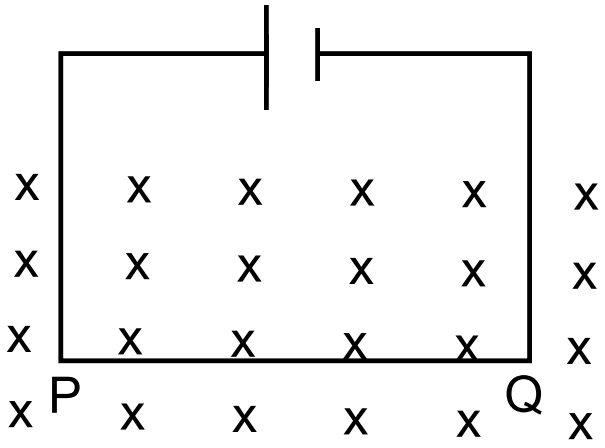
A current of 5.0A exists in the circuit shown in the figure. The wire PQ has a length of 50cm and the magnetic field in which it is immersed has a magnitude of 0.20T. Find the magnetic force acting on the wire PQ.
From the top of a tower 100m in height, a ball is dropped and at the same time another ball is projected vertically upwards from the ground with a velocity of $25ms^{-1}$. Find when and where the two balls will meet? $g = 9.8ms^{-2}$?
Can you associate vectors with $(a)$ the length of a wire bent into a loop, $(b)$ a plane area, $(c)$ a sphere? Explain
A monochromatic light source of intensity $6mW$ emits $8 \times 10^{16}$ photons per second. This light ejects photoelectrons from a metal surface. The stopping potential for this setup is $2.0V$. Calculate the work function of the metal.
On complete combustion a litre of petrol gives off heat equivalent to $3 × 10⁷J$. In a test drive a car weighing $1200kg$. including the mass of driver, runs $15km$ per litre while moving with a uniform speed on a straight track. Assuming that friction offered by the road surface and air to be uniform, calculate the force of friction acting on the car during the test drive, if the efficiency of the car engine were $0.5$
A person standing on a platform finds that a train moving with velocity $0.6c$ takes one second to pass by him. Find:
  1. The length of the train as seen by the person and.
  2. The rest length of the train.
The driver of a truck travelling with a velocity v suddenly notices a brick wall in front of him at a distance d. Is it better for him to apply brakes or to make a circular turn without applying brakes in order to just avoid crashing into the wall? Why?
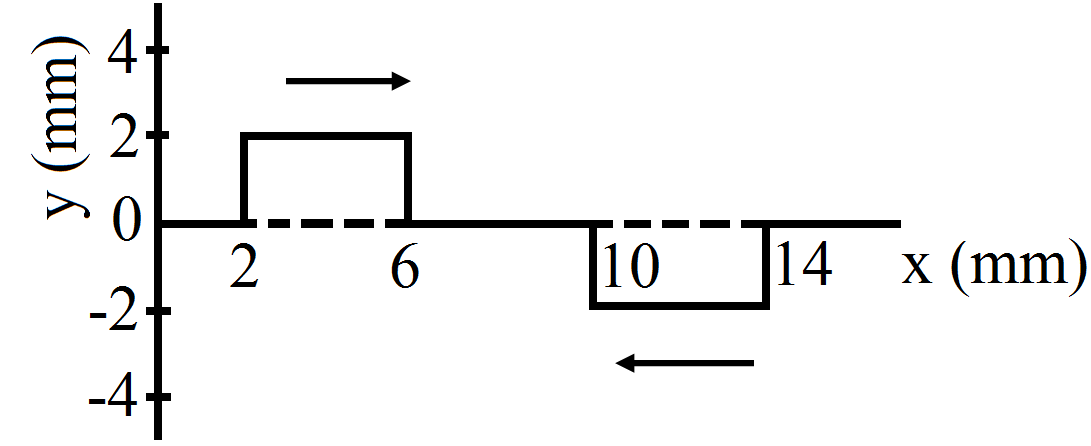
Figure shows two wave pulses at t = 0 travelling on a string in opposite directions with the same

wave speed 50cm/s. Sketch the shape of the string at t = 4ms, 6ms, 8ms, and 12ms.
Define kinetic energy. Prove that K.E. associated with a mass 'm' moving with velocity v $\frac{1}{2}\text{mv}^2$.
A steam engine delivers $5.4 \times 10^8 \mathrm{~J}$ of work per minute and services $3.6 \times 10^9 \mathrm{~J}$ of heat per minute from its boiler. What is the efficiency of the engine? How much heat is wasted per minute?