MCQ
A sphere is rolled on a rough horizontal surface. It gradually shows down and stops. The force of friction tries to:
  • A
    Increase the angular velocity.
  • B
    Decreases the angular velocity.
  • C
    Decrease the linear velocity.
  • Both $A$ and $C$

Answer

Correct option: D.
Both $A$ and $C$
Force of friction produces the torque for rotation.
Therefore, it tries to increase the angular velocity.
However, friction opposes the motion:
Therefore, it tries to decrease the linear velocity.

Need a full question paper?

Generate a complete, print-ready paper with questions like this in minutes — across 16+ boards, with answer keys.
Start Generating Free

Similar questions

A physical quantity which has a direction
Consider a planet moving in an elliptical orbit round the sun. The work done on the planet by the gravitational force of the sun:
  1. Is zero in any small part of the orbit.
  2. Is zero in some parts of the orbit.
  3. Is zero in one complete revolution.
  4. Is zero in no part of the motion.
The value of work done on the system by all types of forces (external and internal) is equal to:
A simple pendulum, suspended from the ceiling of a stationary van, has time period $T$. If the van starts moving with a uniform velocity the period of the pendulum will be
The displacement of a particle is represented by the equation:$\text{y}=3\cos\Big(\frac{\pi}{4}-2\omega\text{t}\Big)$
The motion of the particle is:
A block slides down an inclined plane of slope of angle $\theta $ with a constant velocity. It is then projected up the plane with an initial velocity $u$. The distance upto which it will rise before coming to rest is
We have two spheres one of which is hollow and the other solid. They have identical masses and moment of inertia about their respectively diameters. The ratio of  their radius is given by
A balloon contains $1500 \,m^3$ of helium at $27^\circ C$ and $4$ atmospheric pressure. The value of helium at $ - \,3^\circ C$ temperature and $2$ atmospheric pressure will be ...... $m^3$
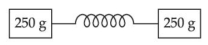
As per the given figure, two blocks each of mass $250\,g$ are connected to a spring of spring constant $2\,Nm ^{-1}$. If both are given velocity $V$ in opposite directions, then maximum elongation of the spring is:
Two closed containers of equal volume filled with air at pressure $P_0$ and temperature $T_0$. Both are connected by a narrow tube. If one of the container is maintained at temperature $T_0$ and other at temperature $T$, then new pressure in the containers will be