MCQ
A sphere is rolled on a rough horizontal surface. It gradually slows down and stops. The force of friction tries to:
  1. Decrease the linear velocity.
  2. Increase the angular velocity.
  3. Increase the linear momentum.
  4. Decrease the angular velocity.
  • $A$ and $B$
  • B
    $B$ and $C$
  • C
    $A$ and $D$
  • D
    $B$ and $D$

Answer

Correct option: A.
$A$ and $B$
If a sphere is rolled on a rough horizontal surface, the force of friction tries to oppose the linear motion and favours the angular motion.

Need a full question paper?

Generate a complete, print-ready paper with questions like this in minutes — across 16+ boards, with answer keys.

Start Generating Free

Similar questions

Two springs $A$ and $B(k_A = 2k_B)$ are stretched by applying forces of equal magnitudes at the four ends. If the energy stored in $A$ is $E,$ that in $B$ is:
At what temperature (in $ ^{\circ} C$) a gold ring of diameter $6.230$ $cm$ be heated so that it can be fitted on a wooden bangle of diameter $6.241 \,cm$ ? Both the diameters have been measured at room temperature $\left(27^{\circ} C \right)$. (Given: coefficient of linear thermal expansion of gold $\alpha_{L}=1.4 \times 10^{-5} \,K ^{-1}$ )
car moves on a circular road. It describes equal angles about the centre in equal intervals of time. Which of the following statement about the velocity of the car is true
Angular momentum of a single particle moving with constant speed along circular path:
Match List $I$ with List $II$.

  List $I$   List $II$
$(A)$ Torque $(I)$ $Nms^{-1}$
$(B)$ Stress $(II)$ $J\,kg^{-1}$
$(C)$ Latent Heat $(III)$ $Nm$
$(D)$ Power $(IV)$ $Nm^{-2}$

Choose the correct answer from the options below.

A $50.0\ kg$ boy is sitting on an amusement park ride where he accelerates straight upward from rest to a speed of $30.0\ m/ s$ in $3.0s$
What is his mass as he accelerates upward?
An ideal gas expands according to the law $P^2 V=$ constant. The internal energy of the gas
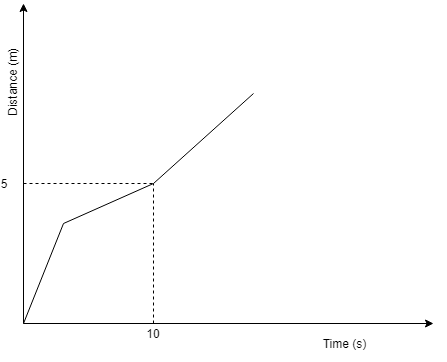
What is the velocity for a body following the graph below at $10s?$
The period of oscillation of a simple pendulum is given by $T = 2\pi \sqrt {\frac{l}{g}} $ where $l$ is about $100 \,cm$ and is known to have $1\,mm$ accuracy. The period is about $2\,s$. The time of $100$ oscillations is measured by a stop watch of least count $0.1\, s$. The percentage error in $g$ is ......... $\%$
A body is moving with velocity $1\ m/ s$ at a height $3m$ from the ground. What will be its speed at height $2m$ from the ground?