MCQ
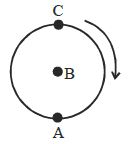
A sphere is rolling without slipping on a fixed horizontal plane surface. $A$ is the point of contact, $B$ is the centre of the sphere and $C$ is top most point.Then
  • A
    ${\vec v_C}\,\, - \,\,{\vec v_A}\,\, = \,2({\vec v_B}\,\, - \,\,{\vec v_C}\,)\,$
  • ${\vec v_C}\,\, - \,\,{\vec v_B}\,\, = \,{\vec v_B}\,\, - \,\,{\vec v_A}\,$
  • C
    $|{\vec v_C}\,\, - \,\,{\vec v_A}|\,\, = \,2({\vec v_B}\,\, - \,\,{\vec v_C}\,)\,$
  • D
    $|{\vec v_C}\,\, - \,\,{\vec v_A}|\,\, = \,4|{\vec v_B}|\,$
Answer

Correct option: B.
${\vec v_C}\,\, - \,\,{\vec v_B}\,\, = \,{\vec v_B}\,\, - \,\,{\vec v_A}\,$
b
If $\vec{V}_{0}$ is the velocity of centre of the sphere, then

$\vec{V}_{C}=2 \vec{V}_{0}, -\vec B=\vec{V}_{0}$ and$-\vec A=0$

$\therefore \vec{V}_{\mathcal{C}}-\vec{V}_{B}=2 \vec{V}_{0}-\vec{V}_{0}=\vec{V}_{0}$

$\vec{V}_{B}-\vec{V}_{A}=\vec{V}_{0}-\overrightarrow{0}=\vec{V}_{0}$

$\therefore \vec{V}_{C}-\vec{V}_{B}=\vec{V}_{B}-\vec{V}_{A}$

Need a full question paper?

Generate a complete, print-ready paper with questions like this in minutes — across 16+ boards, with answer keys.

Start Generating Free

Similar questions

A second harmonic has to be generated in a string of length $l$ stretched between two rigid supports. The point where the string has to be plucked and touched are
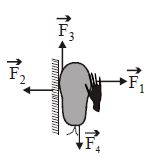
In the figure shown, a balloon is pressed against a wall. It is in equilibrium and maximum compresed state.$\vec F_1\,=$ force of balloon on hand of man $;$  $\vec F_2\,=$  force of balloon on wall $;$  $\vec F_3\,=$ friction $;$ $\vec F_4=$  weight of balloon. Choose the correct statement.
A parallel plate capacitor having capacitance $12\, pF$ is charged by a battery to a potential difference of $10\, V$ between its plates. The charging battery is now disconnected and a porcelain slab of dielectric constant $6.5$ is slipped between the plates. The work done by the capacitor on the slab is.......$pJ$
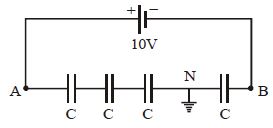
Four identical capacitors are connected in series with a $10\,V$ battery as shown. The point $N$ is earthed. The potentials of points $A$ and $B$ are
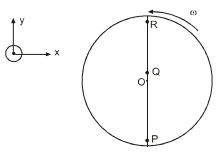
Consider a disc rotating in the horizontal plane with a constant angular speed $\omega$ about its centre $O$. The disc has a shaded region on one side of the diameter and an unshaded region on the other side as shown in the figure. When the disc is in the orientation as shown, two pebbles $P$ and $Q$ are simultaneously projected at an angle towards $R$. The velocity of projection is in the $y$-z plane and is same for both pebbles with respect to the disc. Assume that $(i)$ they land back on the disc before the disc completed $\frac{1}{8}$ rotation. $(ii)$ their range is less than half disc radius, and $(iii)$ $\omega$ remains constant throughout. Then
A hot body, obeying Newton's law of cooling is cooling down from its peak value $80\,^oC$ to an ambient temperature of $30\,^oC$ . It takes $5\, minutes$ in cooling down from $80\,^oC$ to $40\,^oC$.  ........  $\min.$ will it take to cool down from $62\,^oC$ to $32\,^oC$ ? (Given $ln\, 2\, = 0.693, ln\, 5\, = 1.609$)
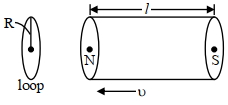
A bar magnet is passing through a conducting loop of radius $R$ with velocity $v .$ The radius of the bar magnet is such that it just passes through the loop. The induced $e.m.f.$ in the loop can be represented by the approximate curve:
Mark the wrong statement
Electric charges of $+10\,\mu\, C, +5\,\mu\, C, -3\,\mu\, C$ and $+8\,\mu\, C$ are placed at the corners of a square of side$\sqrt 2\,m$ . The potential at the centre of the square is
The vertical component of the earth's magnetic field is $6 \times 10^{-5} T$ at any place where the angle of dip is $37^{\circ}$. The earth's resultant magnetic field at that place will be $\left(\right.$ Given $\left.\tan 37^{\circ}=\frac{3}{4}\right)$