MCQ
A sphere is rotating about a diameter
  • A
    The particles on the surface of the sphere do not have any linear acceleration
  • The particles on the diameter mentioned above do not have any linear acceleration
  • C
    Different particles on the surface have different angular speeds
  • D
      All the particles on the surface have same linear speed
Answer

Correct option: B.
The particles on the diameter mentioned above do not have any linear acceleration
b
the particles on the surface of the sphere do not have any linear acceleration the particles on the diameter mentioned above do not have any linear acceleration different particle son the surfce have different angular speeds.

All particles on the surface have same linear speed

Need a full question paper?

Generate a complete, print-ready paper with questions like this in minutes — across 16+ boards, with answer keys.

Start Generating Free

Similar questions

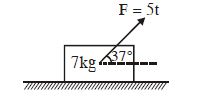
A block of $7\,kg$ is placed on a rough horizontal surface and is pulled through a variable force $F$ (in $N$ ) $= 5\,t$ , where $'t'$ is time in second, at an angle of $37^o$ with the horizontal as shown in figure. The coefficient of static friction of the block with the surface is one. If the force starts acting at $t = 0\,s$ . Find the time at which the block starts to slide ......... $\sec$ (Take $g = 10\,m/s^2$ )
The uncertain digit in the measurement of a length reported as $41.68 \,cm$ is ........... 
A stone drop from height $'h\ '$ on Earth surface fall in $1\sec.$ If the same stone taken to Moon and drop freely then it will reaches from the surface of the Moon in the time $($The $'g\ '$ of Moon is $1/6$ times of Earth$):-$
Two particles of mass $m$ each are fixed at the opposite ends of a massless rod of length $5m$ which is oriented vertically on a smooth horizontal surface and released. Find the displacement of the lower mass on the ground when the rod makes an angle of $37^o$ with the vertical. ........ $m$
A block moving horizontally on a smooth surface with a speed of $40\, {m} / {s}$ splits into two parts with masses in the ratio of $1: 2$. If the smaller part moves at $60\, {m} / {s}$ in the same direction, then the fractional change in kinetic energy is :-
A stone of mass $0.25\; kg$ tied to the end of a string is whirled round in a circle of radius $1.5 \;m$ with a speed of $40\; rev./min$ in a hortzontal plane. What is the tenston in the string? What is the maximum speed in $m/s $ with which the stone can be whirled around if the string can withstand a maximum tension of $200\; N ?$
Two objects are thrown up at angles of $45^{\circ}$ and $60^{\circ}$ respectively, with the horizontal. If both objects attain same vertical height, then the ratio of magnitude of velocities with which these are projected is .........
The angular velocities of three bodies in simple harmonic motion are ${\omega _1},\,{\omega _2},\,{\omega _3}$ with their respective amplitudes as ${A_1},\,{A_2},\,{A_3}$. If all the three bodies have same mass and velocity, then
In a transverse wave, the particles of the medium:
The International Avogadro Coordination project created the world's most perfect sphere using Silicon in its crystalline form. The diameter of the sphere is $9.4 \,cm$ with an uncertainty of $0.2 \,nm$. The atoms in the crystals are packed in cubes of side $a$. The side is measured with a relative error of $2 \times 10^{-9}$, and each cube has $8$ atoms in it. Then, the relative error in the mass of the sphere is closest to (assume molar mass of Silicon and Avogadro's number to be known precisely)