MCQ
A stone drop from height $'h\ '$ on Earth surface fall in $1\sec.$ If the same stone taken to Moon and drop freely then it will reaches from the surface of the Moon in the time $($The $'g\ '$ of Moon is $1/6$ times of Earth$):-$
  • $\sqrt{6}\ \text{​second}$
  • B
    $9\ \text{​second}$
  • C
    $\sqrt{3}\ \text{​second}$
  • D
    $6\ \text{​second}$

Answer

Correct option: A.
$\sqrt{6}\ \text{​second}$

Need a full question paper?

Generate a complete, print-ready paper with questions like this in minutes — across 16+ boards, with answer keys.

Start Generating Free

Similar questions

Work done in increasing the size of a soap bubble from a radius of $3\, cm$ to $5\,cm$ is  (Surface tension of soap solution $= 0.03 \,Nm^{-1})$
The position of a particle moving along $x$-axis is given by $x=10 t-2 t^2$. Then the time $(t)$ at which it will momently come to rest is .......... $s$
In steady state graph between temp and distance from hot end is
 In a standing wave on a string rigidly fixed at both ends
The distance of the eye-lens from the retina is x. For a normal eye, the maximum focal length of the eye-lens:
Two pendulums of length $121\,cm$ and $100\,cm$ start vibrating in phase. At some instant, the two are at their mean position in the same phase. The minimum number of vibrations of the shorter pendulum after which the two are again in phase at the mean position is :
The rates of cooling of two different liquids put in exactly similar calorimeters and kept in identical surroundings are the same if:
Vertical displacement of a plank with a body of mass $'m'$ on it is varying according to law $y = \sin \omega t + \cos \omega t.$ The minimum value of $\omega $ for which the mass just breaks off the plank and the moment it occurs first after $t = 0$ are given by : ( $y$ is positive vertically upwards)
The angular momentum of a moving body remains constant, if
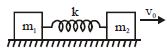
Two block of masses $m_1$ and $m_2$ connected with the help of a spring of spring constant $k$ initially to natural length as shown. A sharp impulse is given to mass $m_2$ so that it acquires a velocity $v_0$ towards right. If the system is kept an smooth floor then find the maximum elongation that the spring will suffer