MCQ
A sphere of mass $m$ is tied to end of a string of length $l$ and rotated through the other end along a horizontal circular path with speed $v$. The work done in full horizontal circle is
  • $0$
  • B
    $\left( {\frac{{m{v^2}}}{l}} \right)\,.\,2\pi l$
  • C
    $mg\,.\,2\pi l$
  • D
    $\left( {\frac{{m{v^2}}}{l}} \right)\,.\,(l)$

Answer

Correct option: A.
$0$
a
(a)Work done by centripetal force in uniform circular motion is always equal to zero.

Need a full question paper?

Generate a complete, print-ready paper with questions like this in minutes — across 16+ boards, with answer keys.

Start Generating Free

Similar questions

A particle of mass $5 \;\mathrm{m}$ at rest suddenly breaks on its own into three fragments. Two fragments of mass $m$ each move along mutually perpendicetion with speed $v$ each. The energy released during the process is
Acceleration due to gravity $'g'$ for a body of mass $'m'$ on earth's surface is proportional to (Radius of earth$=R$, mass of earth$=M$)
To find the spring constant $(k)$ of a spring experimentally, a student commits $2 \%$ positive error in the measurement of time and $1 \%$ negative error in measurement of mass. The percentage error in determining value of $\mathrm{k}$ is :
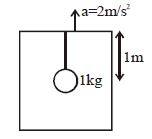
In the figure shown a mass $1\  kg$ is connected to a string of mass per unit length $1.2\  gm/m$ . Length of string is $1\  m$ and its other end is connected to the top of a ceiling which is accelerating up with an acceleration $2\  m/s^2$ . A transverse pulse is produced at the lowest point of string. Time taken by pulse to reach the top of string is .... $s$
Two satellites of earth, $S_1$ and $S_2$ are moving in the same orbit. The mass of $S_1$ is four times the mass of $S_2.$ Which one of the following statements is true?
If the gravitation force on body 1 due to 2 is given by $F_2$ and on body 2 due to 1 is given as $F_1$, then
A car of $800 \mathrm{~kg}$ is taking turn on a banked road of radius $300 \mathrm{~m}$ and angle of banking $30^{\circ}$. If coefficient of static friction is $0.2$ then the maximum speed with which car can negotiate the turn safely : $\left(\mathrm{g}=10 \mathrm{~m} / \mathrm{s}^2, \sqrt{3}=1.73\right)$
Two trains $A$ and $B$ are moving with speeds $20 \mathrm{~m} / \mathrm{s}$ and $30 \mathrm{~m} / \mathrm{s}$ respectively in the same direction on the same straight track, with $B$ ahead of $A$. The engines are at the front ends. The engine of train  $A$ blows a long whistle.

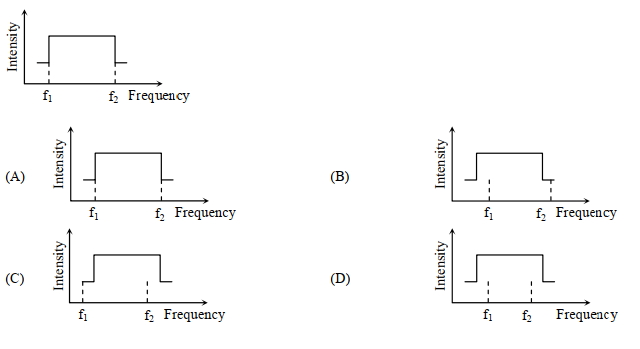
Assume that the sound of the whistle is composed of components varying in frequency from $f_1=800 \mathrm{~Hz}$ to $f_2=1120 \mathrm{~Hz}$, as shown in the figure. The spread in the frequency (highest frequency - lowest frequency) is thus $320 \mathrm{~Hz}$. The speed of sound in still air is $340 \mathrm{~m} / \mathrm{s}$.

$1.$  The speed of sound of the whistle is

$(A)$ $340 \mathrm{~m} / \mathrm{s}$ for passengers in $A$ and $310 \mathrm{~m} / \mathrm{s}$ for passengers in $B$

$(B)$ $360 \mathrm{~m} / \mathrm{s}$ for passengers in $A$ and $310 \mathrm{~m} / \mathrm{s}$ for passengers in $B$

$(C)$ $310 \mathrm{~m} / \mathrm{s}$ for passengers in $A$ and $360 \mathrm{~m} / \mathrm{s}$ for passengers in $B$

$(D)$ $340 \mathrm{~m} / \mathrm{s}$ for passengers in both the trains

$2.$  The distribution of the sound intensity of the whistle as observed by the passengers in train $\mathrm{A}$ is best represented by

$Image$

$3.$  The spread of frequency as observed by the passengers in train $B$ is

$(A)$ $310 \mathrm{~Hz}$ $(B)$ $330 \mathrm{~Hz}$ $(C)$ $350 \mathrm{~Hz}$ $(D)$ $290 \mathrm{~Hz}$

Give the answer question $1,2$ and $3.$
A screw gauge gives the following readings when used to measure the diameter of a wire

Main scale reading : $0 \,\mathrm{~mm}$

Circular scale reading $: 52$ $divisions$

Given that $1\, \mathrm{~mm}$ on main scale corresponds to $100\, divisions$ on the circular scale. The diameter of the wire from the above data is ...... $cm$

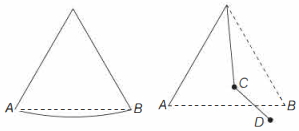
A simple pendulum oscillates freely between points $A$ and $B$. We now put a peg (nail) at the point $C$ as shown in above figure. As the pendulum moves from $A$ to the right, the string will bend at $C$ and the pendulum will go to its extreme point $D$. Ignoring friction, the point $D$