Question
A spherical conducting shell of inner radius $r_1$ and outer radius $r_2$ has a charge Q.
  1. A charge q is placed at the centre of the shell. What is the surface charge density on the inner and outer surfaces of the shell?
  2. Is the electric field inside a cavity (with no charge) zero, even if the shell is not spherical, but has any irregular shape? Explain
Answer

  1. Charge placed at the centre of a shell is +q. Hence, a charge of magnitude -q will be induced to the inner surface of the shell. Therefore, total charge on the inner surface of the shell is -q.
Surface charge density at the inner surface of the shell is given by the relation,

$\sigma_1=\frac{\text{Total charge}}{\text{Inner surface area}}=\frac{-\text{q}}{4\pi\text{r}^2_1} \dots\dots(1)$

A charge of +q is induced on the outer surface of the shell. A charqe of magnitude Q is placed on the outer surface of the shell. Therefore, total charge on the outer surface of the shell is Q + q. Surface charge density at the outer surface of the shell,

$\sigma_2=\frac{\text{Total charge}}{\text{Outer surface area}}=\frac{-\text{Q+q}}{4\pi\text{r}^2_2} \dots\dots(2)$
  1. Yes
The electric field intensity inside a cavity is zero, even if the shell is not spherical and has any irregular shape. Take a closed loop such that a part of it is inside the cavity along a field line while the rest is inside the conductor. Net work done by the field in carrying a test charge over a closed loop is zero because the field inside the conductor is zero. Hence, electric field is zero, whatever is the shape.

Need a full question paper?

Generate a complete, print-ready paper with questions like this in minutes — across 16+ boards, with answer keys.

Start Generating Free

Similar questions

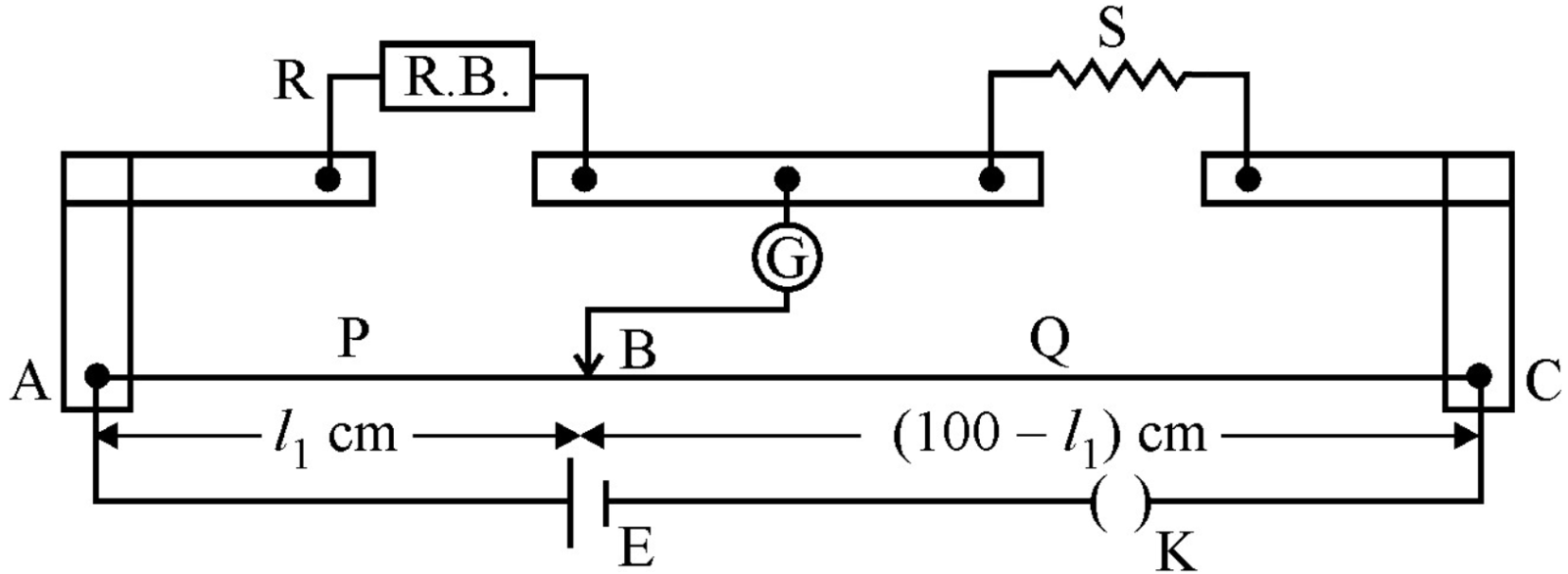
What is end error in a metre bridge? How is it overcome? The resistances in the two arms of the metre bridge are $\text{R}=5\Omega$ and S respectively. When the resistance S is shunted with an equal resistance, the new balance length found to be 1.5 $l_1$, where $l_1$ is the initial balancing length. Calculate the value of S.
How does a charge oscillating with any frequency produces electromagnetic waves? Draw a schematic diagram by showing electric and magnetic fields for an electromagnetic wave transmitting along Z-axis.
Assume that each atom in a copper wire contributes one free electron. Estimate the number of free electrons in a copper wire having a mass of $6.4g$ (take the atomic weight of copper to be $64g$ mol$^{-1}.$
What is the de Broglie wavelength of:
  1. A bullet of mass 0.040 kg travelling at the speed of 1.0 km/s,
  2. A ball of mass 0.060 kg moving at a speed of 1.0 m/s, and
  3. A dust particle of mass $1.0 \times 10^{–9} kg$ drifting with a speed of 2.2 m/s?
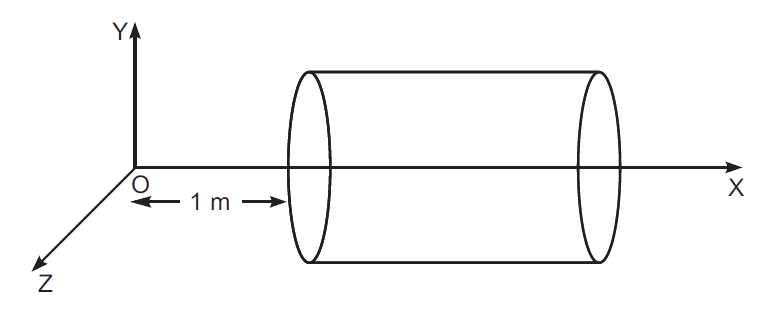
A hollow cylindrical box of length 1 m and area of cross-section $25\ cm^2$ is placed in a three dimensional coordinate system as shown in the figure. The electric field in the region is given by$\overrightarrow{\text{E}} = 50\text{x}\hat{\text{i}},$ where E is in $NC^{–1}$ and x is in metres. Find
  1. Net flux through the cylinder.
  2. Charge enclosed by the cylinder.
0.5 A of current is flowing through a coil of 25 turns and area $200 cm^2$. What is the pole strength of 10 cm length of bar magnet whose magnetic moment is equal to magnetic moment of the coil?
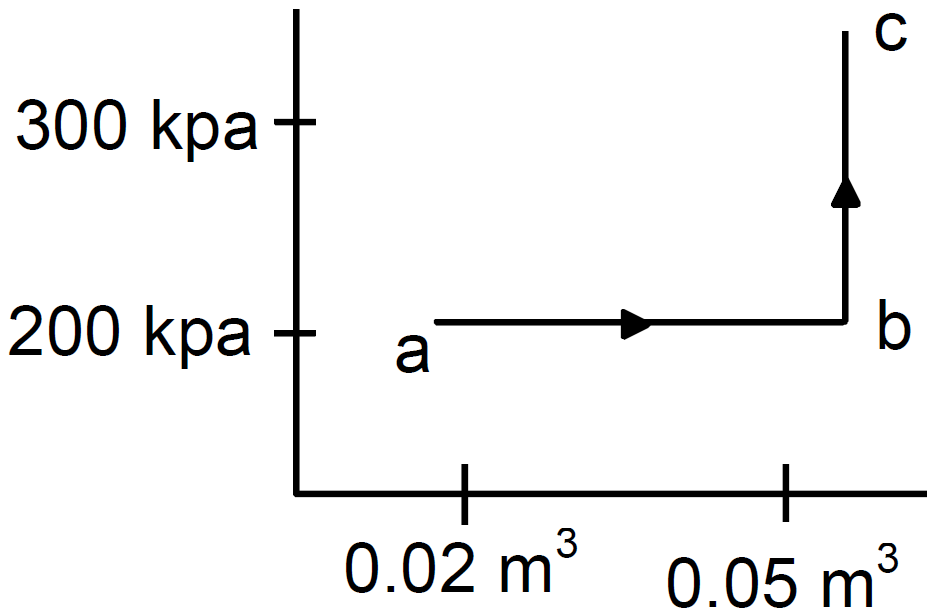
A substance is taken through the process abc as shown in figure. If the internal energy of the substance increases by 5000J and a heat of 2625cal is given to the system, calculate the value of J.
A coil of resistance $100\Omega$ is connected across a battery of emf 6.0V. Assume that the heat developed in the coil is used to raise its temperature. If the heat capacity of the coil is 4.0J/K, how long will it take to raise the temperature of the coil by 15°C?
The specification on a heater coil is 250V, 500W. Calculate the resistance of the coil. What will be the resistance of a coil of 1000W to operate at the same voltage?
  1. Draw a neat labelled ray diagram of an astronomical telescope in normal adjustment. Explain briefly its working.
  2. An astronomical telescope uses two lenses of powers 10 D and 1 D. What is its magnifying power in normal adjustment?