Question
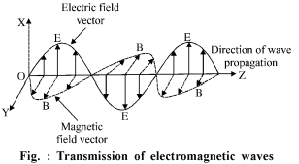
How does a charge oscillating with any frequency produces electromagnetic waves? Draw a schematic diagram by showing electric and magnetic fields for an electromagnetic wave transmitting along Z-axis.
Answer

When a charge oscillates with any frequency then it produces an electric field oscillating from that place. This produces an oscillating magnetic field. Oscillating magnetic field becomes a source to produce electric field and this process continues. In this way the electric and magnetic field vectors producing each other are mutually perpendicular to each other and also to the direction of propagation of wave.
Image

Need a full question paper?

Generate a complete, print-ready paper with questions like this in minutes — across 16+ boards, with answer keys.

Start Generating Free

Similar questions

In Fizeau method of measuring the speed of light, the toothed wheel is placed in the focal plane of a converging lens. How would the experiment be affected if the wheel is slightly away from the focal plane?
The equation for the vibration of a string, fixed at both ends vibrating in its third harmonic, is given by$\text{y}=(0.4\text{cm})\sin\big[(0.314\text{cm}^{-1})\text{x}\big]\cos\big[(600\pi\text{s}^{-1})\text{t}\big]$
  1. What is the frequency of vibration?
  2. What are the positions of the nodes?
  3. What is the length of the string?
  4. What is the wavelength and the speed of two travelling waves that can interfere to give this vibration ?
Assume that each atom in a copper wire contributes one free electron. Estimate the number of free electrons in a copper wire having a mass of $6.4g$ (take the atomic weight of copper to be $64g$ mol$^{-1}.$
A small telescope has an objective lens of focal length 144 cm and an eyepiece of focal length 6.0 cm. What is the magnifying power of the telescope? What is the separation between the objective and the eyepiece?
Which constituent radiation of the electromagnetic spectrum is used:
  1. In RADAR,
  2. To photograph internal parts of a human body,
  3. For taking photographs of the sky during night and foggy conditions?
Give one reason for your answer in each case.
Mention any three applications of the internet. Explain one of these in detail.
The absolute refractive index of air is 1.0003 and the wavelength of yellow light in a vacuum is $6000 \stackrel{\circ}{A}$ . Find the thickness of air column which will contain one more wavelength of yellow light than in the same thickness of vacuum.
Two moving coil meters, $M_1$ and $M_2$ have the following particulars:
$R_1 = 10 Ω, N_1 = 30,$
$A_1 = 3.6 \times 10^{–3} m^2, B_1 = 0.25 T$
$R_2 = 14 Ω, N_2 = 42,$
$A_2 = 1.8 \times 10^{–3} m^2, B_2 = 0.50 T$
(The spring constants are identical for the two meters).
Determine the ratio of (a) current sensitivity and (b) voltage sensitivity of $M_2$ and $M_1.$
The magnifying power of a converging lens used as a simple microscope is $\Big(1+\frac{\text{D}}{\text{f}}\Big).$ A compound microscope is a combination of two such converging lenses. Why don't we have magnifying power $\Big(1+\frac{\text{D}}{\text{f}_\text{o}}\Big) \Big(1+\frac{\text{D}}{\text{f}_\text{o}}\Big)?$ In other words, why can the objective not be treated as a simple microscope but the eyepiece can?
Design a logical circuit using AND, OR and NOT gates to evaluate $\text{A}\overline{\text{BC}}+\text{B}\overline{\text{CA}}.$