A spherical conductor of radius $2m$ is charged to a potential of $120\, V$. It is now placed inside another hollow spherical conductor of radius $6m$. Calculate the potential to which the bigger sphere would be raised......$V$
Easy


Download our appand get started for free
Experience the future of education. Simply download our apps or reach out to us for more information. Let's shape the future of learning together!No signup needed.*
Similar Questions
- 1A parallel plate capacitor is charged to a potential difference of $100\,V$ and disconnected from the source of $emf$ . A slab of dielectric is then inserted between the plates. Which of the following three quantities change?View Solution
$(i)$ The potential difference
$(ii)$ The capacitance
$(iii)$ The charge on the plates
- 2$S_1$ and $S_2$ are two equipotential surfaces on which the potentials are not equal. Which of the statement is incorrect ?View Solution
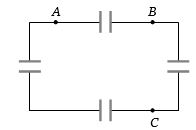
- 3Four capacitors of each of capacity $3\,\mu F$ are connected as shown in the adjoining figure. The ratio of equivalent capacitance between $A$ and $B$ and between $A$ and $C$ will beView Solution
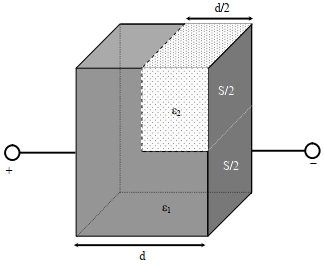
- 4A parallel plate capacitor having plates of area $S$ and plate separation $d$, has capacitance $C _1$ in air. When two dielectrics of different relative permittivities $\left(\varepsilon_1=2\right.$ and $\left.\varepsilon_2=4\right)$ are introduced between the two plates as shown in the figure, the capacitance becomes $C _2$. The ratio $\frac{ C _2}{ C _1}$ isView Solution
- 5A proton and an anti-proton come close to each other in vacuum such that the distance between them is $10 \,cm$. Consider the potential energy to be zero at infinity. The velocity at this distance will be ........... $\,m / s$View Solution
- 6A fully charged capacitor has a capacitance $‘C’$. It is discharged through a small coil of resistance wire embedded in a thermally insulated block of specific heat capacity $‘s’$ and mass $‘m’$. If the temperature of the block is raised by ‘$\Delta T$’, the potential difference $‘V’$ across the capacitance isView Solution
- 7The electrostatic potential due to an electric dipole at a distance ' $r$ ' varies as :View Solution
- 8View SolutionThree identical capacitors are combined differently. For the same voltage to each combination, the one that stores the greatest energy is
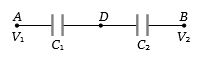
- 9Two condensers ${C_1}$and ${C_2}$ in a circuit are joined as shown in figure. The potential of point $A$ is ${V_1}$ and that of $B$ is ${V_2}$. The potential of point $D$ will beView Solution
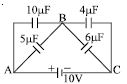
- 10In the circuit shown in figure, four capacitors are connected to a battery. The potential difference across the $6$ $\mu F$ capacitor is......$V$View Solution