b
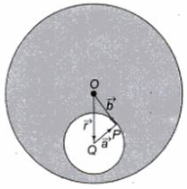
If a Gaussian surface is constructed within the cavity then by Gauss Law $\oint$ E. dS $=0$. This does not mean that $E =0$.
From the image, consider a point $P$ inside the cavity and let $\rho$ be the charge density. Then, after applying superposition principle the net electric field at point $P$ will be:
$E=\frac{\rho}{3 \epsilon_0} \vec{b}-\frac{\rho}{3 \epsilon_0} \vec{a}$
$=\frac{\rho}{3 \epsilon_0} \vec{r} \text { (Since } \vec{r}=\vec{b}-\vec{a} \text { ) }$
which for a given cavity is independent of the position of a point within the cavity.
Therefore, Electric field is non-zero and uniform within the cavity.