Question
A spherical shell made of plastic, contains a charge Q distributed uniformly over its surface. What is the electric field inside the shell? If the shell is hammered to deshape it without altering the charge, will the field inside be changed? What happens if the shell is made of a metal?
Answer

As the shell is made of plastic, it is non-conducting. But as the charge is distributed uniformly over the surface of the shell, the sum of all the electric field vectors at the centre due to this kind of distribution is zero. But when the plastic shell is deformed, the distribution of charge on it becomes non-uniform. In other words, the sum of all the electric field vectors is non-zero now or the electric field exists at the centre now.
In case of a deformed conductor, the field inside is always zero.

Need a full question paper?

Generate a complete, print-ready paper with questions like this in minutes — across 16+ boards, with answer keys.

Start Generating Free

Similar questions

Write any four characteristics of electromagnetic waves. Give two uses each of (i) Radio-waves (ii) Micro-waves.
  1. What is linearly polarized light? Describe briefly using a diagram how sunlight is polarised.
  2. Unpolarised light is incident on a polaroid. How would the intensity of transmitted light change when the polaroid is rotated?
What happens to the intensity of light from a bulb if the distance from the bulb is doubled? As a laser beam travels across the length of a room, its intensity essentially remains constant. What geomatrical characteristic of LASER beam is responsible for the constant intensity which is missing in the case of light from the bulb?
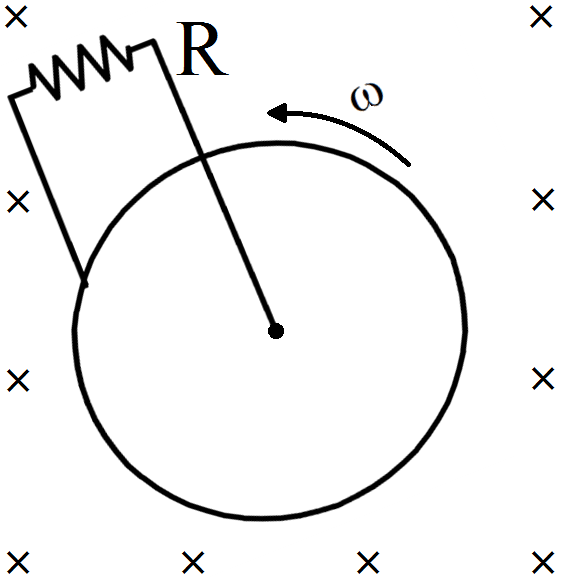
Figure shows a conducting disc rotating about its axis in a perpendicular magnetic field B. A resistor of resistance R is connected between the centre and the rim. Calculate the current in the resistor. Does it enter the disc or leave it at the centre? The radius of the disc is 5.0cm, angular speed $\omega=10 \ \text{rad/s}, \ \text{B}=0.40\text{T}$ and $\text{R}=10\Omega.$

A parallel plate capacitor is charged by a battery. After sometime the battery is disconnected and a dielectric slab with its thickness equal to the plate separation is inserted between the plates. How will (i) the capacitance of the capacitor, (ii) potential difference between the plates and (iii) the energy stored in the capacitor be affected?
Justify your answer in each case.
A thin conducting spherical shell of radius R has charge Q spread uniformly over its surface. Using Gauss’s law, derive an expression for an electric field at a point outside the shell.

Draw a graph of electric field E(r) with distance r from the centre of the shell for $0\underline{<}\text{r}\underline{<}\infty.$

A potentiometer wire of length 1 m has a resistance of 5 $\Omega$. It is connected to a 8 V battery in series with a resistance of 15 $\Omega$. Determine the emf of the primary cell which gives a balance point at 60 cm.
An electromagnetic wave of wavelength λ is incident on a photosensitive surface of negligible work function. If the photo-electrons emitted from this surface have the de-Broglie wavelength $\lambda_{1}$, prove that $\lambda = \begin{pmatrix} 2 \text{mc} \\ h \end{pmatrix}\lambda^{2}_{1}$.
What is the de-Broglie wavelength associated with (a) an electron moving with a speed of $5.4 \times 10^6 m / s$, and (b) a ball of mass 150 g travelling at $ 30 . m / s$ ?