Question
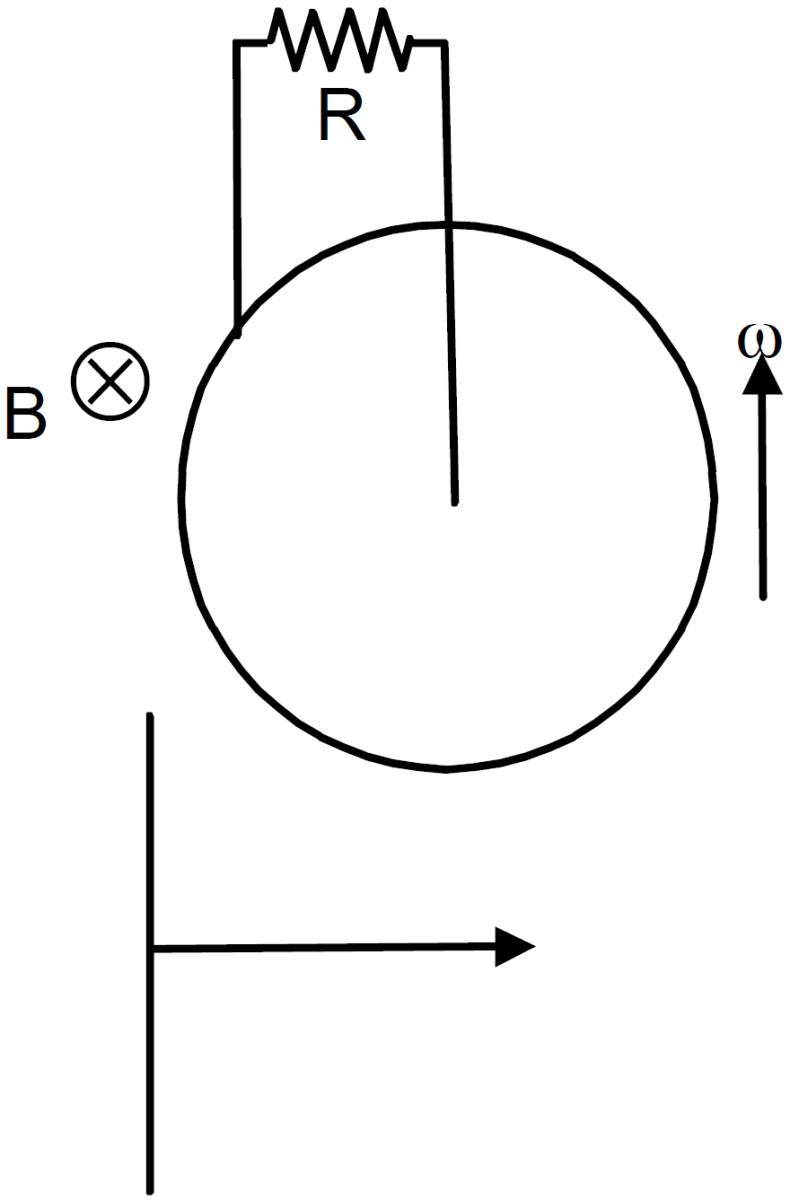
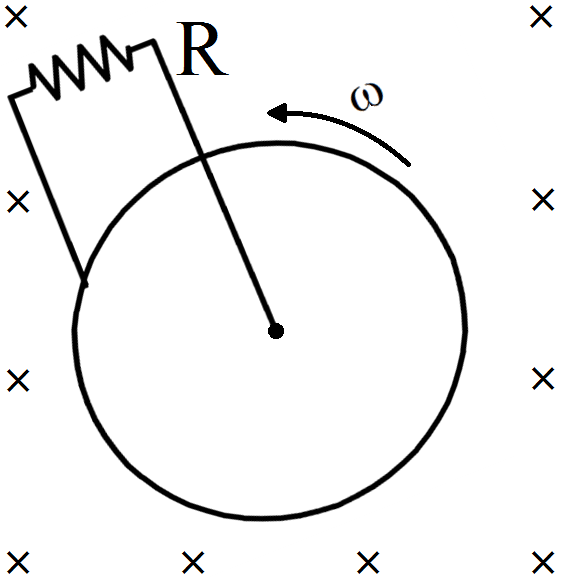
Figure shows a conducting disc rotating about its axis in a perpendicular magnetic field B. A resistor of resistance R is connected between the centre and the rim. Calculate the current in the resistor. Does it enter the disc or leave it at the centre? The radius of the disc is 5.0cm, angular speed $\omega=10 \ \text{rad/s}, \ \text{B}=0.40\text{T}$ and $\text{R}=10\Omega.$
Answer


$\text{B}=0.40\text{T},\omega=10 \ \text{rad}/',\text{r}=10\Omega$

$\text{r}=5\text{cm}=0.05\text{m}$

Considering a rod of length 0.05m affixed at the centre and rotating with the same $\omega$.

$\text{V}=\frac{\text{L}}{2}\times\omega=\frac{0.05}{2}\times10$

$\text{e}=\text{BLV}=0.40\times\frac{0.05}{2}\times10\times0.05=5\times10^{-3}\text{V}$

$\text{L}=\frac{\text{e}}{\text{R}}=\frac{5\times10^{-3}}{10}=0.5 \ \text{mA}$

It leaves from the centre.

Need a full question paper?

Generate a complete, print-ready paper with questions like this in minutes — across 16+ boards, with answer keys.

Start Generating Free

Similar questions

A capacitor of capacitance $10\mu\text{F}$ is connected across a battery of emf 6.0V through a resistance of $20\text{k}\Omega$ for 4.0s. The battery is then replaced by a thick wire. What will be the charge on the capacitor 4.0s after the battery is disconnected?
Write the difference between alternating current and voltage.
Calculate the following:

  1. Impedance of the given ac circuit.
  2. Wattless current of the given ac circuit.
A steel wire of mass 4.0g and length 80cm is fixed at the two ends. The tension in the wire is 50N. Find the frequency and wavelength of the fourth harmonic of the fundamental.
In the relation to the photoelectric effect, write the definition of the terms 'stopping potential' and 'threshold frequency'. How are these physical quantities determined using Einstein's equation?
An electron and a photon each have a wavelength of 1.00 nm. Find:
  1. Their momenta,
  2. The energy of the photon, and
  3. The kinetic energy of electron.
Calculate the de Broglie wavelength of a neutron of kinetic energy 150eV. Mass of neutron = 1.67 × 10⁻²⁷kg.
State Kirchhoff's laws and explain them by giving examples.###Explain that first law of Kirchhoff is equivalent to law of conservation of charge and the second law is a descriptive form of Ohm's law.###For a current carrying conductor, write Kirchhoff's laws of charge and energy conservation.
We have valence electrons and conduction electrons in a semiconductor. Do we also have 'valence holes' and 'conduction holes'?
A wire carries an alternating current $\text{i}=\text{i}_0\sin\omega\text{t}.$ Is there an electric field in the vicinity of the wire?