Question
A spherical solid ball of $10\,kg$ mass and radius $3\,cm$ is rotating about an axis passing through its centre with an angular velocity of $50\,radian/s$ the kinetic energy of rotation is ....... $J.$

Answer

${K_R}\, = \,\frac{1}{2}\,I{\omega ^2}$

Need a full question paper?

Generate a complete, print-ready paper with questions like this in minutes — across 16+ boards, with answer keys.
Start Generating Free

Similar questions

A reflecting telescope has a large mirror as its objective with radius of curvature equal to $80\,cm$. The magnifying power of this telescope if eye piece used has a focal length of $1.6\, cm$ is 
Electric current has both magnitude and direction. It is a
Two discs of the same material and thickness have radii $0.2\, m$ and $0.6\, m.$  Their moments of inertia about their axes will be in the ratio 
The ($\tau -\theta$) graph for a coil is
If a star emitting light of wavelength $5000\,\mathop A\limits^o$ is moving towards earth with a velocity of  $1.5\,\,\times \,\,10^6\,\, m/s$  then the shift in the wave length due to Doppler's effect will be......$\mathop A\limits^o$
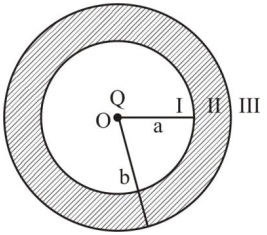
As shown in the figure, a point charge $Q$ is placed at the centre of conducting spherical shell of inner radius a and outer radius $b$. The electric field due to charge $Q$ in three different regions I, II and III is given by: $( I : r < a , II : a < r < b , III : r > b )$
The potential difference applied to an $X-$ ray tube is increased. As a result, in the emitted radiation
A disk of radius $R$ with uniform positive charge density $\sigma$ is placed on the $x y$ plane with its center at the origin. The Coulomb potential along the $z$-axis is

$V(z)=\frac{\sigma}{2 \epsilon_0}\left(\sqrt{R^2+z^2}-z\right)$

A particle of positive charge $q$ is placed initially at rest at a point on the $z$ axis with $z=z_0$ and $z_0>0$. In addition to the Coulomb force, the particle experiences a vertical force $\vec{F}=-c \hat{k}$ with $c>0$. Let $\beta=\frac{2 c \epsilon_0}{q \sigma}$. Which of the following statement($s$) is(are) correct?

$(A)$ For $\beta=\frac{1}{4}$ and $z_0=\frac{25}{7} R$, the particle reaches the origin.

$(B)$ For $\beta=\frac{1}{4}$ and $z_0=\frac{3}{7} R$, the particle reaches the origin.

$(C)$ For $\beta=\frac{1}{4}$ and $z_0=\frac{R}{\sqrt{3}}$, the particle returns back to $z=z_0$.

$(D)$ For $\beta>1$ and $z_0>0$, the particle always reaches the origin.

$AB$ is an object dipped in water at a depth of $d$ . Its length is $l$ . It is seen from air at near normal incidence. The length of the image is
The objective lens of a compound microscope produces magnification of $10$. In order to get an overall magnification of $100$ when image is formed at $ 25\, cm$ from the eye, the focal length of the eye lens should be