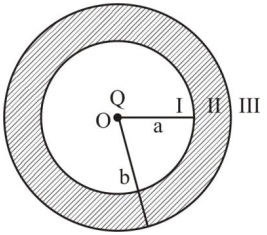
As shown in the figure, a point charge $Q$ is placed at the centre of conducting spherical shell of inner radius a and outer radius $b$. The electric field due to charge $Q$ in three different regions I, II and III is given by: $( I : r < a , II : a < r < b , III : r > b )$
JEE MAIN 2023, Medium


Download our appand get started for free
Experience the future of education. Simply download our apps or reach out to us for more information. Let's shape the future of learning together!No signup needed.*
Similar Questions
- 1The plates of a parallel plate capacitor of capacity $50\,\mu C$ are charged to a potential of $100\;volts$ and then separated from each other so that the distance between them is doubled. How much is the energy spent in doing soView Solution
- 2The space between the plates of a parallel plate capacitor is filled with a 'dielectric' whose 'dielectric constant' varies with distance as per the relation:View Solution
$K(x) = K_0 + \lambda x$ ( $\lambda =$ constant)
The capacitance $C,$ of the capacitor, would be related to its vacuum capacitance $C_0$ for the relation
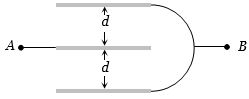
- 3Three plates of common surface area $A$ are connected as shown. The effective capacitance will beView Solution
- 4Three concentric metallic spherical shell $A, B$ and $C$ or radii $a, b$ and $c$ $(a < b < c)$ have surface charge densities $- \sigma , + \sigma ,$ and $- \sigma $ respectively. The potential of shell $A$ is :View Solution
- 5A parallel plate capacitor is charged and then disconnected from the source steady $E.M.F.$ The plates are then drawn apart farther. Again it is connected to the same source. Then :View Solution
- 6A conducting body $1$ has some initial charge $Q$, and its capacitance is $C$. There are two other conducting bodies, $2$ and $3$, having capacitances : $C_2 = 2C$ and $C_3 \rightarrow \infty$ . Bodies $2 $ and $3 $ are initially uncharged. "Body $2$ is touched with body $1$. Then, body $2$ is removed from body $1 $ and touched with body $3$, and then removed." This process is repeated $N$ times. Then, the charge on body $1$ at the end must beView Solution
- 7The electric potential $V(x, y, z)$ for a planar charge distribution is given by:View Solution
$V\left( {x,y,z} \right) = \left\{ {\begin{array}{*{20}{c}}
{0\,\,\,\,\,\,\,\,\,\,\,\,\,\,\,\,\,\,\,\,\,\,\,\,\,\,\,\,\,\,\,\,\,\,\,for\,x\, < \, - d}\\
{ - {V_0}{{\left( {1 + \frac{x}{d}} \right)}^2}\,\,\,\,\,\,\,\,\,\,\,\,\,\,\,\,\,\,for\, - \,d\, \le x < 0}\\
{ - {V_0}\left( {1 + 2\frac{x}{d}} \right)\,\,\,\,\,\,\,\,\,\,\,for\,0\, \le x < d}\\
{ - 3{V_0}\,\,\,\,\,\,\,\,\,\,\,\,\,\,\,\,\,\,\,\,\,\,\,\,\,\,for\,x\, > \,d}
\end{array}} \right.$where $-V_0$ is the potential at the origin and $d$ is a distance. Graph of electric field as a function of position is given as
- 8View SolutionTwo equal capacitors are first connected in series and then in parallel. The ratio of the equivalent capacities in the two cases will be
- 9View SolutionA battery is used to charge a parallel plate capacitor till the potential difference between the plates becomes equal to the electromotive force of the battery. The ratio of the energy stored in the capacitor and the work done by the battery will be
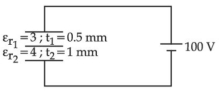
- 10A composite parallel plate capacitor is made up of two different dielectric materials with different thickness $\left(t_{1}\right.$ and $\left.t_{2}\right)$ as shown in figure. The two different dielectric material are separated by a conducting foil $F$. The voltage of the conducting foil is $.....V$View Solution