MCQ
A spherically symmetric charge distribution is characterised by a charge density having the following variations

$\rho (r)\, = \,{\rho _0}\left( {1 - \frac{r}{R}} \right)$ for $r < R$

$\rho (r)\,=\,0$ for $r\, \ge \,R$

Where $r$ is the distance from the centre of the charge distribution $\rho _0$ is a constant. The electric field at an internal point $(r < R)$ is

  • A
    $\frac{{{\rho _0}}}{{4{\varepsilon _0}}}\left( {\frac{r}{3} - \frac{{{r^2}}}{{4R}}} \right)$
  • $\frac{{{\rho _0}}}{{{\varepsilon _0}}}\left( {\frac{r}{3} - \frac{{{r^2}}}{{4R}}} \right)$
  • C
    $\frac{{{\rho _0}}}{{3{\varepsilon _0}}}\left( {\frac{r}{3} - \frac{{{r^2}}}{{4R}}} \right)$
  • D
    $\frac{{{\rho _0}}}{{12{\varepsilon _0}}}\left( {\frac{r}{3} - \frac{{{r^2}}}{{4R}}} \right)$
Answer

Correct option: B.
$\frac{{{\rho _0}}}{{{\varepsilon _0}}}\left( {\frac{r}{3} - \frac{{{r^2}}}{{4R}}} \right)$
b
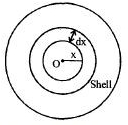
Let us consider a spherical shell of radius $x$ and thickness $dx.$

Charge on this shell

$\mathrm{dq}=\rho 4 \pi \mathrm{x}^{2} \mathrm{dx}=\rho_{0}\left(1-\frac{\mathrm{x}}{\mathrm{R}}\right) .4 \pi \mathrm{x}^{2} \mathrm{dx}$

$\therefore$ Total charge in the spherical region from centre to $r(r < R)$

$q=\int d q=4 \pi \rho_{0} \int_{0}^{T}\left(1-\frac{x}{R}\right) x^{2} d x$

$=4 \pi \rho_{0}\left[\frac{x^{3}}{3}-\frac{x^{4}}{4 R}\right]_{0}^{t}$

$=4 \pi \rho_{0}\left[\frac{r^{3}}{3}-\frac{r^{4}}{4 R}\right]$

$=4 \pi \rho_{0} r^{3}\left[\frac{1}{3}-\frac{r}{4 R}\right]$

$\therefore$ Electric field atr, $\mathrm{E}=\frac{1}{4 \pi \varepsilon_{0}} \cdot \frac{\mathrm{q}}{\mathrm{r}^{2}}$

$ = \frac{1}{{4\pi {\varepsilon _0}}} \cdot \frac{{4\pi {\rho _0}{r^3}}}{{{r^2}}} \cdot \left[ {\frac{1}{3} - \frac{r}{{4R}}} \right]$

$=\frac{\rho_{0}}{\varepsilon_{0}}\left[\frac{\tau}{3}-\frac{\tau^{2}}{4 R}\right]$

Need a full question paper?

Generate a complete, print-ready paper with questions like this in minutes — across 16+ boards, with answer keys.

Start Generating Free

Similar questions

A nucleus represented by the symbol ${ }_{Z}^{ A } X$ has
Two beams of light having intensities $I$ and $4\,I$ interfere to produce a fringe pattern on a screen. The phase difference between the two beams are $\pi / 2$ and $\pi / 3$ at points $A$ and $B$ respectively. The difference between the resultant intensities at the two points is $x I$. The value of $x$ will be.
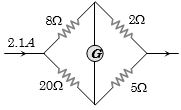
In the given figure, when galvanometer shows no deflection, the current (in $A$) flowing through $5\,\Omega $ resistance will be
In a compound microscope focal length of objective and eyepiece lens is $4\,cm$ and $8\,cm$ respectively. If length of tube is $30\,cm$ then magnifying power for normal adjustment will be
What should be the maximum acceptance angle at the aircore interface of an optical fibre if $n_1$ and $ n_2$ are the refractive indices of the core and the cladding, respectively
The binding energy of nucleons in a nucleus can be affected by the pairwise Coulomb repulsion. Assume that all nucleons are uniformly distributed inside the nucleus. Let the binding energy of a proton be $E_b^p$ and the binding energy of a neutron be $E_b^n$ in the nucleus.

Which of the following statement($s$) is(are) correct?

$(A)$ $E_b^p-E_b^n$ is proportional to $Z(Z-1)$ where $Z$ is the atomic number of the nucleus.

$(B)$ $E_b^p-E_b^n$ is proportional to $A^{-\frac{1}{3}}$ where $A$ is the mass number of the nucleus.

$(C)$ $E_b^p-E_b^n$ is positive.

$(D)$ $E_b^p$ increases if the nucleus undergoes a beta decay emitting a positron.

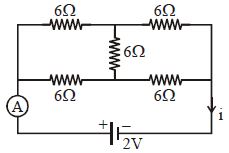
Reading of ammeter in ampere for the following circuit is
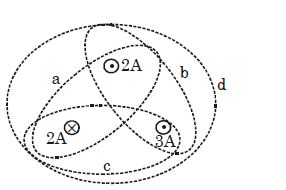
Rank the value of $\oint {\vec B.\overrightarrow {dl} } $ for the closed paths shown in figure from the smallest to largest
A potentiometer is an ideal device of measuring potential difference because
In a photoelectric experiment, the wavelength of the light incident on a metal is changed from $300\, nm$ to $400\, nm$. The decrease in the stopping potential is close to ................ $V$ $\left( {\frac {{hc}}{e} = 1240\,nm - V} \right)$