Question
A spring having with a spring constant $1200 N m ^{-1}$ is mounted on a horizontal table as shown in Fig. A mass of 3 kg is attached to the free end of the spring. The mass is then pulled sideways to a distance of 2.0 cm and released.
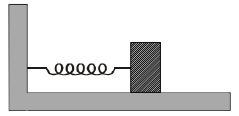
Image
Determine (i) the frequency of oscillations, (ii) maximum acceleration of the mass. and (iii) the maximum speed of the mass.

Answer

Given :
$
k=1200 N / m, m=3.0 kg
$
Maximum displacement
$
A=2.0 cm=2 \times 10^{-2} m
$
(i) We know time period
$
T=2 \pi \sqrt{\frac{m}{k}}
$
Frequency $\quad n=\frac{1}{T}$
$\begin{aligned} n & =\frac{1}{2 \pi} \sqrt{\frac{k}{m}} \\ \text { Put value } \quad & =\frac{1}{2 \times 3.14} \sqrt{\frac{1200}{3}} \\ & =\frac{20}{2 \times 3.142}=3.18 \\ n & =3.18 \text { per second } \\ & =3.2 \text { per second }\end{aligned}$
(ii) Acceleration $a=-\omega^2 A=\frac{-k}{m} A$
$
\left|a_{\max }\right|=\frac{k}{m}\left|A_{\max }\right|
$
Here denoted $\omega=\sqrt{\frac{k}{m}}$
When displacement is maximum then acceleration will also be maximum
$
A=0.02 m
$
$a=\frac{1200}{3} \times 0.02=8.0 m / s ^2$
(iii) Keeping the speed value of maximum mass when it will pass through the
$\begin{aligned} v _{\max } & = A \omega= A \sqrt{\frac{k}{m}} \\ & =0.02 \times \sqrt{\frac{1200}{3}}=0.02 \sqrt{400} \\ & =0.02 \times 20=0.40 m / s .\end{aligned}$

Need a full question paper?

Generate a complete, print-ready paper with questions like this in minutes — across 16+ boards, with answer keys.

Start Generating Free

Similar questions

An infinite ladder is constructed with $1\Omega$ and $2\Omega$ resistors, as shown in the figure.

(a) Find the effective resistance between the points A and B. (b) Find the current that passes through the $2\Omega$ resistor nearest to the battery.

  1. Define viscosity. Write SI units of coefficient of viscosity.
  2. Define terminal velocity. Establish an expression for it.
If the outer coil of the previous problem is rotated through 90° about a diameter, what would be the magnitude of the magnetic field B at the centre?
What are methods of reducing friction? Write these and explain. Or Explain what are the measures to reduce the effect of friction. Explain the usefulness of lurbicants
A uniform wheel of radius R is set into rotation about its axis at an angular speed $\omega.$ This rotating wheel is now placed on a rough horizontal surface with its axis horizontal. Because of friction at the contact, the wheel accelerates forward and its rotation decelerates till the wheel starts pure rolling on the surface. Find the linear speed of the wheel after it starts pure rolling.
  1. It is known that density r of air decreases with height y as $\rho_0\text{e}^{-\frac{\text{y}}{\text{y}_0}}$ where $\rho=1.25\text{kg m}^{-3}$ is the density at sea level, and y0 is a constant. This density variation is called the law of atmospheres. Obtain this law assuming that the temperature of atmosphere remains a constant (isothermal conditions). Also assume that the value of g remains constant.
  2. A large He balloon of volume 1425m3 is used to lift a payload of 400kg. Assume that the balloon maintains constant radius as it rises. How high does it rise? [Take y0 = 8000m and rHe = 0.18 kgm–3].
A ball is dropped from a building of height 45m. Simultaneously another ball is thrown up with a speed 40m/s. Calculate the relative speed of the balls as a function of time.
The capacitance between the adjacent plates shown in figure is 50nF. A charge of $1.0\mu\text{C}$ is placed on the middle plate:

  1. What will be the charge on the outer surface of the upper plate?
  2. Find the potential difference developed between the upper and the middle plates.
A body of mass 0.40kg moving initially with a constant speed of 10ms-1 to the north is subject to a constant force of 8.0 N directed towards the south for 30s. Take the instant the force is applied to be t = 0, the position of the body at that time to be x = 0, and predict its position at t = –5s, 25s, 100s.
Differentiate between progressive and non- progressive waves.