Question
A spring mass system preforms $S.H.M.$ If the mass is doubled keeping amplitude same, then the total energy of $S.H.M.$ will become :

Answer

The total energy of the mass spring system is equal to $\frac{1}{2} k A^{2},$ which is independent of mass. So the total energy will remain unchanged if amplitude is kept the same.

Need a full question paper?

Generate a complete, print-ready paper with questions like this in minutes — across 16+ boards, with answer keys.
Start Generating Free

Similar questions

When a stationary wave is formed then its frequency is
If two identical mercury drops are combined to form a single drop, then its temperature will
The vectors from origin to the points $A$ and $B$ are $\overrightarrow A = 3\hat i - 6\hat j + 2\hat k$ and $\overrightarrow B = 2\hat i + \hat j - 2\hat k$ respectively. The area of the triangle $OAB$ be
The average translational energy and the $r.m.s.$ speed of molecules in a sample of oxygen gas at $300 K$ are $6.21 \times {10^{ - 21}}\,J$ and $484\, m/s$ respectively. The corresponding values at $600 K$ are nearly (assuming ideal gas behaviour)
A bullet of mass $0.02\, kg$ travelling horizontally with velocity $250\, ms^{-1}$ strikes a block of wood of mass $0.23\, kg$ which rests on a rough horizontal surface. After the impact, the block and bullet move together and come to rest after travelling a distance of $40\,m$. The coefficient of sliding friction of the rough surface is $(g = 9.8\, ms^{-2})$
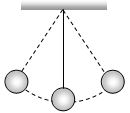
What is the velocity of the bob of a simple pendulum at its mean position, if it is able to rise to vertical height of $10cm$  ......... $m/s$ (Take $g = 9.8\,m/{s^2})$
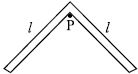
A system of two identical rods ($L-$ shaped) of mass $m$ and length $l$ are resting on a peg $P$ as shown in the figure. If the system is displaced in its plane by a small angle $\theta ,$ find the period of oscillations :
Two convex lenses of focal length $20\,cm$ each are placed coaxially with a separation of $60\,cm$ between them. The image of the distant object formed by the combination is at $...........\,cm$ from the first lens.
Four solid spheres each of diameter $\sqrt{5} \ cm$ and mass $0.5 \ kg$ are placed with their centers at the corners of a square of side $4 \ cm$. The moment of inertia of the system about the diagonal of the square is $N \times 10^{-4} kg - m ^2$, then $N$ is
Two charges each of $1\;coulomb$ are at a distance $1\,km$ apart, the force between them is