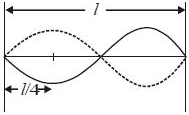
When a stationary wave is formed then its frequency is
Easy
Download our app for free and get started
Second harmonic means $2$ loops in a total length. Hence plucking distance from one end
$=\frac{l}{2 p}=\frac{l}{2 \times 2}=\frac{l}{4}$
Download our app
and get started for free
Experience the future of education. Simply download our apps or reach out to us for more information. Let's shape the future of learning together!No signup needed.*
What could be a correct expression for the speed of ocean waves in terms of its wavelength $\lambda $ , the depth $h$ of the ocean, the density $\rho $ of sea water, and the acceleration of free fall $g$ ?
A source of sound emitting a note of frequency $200 Hz$ moves towards an observer with a velocity $v$ equal to the velocity of sound. If the observer also moves away from the source with the same velocity $v$, the apparent frequency heard by the observer is .... $Hz$
A pipe $17\, cm$ long is closed at one end. Which harmonic mode of the pipe resonates a $1.5\, kHz$ source ?
(Speed of sound in air $= 340\, m\, s^{-1}$)
A closed organ pipe has a fundamental frequency of $1.5\, kHz$. The number of overtones that can be distinctly heard by a person with this organ pipe will be : (Assume that the highest frequency a person can hear is $20,000\, Hz$)
A source of sound is moving with constant velocity of $20\, m/s$ emitting a note of frequency $1000 \,Hz.$ The ratio of frequencies observed by a stationary observer while the source is approaching him and after it crosses him will be
An engine is moving on a circular track with a constant speed. It is blowing a whistle of frequency $500 Hz$. The frequency received by an observer standing stationary at the centre of the track is
Vibrating tuning fork of frequency $n$ is placed near the open end of a long cylindrical tube. The tube has a side opening and is fitted with a movable reflecting piston. As the piston is moved through $8.75 cm$, the intensity of sound changes from a maximum to minimum. If the speed of sound is $350 \,m/s. $ Then $n$ is .... $Hz$
A train moves towards a stationary observer with speed $34\, m/s$. The train sounds a whistle and its frequency registered by the observer is $f_1$. If the speed of the train is reduced to $17\, m/s$, the frequency registered is $f_2$. If speed of sound is $340\, m/s$, then the ratio $f_1/f_2$ is