Question
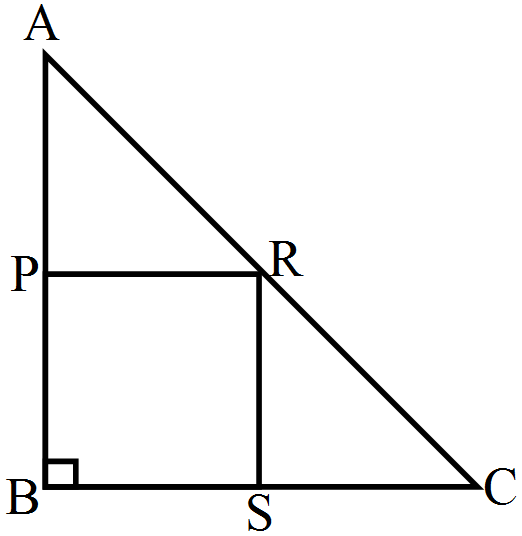
A square is inscribed in an isosceles right triangle so that the square and the triangle have one angle common. Show that the vertex of the square opposite the vertex of the common angle bisects the hypotenuse.
Answer


Let $\triangle\text{ABC}$ be an isosceles right triangle, right-angled at B.

$\Rightarrow\text{AB = BC}$

Let PBSR be a square inscribed in $\triangle\text{ABC}$ with common $\angle\text{B}.$

$\Rightarrow\text{PB = BS = SR = RP}$

Now, $\text{AB} - \text{PB = BC} -\text{BS}$

 $\Rightarrow\text{AP = CS ...(i)}$

In $\triangle\text{APR}$ and $\triangle\text{CSR}$

$\text{AP = CS}$ [from (i)]

$\angle\text{APR}=\angle\text{CSR}$ (Each 90°)

$\text{PR = SR}$ (sides of a square)

$\therefore\triangle\text{APR}\cong\triangle\text{CSR}$ (by SAS congruence criterion)

$\Rightarrow\text{AR = CR}$ [C.P.C.T.]

Thus, point R bisects the hypotenuse AC.

Need a full question paper?

Generate a complete, print-ready paper with questions like this in minutes — across 16+ boards, with answer keys.
Start Generating Free

Similar questions

Prove that:
$\frac{1}{1+\sqrt{2}}+\frac{1}{\sqrt{2}+\sqrt{3}}+\frac{1}{\sqrt{3}+\sqrt{4}}+\frac{1}{\sqrt{4}+\sqrt{5}}\\+\frac{1}{\sqrt{5}+\sqrt{6}}+\frac{1}{\sqrt{6}+\sqrt{7}}+\frac{1}{\sqrt{7}+\sqrt{8}}+\frac{1}{\sqrt{8}+\sqrt{9}}=2$
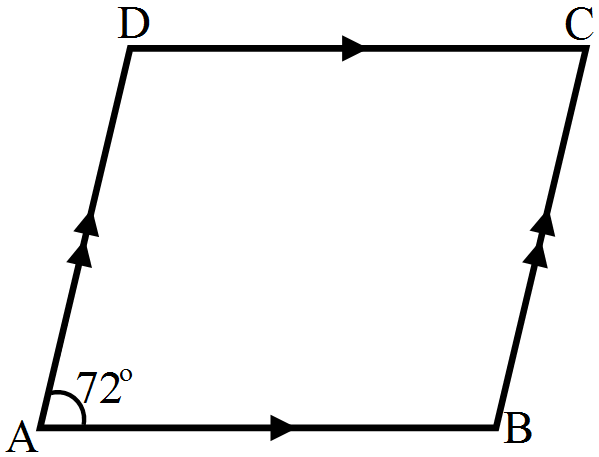
In the adjoining figure, ABCD is a parallelogram in which $\angle\text{A}=70^{\circ}.$ Calculate $\angle\text{B},\angle\text{C}$ and $\angle\text{D}.$

Using factor theorem, factorize the following polynomials:
x3 - 10x2 - 53x - 42
A right angled triangles of which the sides containing the right angle are 6.3cm and 10cm in length, is made to turn round on the longer side. Find the volume of the solid, thus generated. Also, find its curved surface area.
Factorize:
a2 + 2ab + b2 - c2
ABCD is a cyclic trapezium with AD || BC. If $\angle\text{B}=70^\circ,$determine other three angles of the trapezium.
Two dice are thrown simultaneously 500 times. Each time the sum of two numbers appearing on their tops is noted and recorded as given in the following table:
Sum
Frequency
2
3
4
5
6
7
8
9
10
11
12
14
30
42
55
72
75
70
53
46
28
15
If the dice are thrown once more, what is the probability of getting a sum:
  1. 3?
  2. More than 10?
  3. Less than or equal to 5?
  4. Between 8 and 12?
The sum of two angles of a triangle is equal to its third angle. Determine the measure of the third angle.
Show that in a quadrilateral ABCD, AB + BC + CD + DA > AC + BD
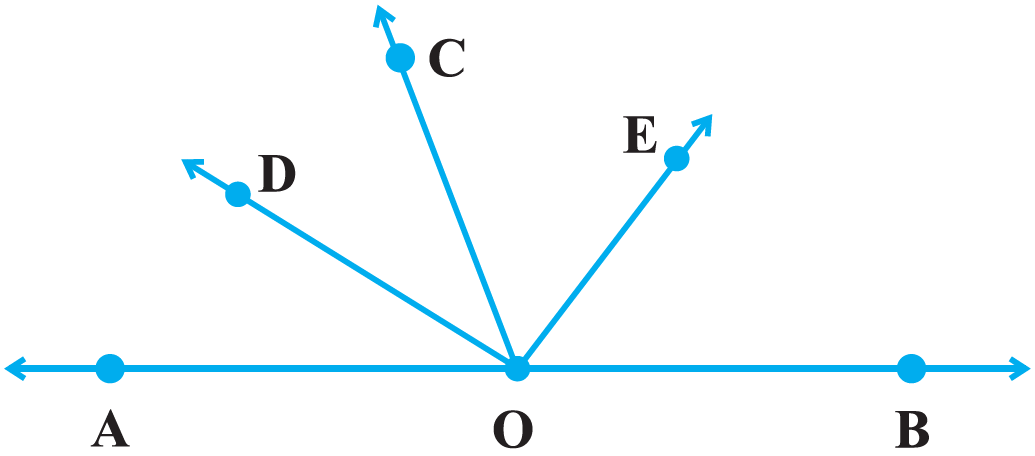
In Fig. OD is the bisector of $\angle\text{AOC},$ OE is the bisector of $\angle\text{BOC}$ and $\text{OD}\perp\text{OE}.$ Show that the points A, O and B are collinear.