Question
Factorize:
a2 + 2ab + b2 - c2

Answer

a2 + 2ab + b2 - c2
Using the identity (p + q)2 = p2 + q2 + 2pq
= (a + b)2 - c2
Using the identity p2 - q2 = (p + q)(p - q)
= (a + b + c)(a + b - c)
$\therefore$ a2 + 2ab + b2 - c2 = (a + b + c)(a + b - c)

Need a full question paper?

Generate a complete, print-ready paper with questions like this in minutes — across 16+ boards, with answer keys.

Start Generating Free

Similar questions

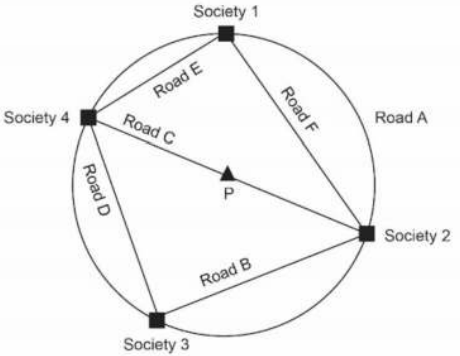
Two new roads, Road E and Road F were constructed between society 4 and 1 and society 1 and 2.
Image
1. What would be the measure of the sum of angles formed by the straight roads at society 1 and society 3?
2. Krish says, “The distance to go from society 4 to society 2 using Road D will be longer that the distance using Road E”
Is Krish correct? Justify your answer with examples.
3. Road G, perpendicular to Road F was constructed to connect the park and Road F.
Which of the following is true for Road G and Road F?
4. Priya said, “Minor arc corresponding to Road B is congruent to minor arc corresponding to Road D.”
Do you agree with Priya? Give reason to support your answer.
ABCD is a rhombus in which altitude from D to side AB bisects AB. Find the angles of the rhombus.
If ABC is an equilateral triangle inscribed in a circle and P be any point on the minor arc BC which does not coincide with B or C, prove that PA is angle bisector of $\angle\text{BPC}.$
Represent $\sqrt{6},\sqrt{7},\sqrt{8}$ on the number line.
If the bisector of the exterior vertical angle of a triangle be parallel to the base. Show that the triangle is isosceles.
A, B and C are three points on a circle. Prove that the perpendicular bisectors of AB, BC and CA are concurrent.
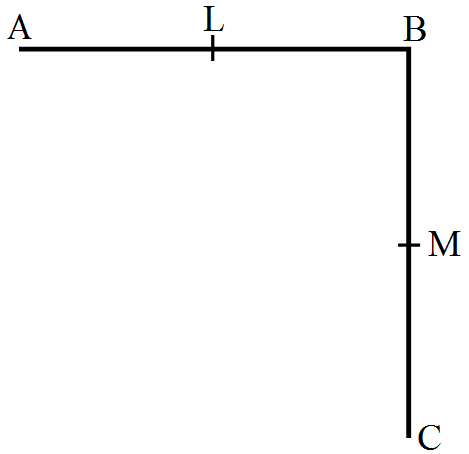
In the given figure, L and M are the mid-points of AB and BC respectively.

  1. If AB = BC, prove that AL = MC.
  2. If BL = BM, prove that AB = BC.
Hint:
  1. $\text{AB}=\text{BC}\Rightarrow\frac{1}{2}\text{AB}=\frac{1}{2}\text{BC}\Rightarrow\text{AL}=\text{MC}.$
  2. $\text{BL}=\text{BM}\Rightarrow2\text{BL}=2\text{BM}\Rightarrow\text{AB}=\text{BC}.$
Using factor theorem, factorize the following polynomials:
x3 - 2x2 - x + 2
Simplify:
$\frac{4+\sqrt{5}}{4-\sqrt{5}}+\frac{4-\sqrt{5}}{4+\sqrt{5}}$
Prove that a cyclic parallelogram is a rectangle.