Question
A square is inscribed in an isosceles right triangle so that the square and the triangle have one angle common. Show that the vertex of the square opposite the vertex of the common angle bisects the hypotenuse.
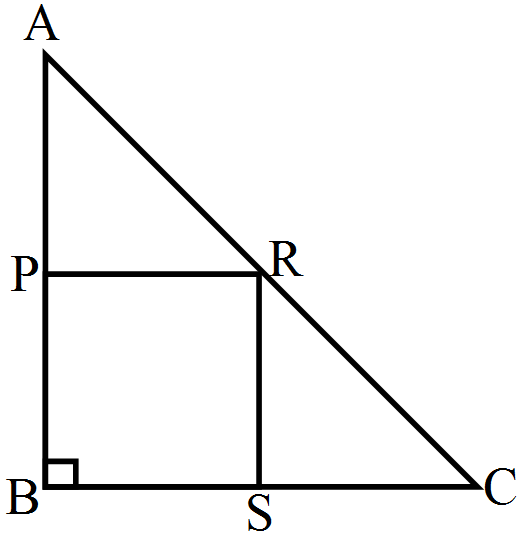 Let $\triangle\text{ABC}$ be an isosceles right triangle, right-angled at B.
Generate a complete, print-ready paper with questions like this in minutes — across 16+ boards, with answer keys.

Given: □PQRS and □MNRL are rectangles. M is the midpoint of side PR.