Question 14 Marks
In the adjoining figure, ABCD is a parallelogram and E is the midpoint of side BC. If DEand AB when produced meet at F, prove that AF = 2AB.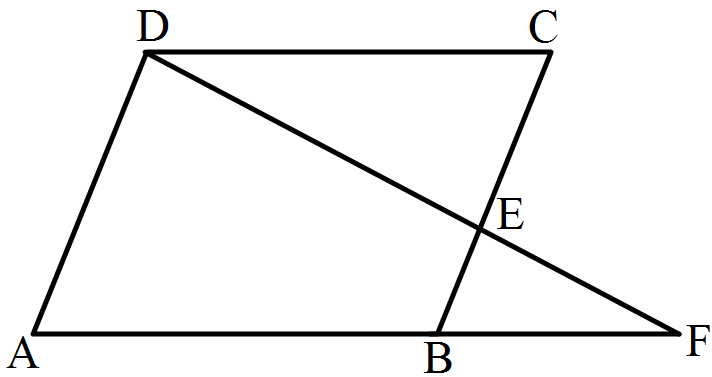
Answer
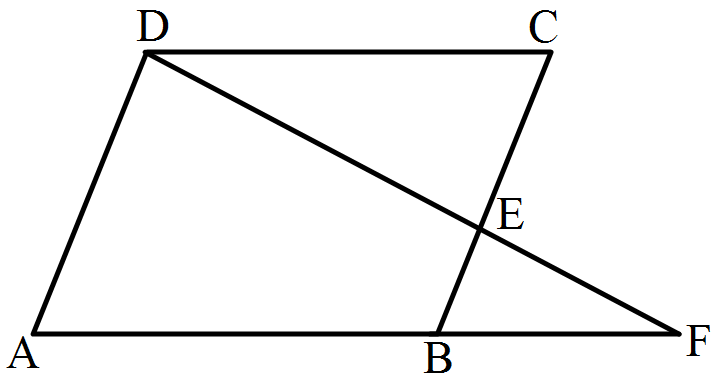 Given: A parrallelogram ABCD in which E is the mid point of side BC, DE and AB when produced meet at F.
To Prove: $\text{AF}=2\text{AB}$
Proof: In $\triangle\text{DEC}$ and $\triangle\text{FEB}$
$\angle\text{DEC}=\angle\text{FEB}$ [vertically opposite angles]
$\angle\text{DCE}=\angle\text{FBE}$ [alternate angles]
$\text{CE = EB}$ [Given]
Thus by Angle-Angle-Side criterion of congruence, we have
$\triangle\text{DEC}\cong\triangle\text{FEB}$ [By AAS]
The corresponding parts of the congruent triangle are equal.
$\therefore\text{DC = FB}$ [By C.P.C.T.]
So, $\text{AF = AB + BF}$
$=\text{AB + DC}$
$=\text{AB + AB}$
$=2\text{AB}$
$\therefore\text{AF}=2\text{AB}$
View full question & answer→Given: A parrallelogram ABCD in which E is the mid point of side BC, DE and AB when produced meet at F.To Prove: $\text{AF}=2\text{AB}$
Proof: In $\triangle\text{DEC}$ and $\triangle\text{FEB}$
$\angle\text{DEC}=\angle\text{FEB}$ [vertically opposite angles]
$\angle\text{DCE}=\angle\text{FBE}$ [alternate angles]
$\text{CE = EB}$ [Given]
Thus by Angle-Angle-Side criterion of congruence, we have
$\triangle\text{DEC}\cong\triangle\text{FEB}$ [By AAS]
The corresponding parts of the congruent triangle are equal.
$\therefore\text{DC = FB}$ [By C.P.C.T.]
So, $\text{AF = AB + BF}$
$=\text{AB + DC}$
$=\text{AB + AB}$
$=2\text{AB}$
$\therefore\text{AF}=2\text{AB}$
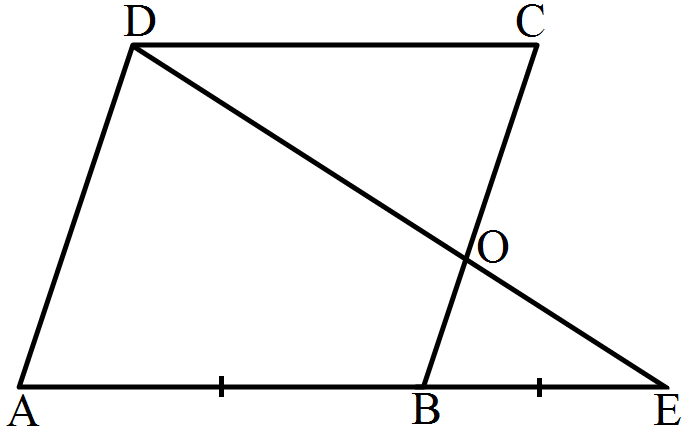
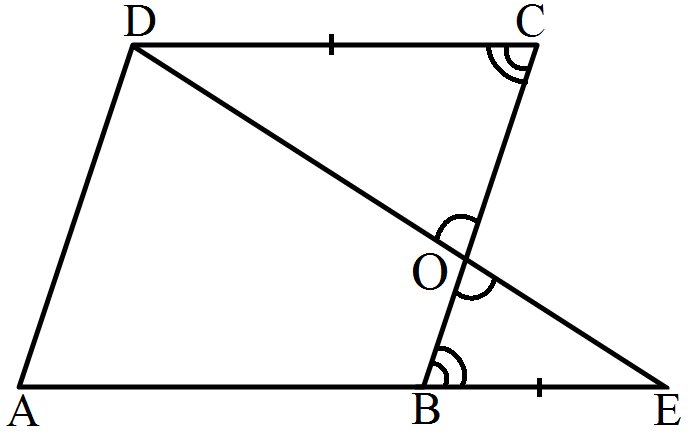
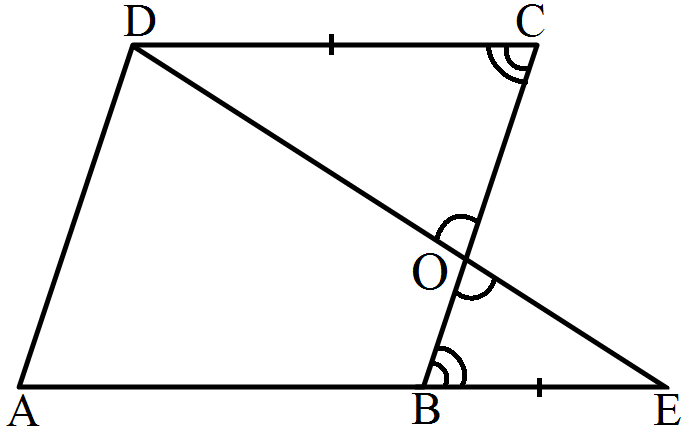 Given: ABCD is a parralegram in which AB is produced to E such that BE = AB. DE is joined which cuts BC at O.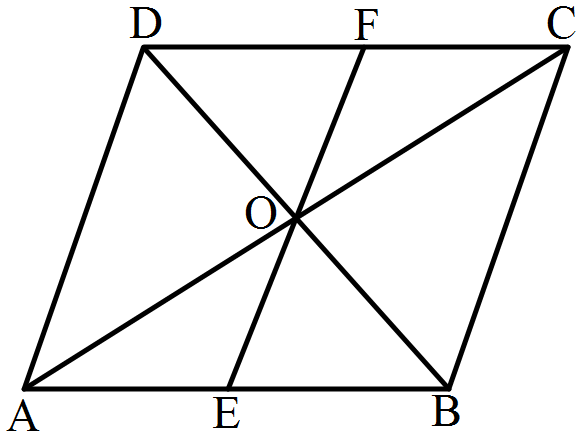
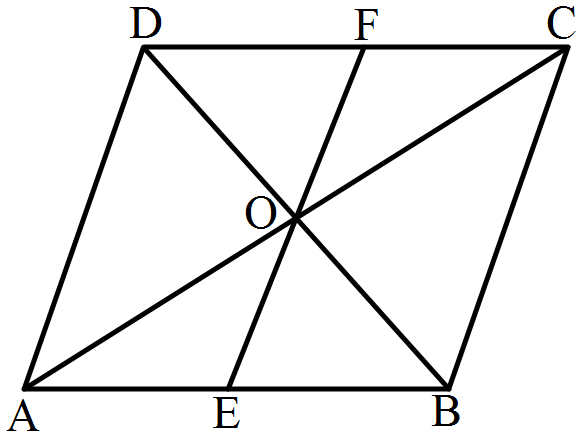 Given: A parallelogram ABCD, in which diagonals intersect at O. E and F are the points on AB and CD
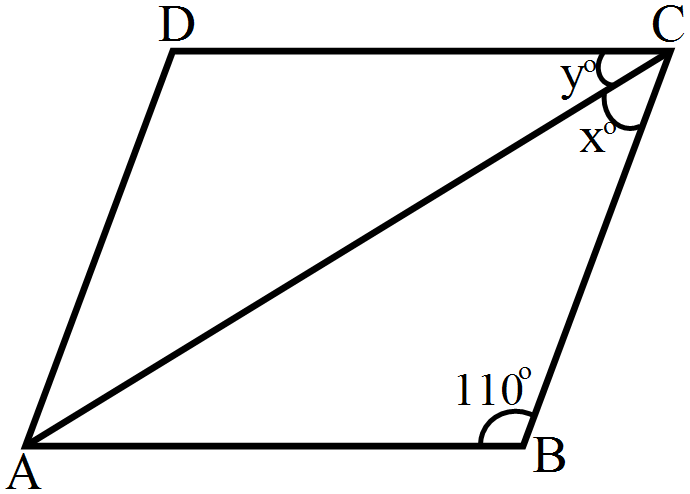
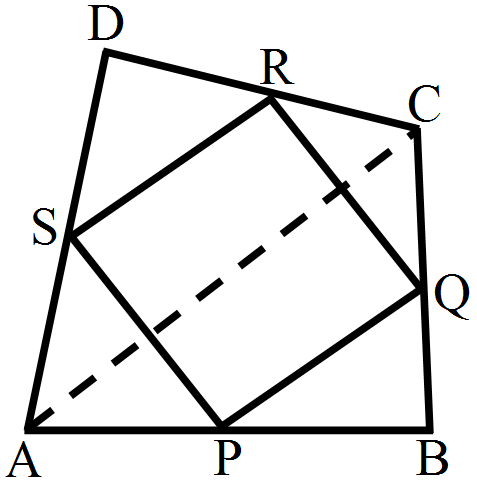
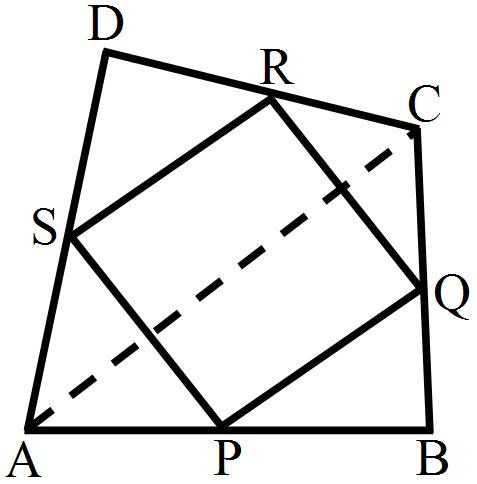
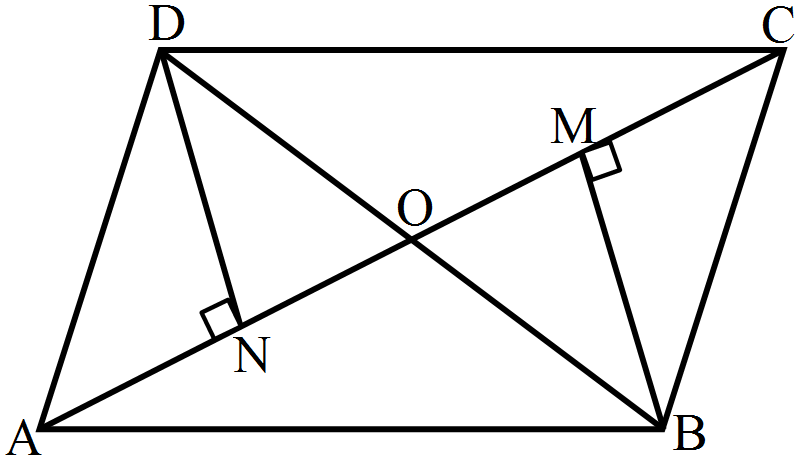
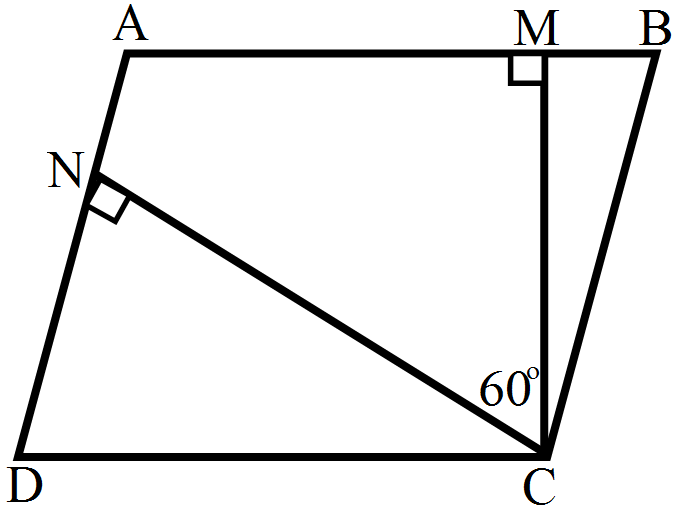 $\angle\text{DCM}=\angle\text{DCN}+\angle\text{MCN}$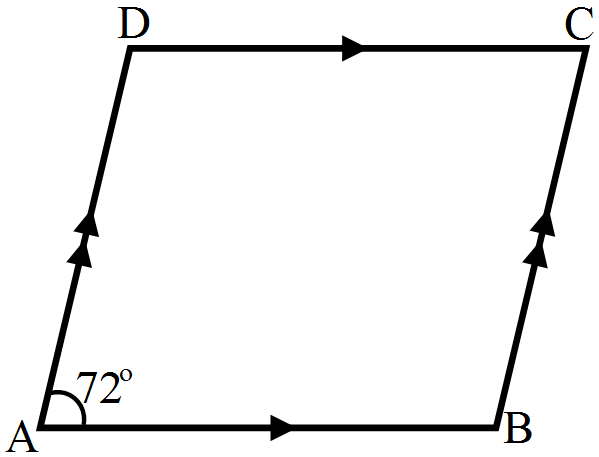
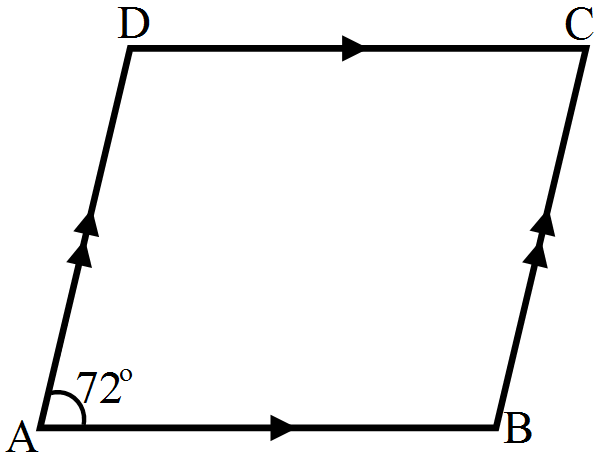 In a parallelogram, opposite angles are equal.$\therefore\angle\text{A}=\angle\text{C}=72^{\circ}$
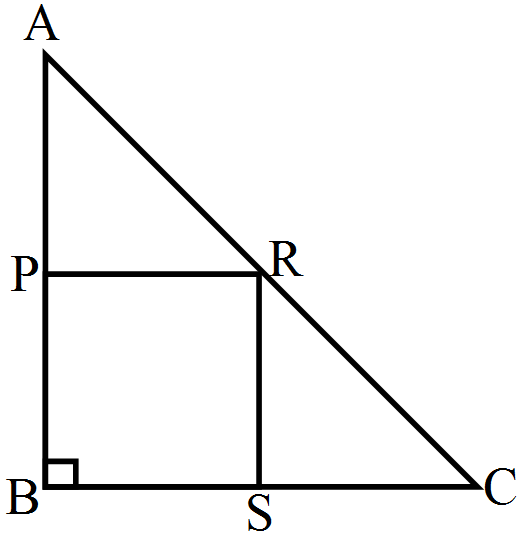 Let $\triangle\text{ABC}$ be an isosceles right triangle, right-angled at B.
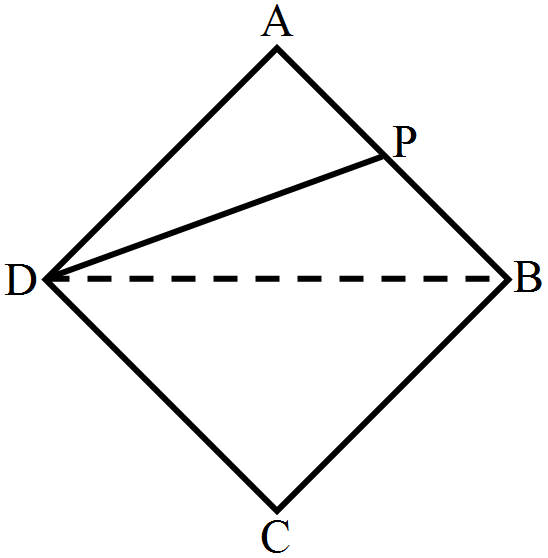 Let the altitude from D to the side AB bisect AB at point P.
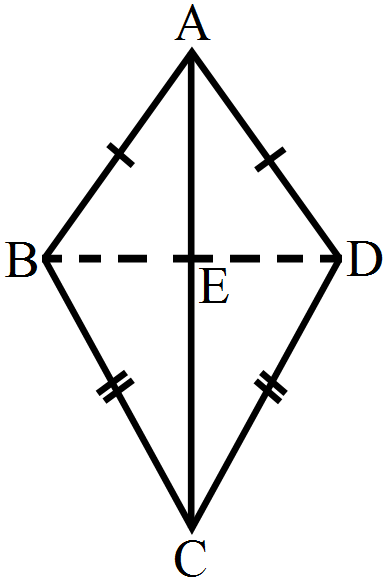
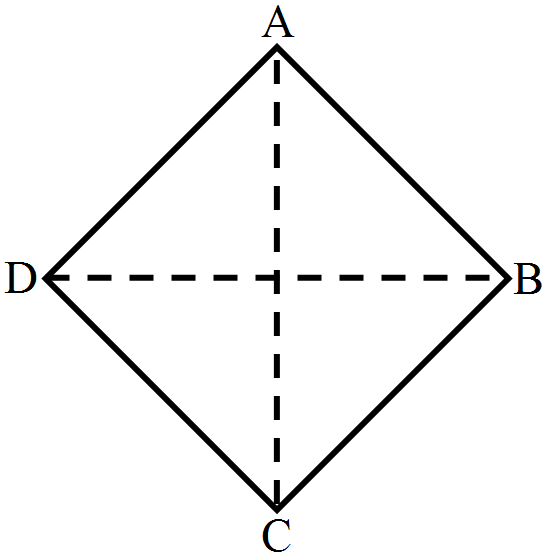 In $\triangle\text{ABC}$ and $\triangle\text{ADC},$
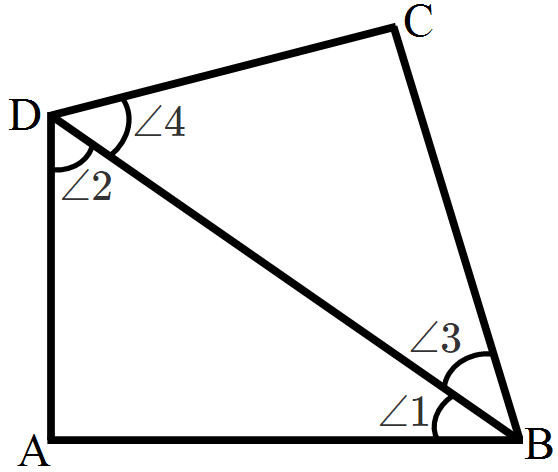 Let ABCD be a quadrilateral and $\angle1,\angle2,\angle3$ and $\angle4$ are its four angles as shown in the figure. Join BD which divides ABCD in two triangles, $\triangle\text{ABD}$ and $\triangle\text{BCD}.$ In $\triangle\text{ABD},$ we have:$\angle1+\angle2+\angle\text{A}=180^{\circ}..(\text{i})$
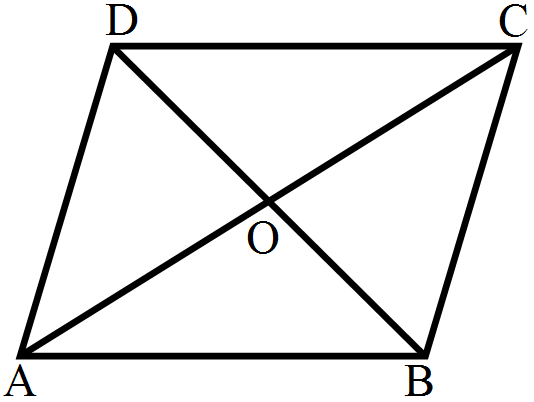 Now, by Pythagoras Theorem, we have$\text{AB}^{2}=\text{AO}^{2}+\text{OB}^2$