MCQ
A square loop, carrying a steady current $I,$ is placed in a horizontal plane near a long straight conductor carrying a steady current $I_1$ at a distance $d$ from the conductor as shown in figure. The loop will experience
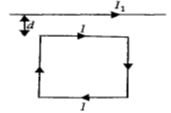
  • a net attractive force towards the conductor
  • B
    a net repulsive force away from the conductor
  • C
    a  net torque acting upward perpendicular to the horizontal plane
  • D
    a net torque acting downward normal to the horizontal plane
Answer

Correct option: A.
a net attractive force towards the conductor
a
$F_{2}=-F_{4}$

$F_{1}=\frac{\mu_{0} I_{1} \Pi}{2 \pi d l}$

$F_{2}=\frac{\mu_{0} I_{1} I}{2 \pi(d+l)}$

$F_{1}>F_{3}$

$F_{n e t}=F_{1}-F_{3}$

So, wire attract loop.

Need a full question paper?

Generate a complete, print-ready paper with questions like this in minutes — across 16+ boards, with answer keys.

Start Generating Free

Similar questions

A point source of light is placed at the bottom of a vessel, which is filled with water of refractive index $\mu$ to a height $h$. If a floating opaque disc has to be placed exactly above it, so that the source is invisible from above. The radius of the disc should be
At what point of a projectile motion acceleration and velocity are perpendicular to each other
According to Poiseuille's law, the pressure drop per unit length required (overcome viscous forces is $\Delta P =\frac{8 \eta v }{ r ^2}$, where $r$ is the radius of cross section, $v$ is the fluid velocity and $\eta$ is the coefficient of viscosity. A capillary tube of radius a is dipped in a liquid of density $\rho$, surface tension $T$ and coefficient of viscosity $\eta$. The liquid starts rising in it so that its height $h ( t )$ is a function of time t. The resulting rate of change of the momentum of liquid column in the capillary (taking vertically up to be positive direction and the contact angle to be close to $\left.0^{\circ}\right)$ is $-\pi a ^2 \rho gh + F$. Then $F$ is $[ g$ is the acceleration due to gravity):
A uniform magnetic field $B$ is acting from south to north and is of magnitude $1.5$ $Wb/{m^2}$. If a proton having mass $ = 1.7 \times {10^{ - 27}}\,kg$ and charge $ = 1.6 \times {10^{ - 19}}\,C$ moves in this field vertically downwards with energy $5\, MeV$, then the force acting on it will be
The two opposite faces of a cubical piece of iron (thermal conductivity $= 0.2\, CGS$ units) are at ${100^o}C$ and ${0^o}C$ in ice. If the area of a surface is $4c{m^2}$, then the mass of ice melted in $10$ minutes will be ...... $gm$
Which of these is unipolar transistor
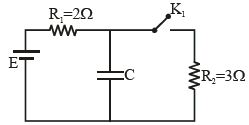
In the circuit shown in the figure $K_1$ is open. The charge on capacitor $C$ in steady state is $q_1$. Now key is closed and at steady state charge on $C$ is $q_2$. The ratio of charges $q_1/q_2$ is
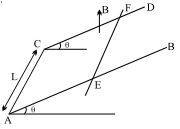
$AB$ and $CD$ are smooth parallel rails, separated by a distance $l$, and inclined to the horizontal at an angle $\theta$ . $A$ uniform magnetic field of magnitude $B$, directed vertically upwards, exists in the region. $EF$ is a conductor of mass $m$, carrying a current $i$. For $EF$ to be in equilibrium,
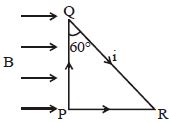
For the circuit shown in figure, the direction and magnitude of the force on $PQR$ is :-
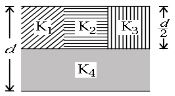
A parallel-plate capacitor of area $A,$ plate separation $d$ and capacitance $C$ is filled with four dielectric materials having dielectric constants $K_1,K_2,K_3$ and $K_4$ as shown in the figure. If a single dielectric material is to be used to have the same capacitance $C$ in this capacitor, then its dielectric constant $K$ is given by