MCQ
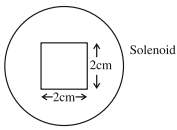
A square loop of side $2.0\,cm$ is placed inside a long solenoid that has $50$ turns per centimetre and carries a sinusoidally varying current of amplitude $2.5\,A$ and angular frequency $700\,rad\,s ^{-1}$. The central axes of the loop and solenoid coincide. The amplitude of the emf induced in the loop is $x \times 10^{-4} V$. The value of $x$ is $.........$(Take, $\pi=\frac{22}{7}$)
  • A
    $43$
  • B
    $42$
  • $44$
  • D
    $41$

Answer

Correct option: C.
$44$
c
$B _{\text {due to solenoid }}=\mu_0 nI$

$\Phi_{\text {through square }}=\mu_0 nI \times A \quad( A =\text { Area })$

$Emf =\mu_0 nA \times \frac{ dI }{ dt }$

$=\mu_0 n A \times I _0 \omega \cos \omega t$

$\text { Emf amplitude }=\mu_0 n A \times I _0 \omega$

$=4 \pi \times 10^{-7} \times \frac{50}{10^{-2}} \times 4 \times 10^{-4} \times 2.5 \times 700$

$=44 \times 10^{-4}\,V$

Need a full question paper?

Generate a complete, print-ready paper with questions like this in minutes — across 16+ boards, with answer keys.

Start Generating Free

Similar questions

$\frac{x}{x+4}$ is the ratio of energies of photons produced due to transition of an electron of hydrogen atom from its

$(i)$ third permitted energy level to the second level and $(ii)$ the highest permitted energy level to the second permitted level. The value of $x$ will be.

A circular coil of radius 4 cm and of 20 turns carries a current of 3 amperes. It is placed in a magnetic field of intensity of 0.5 weber/m$^2$. The magnetic dipole moment of the coil is
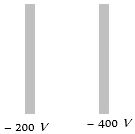
In the following figure two parallel metallic plates are maintained at different potential. If an electron is released midway between the plates, it will move
A convex lens is used to form an image of an object on a screen. If the upper half of the lens is blackened, so that it becomes opaque, then
Monochromatic green light of wavelength $5 \times {10^{ - 7}}m$ illuminates a pair of slits $1 \,mm$ apart. The separation of bright lines on the interference pattern formed on a screen $2\, m $ away is......$mm$
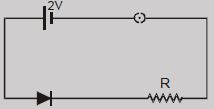
A $2\,V$ battery forward biases a diode. There is a drop of $0.5\,V$ across the diode which is independent of current. Also a current greater then $10\,mA$ produces large joule heat and damages diode. If diode is to be operated at $5\,mA,$ the series resistance to be put is
Following statements related to radioactivity are given below

$(A)$ Radioactivity is a random and spontaneous process and is dependent on physical and chemical conditions.

$(B)$ The number of un-decayed nuclei in the radioactive sample decays exponentially with time.

$(C)$ Slope of the graph of $\log _{e}$ (no. of undecayed nuclei) $Vs$. time represents the reciprocal of mean life time $(\tau)$.

$(D)$ Product of decay constant ( $\lambda$ ) and half-life time $\left(T_{1 / 2}\right)$ is not constant.

Choose the most appropriate answer from the options given below

A series $LCR$ circuit of $R=5\, \Omega, L=20\, {mH}$ and ${C}=0.5 \,\mu \,{F}$ is connected across an ${AC}$ supply of $250\, V$, having variable frequency. The power dissipated at resonance condition is $.....\,\times 10^{2}\, {W}$
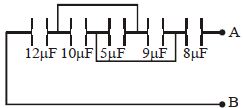
Five capacitors together with their capacitances are shown in the adjoining figure. The potential difference between the points $A$ and $B$ is $60\, volt.$ The equivalent capacitance between the point $A$ and $B$ and charge on capacitor $5\,\mu F$ will be respectively :-
Which of the following wiring diagrams could be used to experimentally determine $R$ using ohm's law? Assume an ideal voltmeter and an ideal ammeter.