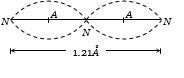
A standing wave having $3$ nodes and $2$ antinodes is formed between two atoms having a distance $1.21\;\mathring A$ between them. The wavelength of the standing wave is .... $\mathop A\limits^o $
AIIMS 2000,AIPMT 1998, Easy
Download our app for free and get started
(a) $\lambda = 1.21{Å}$

Download our appand get started for free
Experience the future of education. Simply download our apps or reach out to us for more information. Let's shape the future of learning together!No signup needed.*
Similar Questions
- 1Tube $A$ has both ends open while tube $B$ has one end closed, otherwise they are identical. The ratio of fundamental frequency of tube $A$ and $B$ isView Solution
- 2The length of a sonometer wire is $0.75\, m$ and density $9 \times 10^3\, kg/m^3$. It can bear a stress of $8.1 \times 10^8\, N/m^2$ without exceeding the elastic limit. What is the fundamental frequency that can be produced in the wire .... $Hz$ ?View Solution
- 3Two vibrating tuning forks produce progressive waves given by ${y_1} = 4\,\sin \,\left( {500\pi t} \right)$ and ${y_2} = 2\,\sin \,\left( {506\pi t} \right)$. These tuning forks are held near the ear of a person. The person will hear $\alpha \, beats/s$ with intensity ratio between maxima and minima equal to $\beta $. Find the value of $\beta - \alpha $View Solution
- 4View SolutionIf vibrations of a string are to be increased by a factor of two, then tension in the string must be made
- 5In an experiment to study standing waves, you use a string whose mass per length is $μ$ = $(1.0 ± 0.1) × 10^{-4}\ kg/m$ . You look at the fundamental mode, whose frequency $f$ is related to the length $L$ and tension $T$ of the string by the following equation $L$ = $\frac{1}{{2f}}\sqrt {\frac{T}{\mu }} $ You make a plot with $L$ on the $y-$ axis and $\sqrt T$ on the $x-$ axis, and find that the best fitting line is $y$ = $(8.0 ± 0.3) × 10^{-3}x + (0.2 ± 0.04)$ in $SI\ units$ . What is the value of the frequency of the wave (including the error)? Express your result in $SI\ unit\ (Hz)$View Solution
- 6The equations of two waves are given byView Solution
$y_{1}=5 \sin 2 \pi(x-v t) \,c m\,$
$y_{2}=3 \sin 2 \pi(x-v t+1.5) \,c m$
These waves are simultaneously passing through a string. The amplitude of the resulting wave is.........$cm$
- 7This question has Statement $1$ and Statement $2.$ Of the four choices given after the Statements, choose the one that best describes the two Statements.View Solution
Statement $1:$ In the resonance tube experiment, if the tuning fork is replaced by another identical turning fork but with its arm having been filled, the length of the air column should be increased to obtain resonance again.
Statement $2:$ On filling the arms, the frequency of a tuning fork increases.
- 8Two sinusoidal waves given below are superposedView Solution
$y_1=A \sin \left(k x-\omega t+\frac{\pi}{6}\right), \quad y_2=A \sin \left(k x-\omega t-\frac{\pi}{6}\right)$
The equation of resultant wave is
- 9While measuring the speed of sound by performing a resonance column experiment, a student gets the first resonance condition at a column length of $18\ cm$ during winter. Repeating the same experiment during summer, she measures the column length to be $x\ cm$ for the second resonance. ThenView Solution
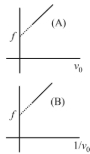
- 10A source of sound emits sound waves at frequency $f_0$. It is moving towards an observer with fixed speed $v_s$ ($v_s < v$, where $v$ is the speed of sound in air). If the observer were to move towards the source with speed $v_0$, one of the following two graphs ($A$ and $B$) will given the correct variation of the frequency $f$ heard by the observer as $v_0$ is changed The variation of $f$ with $v_0$ is given correctly byView Solution