MCQ
A stationary horizontal disc is free to rotate about its axis. When a torque is applied on it, its kinetic energy as a function of $\theta ,$ where $\theta $ is the angle by which it has rotated, is given as $k\theta ^2.$ If its moment of inertia is $I$ then the angular acceleration of the disc is
  • A
    $\frac {K}{I}\,\theta $
  • B
    $\frac {K}{2I}\,\theta $
  • C
    $\frac {K}{4I}\,\theta $
  • $\frac {2K}{I}\,\theta $

Answer

Correct option: D.
$\frac {2K}{I}\,\theta $
d
$Kinetic\,energy\,KE = \frac{1}{2}I{\omega ^2} = K{\theta ^2}$

$ \Rightarrow {\omega ^2} = \frac{{2k{\theta ^2}}}{I} \Rightarrow \omega  = \sqrt {\frac{{2k}}{I}} \theta \,\,\,\,\,\,\,\,\,\,\,...\left( A \right)$

$Differentiate\,\left( A \right)\,wrt\,time\, \to $

$\frac{{d\omega }}{{dt}} = \alpha  = \sqrt {\frac{{2k}}{I}} \left( {\frac{{d\theta }}{{dt}}} \right)$

$ \Rightarrow \alpha  = \sqrt {\frac{{2k}}{I}} .\sqrt {\frac{{2k}}{I}} \,\theta \left\{ {by\,\left( 1 \right)} \right\}$

$ \Rightarrow \alpha  = \frac{{2k}}{I}\theta $

Need a full question paper?

Generate a complete, print-ready paper with questions like this in minutes — across 16+ boards, with answer keys.

Start Generating Free

Similar questions

A long straight wire is carrying current $I_1$ in $+z$ direction. The $x-y$ plane contains a closed circular loop carrying current $I_2$ and not encircling the straight wire. The force on the loop will be:
The mass of the moon is $(1/8)$ of the earth but the gravitational pull is $(1/6)$ of the earth. It is due to the fact that.
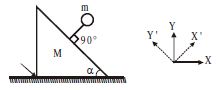
A ball of mass $m$ strikes the inclined face of the wedge normally with speed $v_0$. The wedge is at rest on a rough horizontal surface before collision. The conservation of momentum is applicable for the event of collision for

$(i)$ $m$ as system, along $Y'$
$(ii) $ $M$ as system, along $Y'$
$(iii)$ $(M + m)$ as system, along $X$
$(iv)$  $(M + m)$ as system, along $Y$
Which of the following is correct?

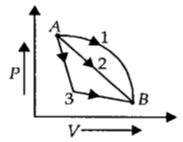
An ideal gas goes from state $A$ to state $B$ via three different processes as indicated in the $P-V$ diagram. If $Q_1, Q_2, Q_3$ indicate the heat absorbed by the gas along the three processes and $\Delta U_1, \Delta U_2, \Delta U_3$ 
indicate the change in internal energy along the three processes respectively, then 
A body is moving with a velocity $v$, breaks up into two equal parts. One of the part retraces back with velocity $v$. Then the velocity of the other part is
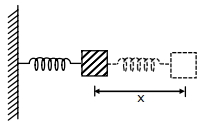
The motion of a mass on a spring, with spring constant ${K}$ is as shown in figure. The equation of motion is given by $x(t)= A sin \omega t+ Bcos\omega t$ with $\omega=\sqrt{\frac{K}{m}}$ Suppose that at time $t=0$, the position of mass is $x(0)$ and velocity $v(0)$, then its displacement can also be represented as $x(t)=C \cos (\omega t-\phi)$, where $C$ and $\phi$ are
If the binding energy of the electron in a hydrogen atom is $13.6\, eV,$ the energy required to remove the electron from the first excited state of $L{i^{ + + }}$ is.....$eV$
A photosensitive metallic surface is illuminated alternately with lights of wavelength $3100 \mathring A$ and $6200 \mathring A$. It is observed that maximum speeds of the photoelectrons in two cases are in ratio $2: 1$. The work function of the metal is ( $h c=12400 \,eV\mathring A$ )
When light travels from air to water and from water to glass, again from glass to $C{O_2}$ gas and finally through air. The relation between their refractive indices will be given by
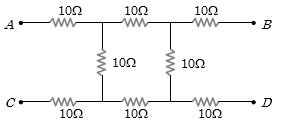
What will be the equivalent resistance between the two points $A$ and $D$ ............. $\Omega$