Question
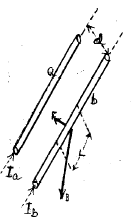
A steady current (I1) flows through a long straight wire. Another wire carrying steady current (I2) in the same direction is kept close and parallel to the first wire. Show with the help of a diagram how the magnetic field due to the current I1 exerts a magnetic force on the second wire. Write the expression for this force.
Answer


$\text{F}_{12} = \text{I}_{2}\text{IB}_{1}$

$\text{F}_{12} = \frac{\mu_{o}\text{I}_{1}\text{I}_{2}}{2\pi\text{d}}\text{l}$.

Need a full question paper?

Generate a complete, print-ready paper with questions like this in minutes — across 16+ boards, with answer keys.

Start Generating Free

Similar questions

A simple microscope is rated 5 for a normal relaxed eye. What will be its magnifying power for a relaxed farsighted eye whose near point is 40cm?
Two electric charges $+Q$ and $-Q(x-y)$ are placed at the points $\left(-x_2, 0\right)$ and $\left(x_1, 0\right)$ respectively in the plane. Find the magnitude and direction of the resultant electric field at the origin $(0,0)$.
A semicircular wire of radius 5.0cm carries a current of 5.0A. A magnetic field B of magnitude 0.50T exists along the perpendicular to the plane of the wire. Find the magnitude of the magnetic force acting on the wire.
Figure shows an electrolyte of AgCl through which a current is passed. It is observed that 2.68g of silver is deposited in 10 minutes on the cathode. Find the heat developed in the $20\Omega$ resistor during this period. Atomic weight of silver is 107.9g/mole.

Write a short note on visible rays.
A rigid wire consists of a semi-circular portion of radius R and two straight sections The wire is partially immersed in a perpendicular magnetic field B, as shown in the figure. Find the magnetic force on the wire if it carries a current i.

Suppose the tube in the previous problem is kept vertical with A upward but the other conditions remain the same. The separation between the cross- sections at A and B is $\frac{15}{16}\text{cm}.$ Repeat parts (a), (b) and (c) of the previous problem. Take g = 10m/s2.
A 100pF capacitor is charged to a potential difference of 24V. It is connected to an uncharged capacitor of capacitance 20pF. What will be the new potential difference across the 100pF capacitor?
Why do stable nuclei never have more protons than neutrons?
The phenomenon of diffraction is commonly seen in sound waves. But generally not in light waves, why?