Question
Write a short note on visible rays.

Answer

→Visible rays are the part of the EM spectrum which is detected by human eye.
→Frequency range: 4 $\times$ $10^{14}$ Hz to about 7 $\times$ $10^{14}$Hz.
→Wavelength range: About 700-400 nm (or 7000 A° to 4000 A°).
→The visible light emitted or reflected from objects around us provide us information about the world.
→Different animals are sensitive to different range of wave lengths. For example, Snakes can detect infrared waves, and the 'visible' range of many insects extends well into the ultra violet.

Need a full question paper?

Generate a complete, print-ready paper with questions like this in minutes — across 16+ boards, with answer keys.
Start Generating Free

Similar questions

What will be the radius of a conducting sphere having electric capacitance of one Farad?
In a Young's double slit experiment, two narrow vertical slits placed 0.800mm apart are illuminated by the same source of yellow light of wavelength 589nm. How far are the adjacent bright bands in the interference pattern observed on a screen 2.00m away?
Ultraviolet light is incident on two photosensitive materials having work functions W1 and W2 (W1 > W2). In which case will the kinetic energy of the emitted electrons be greater? Why?
Due to diffraction effects, the beam of ray gets focused as a spot of radius of approximately what value?
Explain characteristics of electric charge.
A magnetic needle free to rotate in a vertical plane parallel to the magnetic meridian has its north tip down at 60° with the horizontal. The horizontal component of the earth's magnetic field at the place is known to be 0.4 G. Determine the magnitude of the earth's magnetic field at the place.
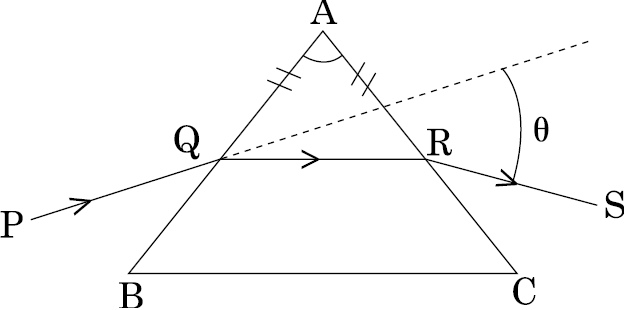
A ray PQ incident on the refracting face BA is refracted in the prism BAC as shown in the figure and emerges from the other refracting face AC as RS such that AQ = AR. If the angle of prism A = 60o and refractive index of material of prism is$\sqrt{3}$, calculate angle $\theta.$

Why does a phonograph-record attract dust particles just after it is cleaned?
Monochromatic light of frequency $6.0 \times 10^{14} Hz$ is produced by a laser. The power emitted is $2.0 \times 10^{-3} W$. (a) What is the energy of a photon in the light beam? (b) How many photons per second, on an average, are emitted by the source?
A convex lens of focal length f1 is kept in contact with a concave lens of focal length f2. Find the focal length of the combination.