A steel rod has a radius $10 \,mm$ and a length of $1.0 \,m$. A force stretches it along its length and produces a strain of $0.32 \%$. Young's modulus of the steel is $2.0 \times 10^{11} \,Nm ^{-2}$. What is the magnitude of the force stretching the rod is ........ $kN$
Medium


Download our appand get started for free
Experience the future of education. Simply download our apps or reach out to us for more information. Let's shape the future of learning together!No signup needed.*
Similar Questions
- 1The area of cross section of a steel wire $(Y = 2.0 \times {10^{11}}N/{m^2})$ is $0.1\;c{m^2}$. The force required to double its length will beView Solution
- 2A steel rod of length $\ell$, cross sectional area $A$, young's modulus of elasticity $Y$, and thermal coefficient of linear expansion $'a'$ is heated so that its temperature increases by $t\,^oC$. Work that can be done by rod on heating will beView Solution
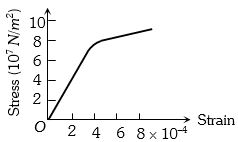
- 3Which one of the following is the Young’s modulus $($in $N/m^2)$ for the wire having the stress-strain curve shown in the figureView Solution
- 4$Assertion :$ Solids are least compressible and gases are most compressible.View Solution
$Reason :$ solids have definite shape and volume but gases do not have either definite shape or definite volume. - 5The breaking stress of aluminium is $7.5 \times 10^7 \,Nm ^{-2}$. The greatest length of aluminium wire that can hang vertically without breaking is $......... \times 10^3 \,m ($Density of aluminium is $2.7 \times 10^3 \,kg m ^{-3} )$View Solution
- 6The density and breaking stress of a wire are $6 \times$ $10^4 \mathrm{~kg} / \mathrm{m}^3$ and $1.2 \times 10^8 \mathrm{~N} / \mathrm{m}^2$ respectively. The wire is suspended from a rigid support on a planet where acceleration due to gravity is $\frac{1^{\text {rd }}}{3}$ of the value on the surface of earth. The maximum length of the wire with breaking is ............ $\mathrm{m}$ (take, $\mathrm{g}=$ $\left.10 \mathrm{~m} / \mathrm{s}^2\right)$View Solution
- 7A uniformly tapering conical wire is made from a material of Young's modulus $Y$ and has a normal, unextended length $L.$ The radii, at the upper and lower ends of this conical wire, have values $R$ and $3R,$ respectively. The upper end of the wire is fixed to a rigid support and a mass $M$ is suspended from its lower end. The equilibrium extended length, of this wire, would equalView Solution
- 8If a load of $9$ $kg$ is suspended on a wire, the increase in length is $4.5\, mm$. The force constant of the wire isView Solution
- 9A rod of length $l$ and area of cross-section $A$ is heated from $0°C$ to $100°C$. The rod is so placed that it is not allowed to increase in length, then the force developed is proportional toView Solution
- 10The stress-strain curves are drawn for two different materials $X$ and $Y$. It is observed that the ultimate strength point and the fracture point are close to each other for material $X$ but are far apart for material $Y$. We can say that materials $X$ and $Y$ are likely to be (respectively)View Solution