$Assertion :$ Solids are least compressible and gases are most compressible.
$Reason :$ solids have definite shape and volume but gases do not have either definite shape or definite volume.
$Reason :$ solids have definite shape and volume but gases do not have either definite shape or definite volume.
AIIMS 2017, Easy


Download our appand get started for free
Experience the future of education. Simply download our apps or reach out to us for more information. Let's shape the future of learning together!No signup needed.*
Similar Questions
- 1Two similar wires under the same load yield elongation of $0.1$ $mm$ and $0.05$ $mm$ respectively. If the area of cross- section of the first wire is $4m{m^2},$ then the area of cross section of the second wire is..... $mm^2$View Solution
- 2View SolutionIn materials like aluminium and copper, the correct order of magnitude of various elastic modulii is
- 3The pressure applied from all directions on a cube is $P$. How much its temperature should be raised to maintain the original volume $?$ The volume elasticity of the cube is $\beta $ and the coefficient of volume expansion is $\alpha $View Solution
- 4View SolutionWhich of the following affects the elasticity of a substance
- 5View SolutionIn the three states of matter, the elastic coefficient can be
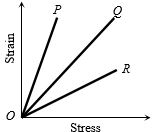
- 6The strain-stress curves of three wires of different materials are shown in the figure. $P, Q$ and $R$ are the elastic limits of the wires. The figure shows thatView Solution
- 7View SolutionIn suspended type moving coil galvanometer, quartz suspension is used because
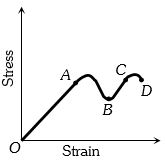
- 8View SolutionA graph is shown between stress and strain for a metal. The part in which Hooke's law holds good is
- 9A wire can be broken by applying a load of $20\, kg$ weight. The force required to break the wire of twice the diameter is .......... $kg\, wt$View Solution
- 10Two wire $A$ and $B$ are stretched by same force. If, for $A$ and $B, Y_A: Y_B=1: 2, r_A: r_B=3: 1$ and $L_A: L_B=4: 1$, then ratio of their extension $\left(\frac{\Delta L_A}{\Delta L_B}\right)$ will be .............View Solution