MCQ
A steel wire $1.5\,m$ long and of radius $1\,mm$ is attached with a load $3\,kg$ at one end the other end of the wire is fixed it is whirled in a vertical circle with a frequency $2\,Hz$ . Find the elongation of the wire when the weight is at the lowest position $(Y = 2 \times 10^{11}\,N/m^2$ and $g = 10\,m/s^2)$
  • $1.77 \times 10^{-3}\,m$
  • B
    $7.17 \times 10^{-3}\,m$
  • C
    $3.17 \times 10^{-7}\,m$
  • D
    $1.37 \times 10^{-7}\,m$

Answer

Correct option: A.
$1.77 \times 10^{-3}\,m$
a
At lower most position

Tension in wire $\mathrm{T}=\mathrm{Mg}+\mathrm{m} \omega^{2} \ell$

$\Delta \ell=\frac{\mathrm{FL}}{\mathrm{AY}}=\frac{\left(\mathrm{Mg}+\mathrm{m} \omega^{2} \ell\right) \ell}{\mathrm{AY}}$

$=\frac{\left[3 \times 10+3 \times(2 \times 3.14 \times 2)^{2} \times 1.5\right] \times 1.5}{3.14 \times\left(10^{-3}\right)^{2} \times 2 \times 10^{11}}$

$=1.77 \times 10^{-3} \mathrm{m}$

Need a full question paper?

Generate a complete, print-ready paper with questions like this in minutes — across 16+ boards, with answer keys.

Start Generating Free

Similar questions

If the mass of earth is $80$ times of that of a planet and diameter is double that of planet and $‘g’$ on earth is $9.8\,m/{s^2}$, then the value of $‘g’ $ on that planet is ........ $m/{s^2}$
An airplane airspeed indicator reads $100 \,m / s$ and its compass shows that it is heading $37^{\circ}$ east of north. The meteorological information provided to the navigator is that the wind velocity is $20 \,m / s$ towards east. The speed of the airplane relative to the ground is closest to ............ $\,m / s$
Newton’s law of cooling, holds good only if the temperature difference between the body and the surroundings is
In rear$-$wheel drive cars, the engine rotates the rear wheels and the front wheels rotate only because the car moves. If such a car accelerates on a horizontal road, the friction:
For any two vectors $\overrightarrow A $ and $\overrightarrow B $, if $\overrightarrow A \,.\,\overrightarrow B = \,\,|\overrightarrow A \times \overrightarrow B |,$ the magnitude of $\overrightarrow C = \overrightarrow A + \overrightarrow B $ is equal to
A particle of mass $10\, gm$ moves in a field where potential energy per unit mas is given by expression $v = 8 \times 10^4\, x^2\, erg/gm$. If the total energy of the particle is $8 \times 10^7\, erg$ then the relation between $x$ and time $t$ is
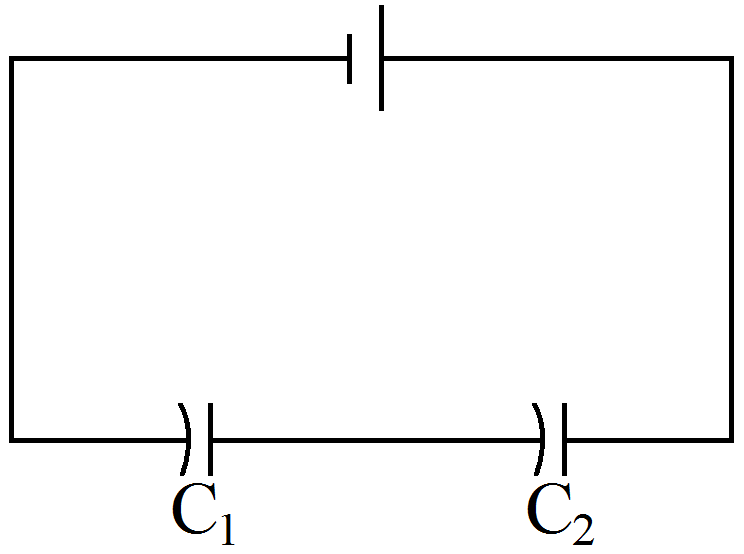
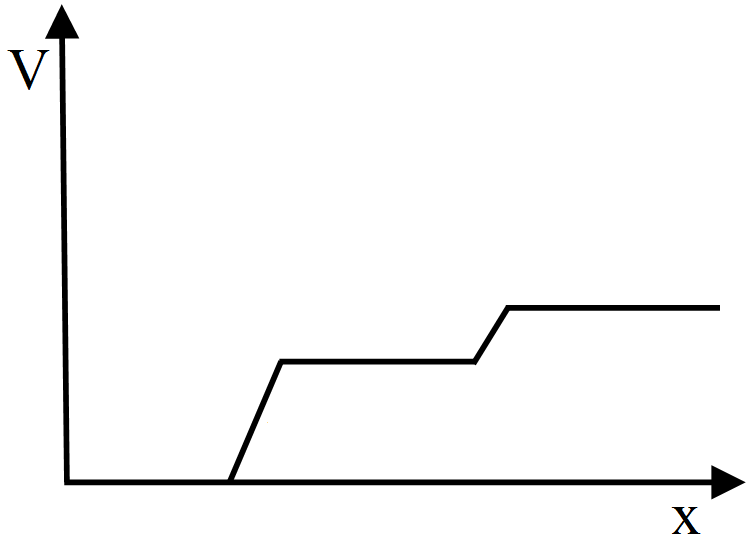
Figure shows two capacitors connected in series and joined to a battery. The graph shows the variation in potential as one moves from left to right on the branch containing the capacitors:

Time $(T)$, velocity $(C)$ and angular momentum $(h)$ are chosen as fundamental quantities instead of mass, length and time. In terms of these, the dimensions of mass would be
A ball is dropped from the top of a building of height $80 \,m$. At same instant another ball is thrown upwards with speed $50 \,m / s$ from the bottom of the building. The time at which balls will meet is ........ $s$
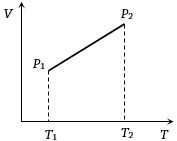
From the following $V-T$ diagram we can conclude