MCQ
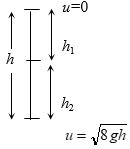
A stone is dropped from a height $h$. Simultaneously, another stone is thrown up from the ground which reaches a height $4 \,h$. The two stones cross each other after time
  • $\sqrt {\frac{h}{{8g}}} $
  • B
    $\sqrt {8g\,h} $
  • C
    $\sqrt {2g\,h} $
  • D
    $\sqrt {\frac{h}{{2g}}} $

Answer

Correct option: A.
$\sqrt {\frac{h}{{8g}}} $
a
(a) For first stone $u = 0$ and

For second stone $\frac{{{u^2}}}{{2g}} = 4h \Rightarrow {u^2} = 8gh$

$\therefore u = \sqrt {8gh} $

Now, ${h_1} = \frac{1}{2}g{t^2}$

${h_2} = \sqrt {8gh} t - \frac{1}{2}g{t^2}$

where, $t =$ time to cross each other.

$\because {h_1} + {h_2} = h$

==> $\frac{1}{2}g{t^2} + \sqrt {8gh} t - \frac{1}{2}g{t^2} = h$ ==> $t = \frac{h}{{\sqrt {8gh} }} = \sqrt {\frac{h}{{8g}}} $

Need a full question paper?

Generate a complete, print-ready paper with questions like this in minutes — across 16+ boards, with answer keys.

Start Generating Free

Similar questions

The electron emitted in beta radiation originates from
An electron beam in an $X-$ ray tube is accelerated through a potential difference of $50000$ volts. These are then made to fall on a tungsten target. The shortest wavelength of the $X-$ ray emitted by the tube is
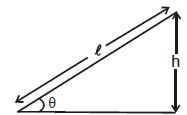
A smooth inclined plane is inclined at an angle $\theta$ with horizontal. A body starts from rest and slides down the inclined surface. Then the time taken by it to reach the bottom is
A conducting sphere of radius $10\, cm$ is charged $10\,\mu \,C$. Another uncharged sphere of radius $20\, cm$ is allowed to touch it for some time. After that if the sphere are separated, then surface density of charges, on the spheres will be in the ratio of
The mass of a ${}_3^7Li$ nucleus is $0.042\,\, u$ less than the sum of the masses of all its nucleons. The binding energy per nucleon of $^7_3 Li$ nucleus is nearly...........$MeV$
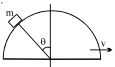
$A$ hemisphere of mass $3m$ and radius $R$ is free to slide with its base on a smooth horizontal table. $A$ particle of mass $m$ is placed on the top of the hemisphere. If particle is displaced with a negligible velocity, then find the angular velocity of the particle relative to the centre of the hemisphere at an angular displacement $\theta$ , when velocity of hemisphere is $v$.
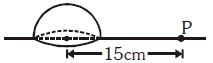
Figure shows a solid hemisphere with a charge of $5\ nC$ distributed uniformly through its volume. The hemisphere lies on a plane and point $P$ is located on this plane, along a radial line from the centre of curvature at distance $15\ cm$. The electric potential at point $P$ due to the hemisphere, is .....$V$
A proton and an electron are associated with same de-Broglie wavelength. The ratio of their kinetic energies is:
$($Assume $h = 6.63 \times 10^{–34} J s, m_e = 9.0 \times 10^{–31} \ kg$ and $m_p = 1836 \times m_e)$
Two equal negative charges $-\, q$ each are fixed at the points $(0, a)$ and $(0, -a)$ on the $Y$ -axis. A positive charge $Q$ is released from rest at the point $(2a, 0)$ on the $X$ -axis. The charge $Q$ will :-