MCQ
A stone is released from an elevator going up with an acceleration a. The acceleration of the stone after the release is:
  • A
    a upward.
  • B
    (g - a) upward.
  • C
    (g - a) downward.
  • g downward.

Answer

Correct option: D.
g downward.
Explanation:

Gravity is the only force acting on the stone when it is released. And, we know that gravity is always in the downward direction.

Need a full question paper?

Generate a complete, print-ready paper with questions like this in minutes — across 16+ boards, with answer keys.
Start Generating Free

Similar questions

One proton beam enters a magnetic field of $10^{-4}$ T normally, Specific charge = $10^{11}$C/kg. velocity = $10^7$m/s. What is the radius of the circle described by it
An electric dipole is placed in a uniform electric field. The net electric force on the dipole.
When a metallic surface is illuminated by a light of wavelength $\lambda,$ the stopping potential for the photoelectric current is $3\, V$. When the same surface is illuminated by light of wavelength $2\, \lambda$ the stopping potential is $1\, V$. The threshold wavelength for this surface is
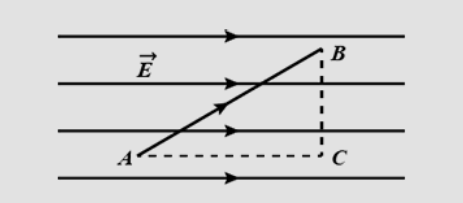
An electron is taken from point $A$ to point $B$ along the path $AB$ in a uniform electric field of intensity $E =10 Vm ^{-1}$. Side $AB = 5m$, and side $BC = 3m$. Then, the amount of work done on the electron by us is:
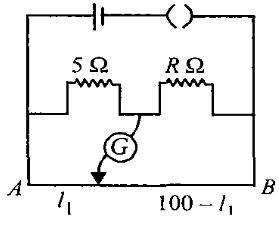
The resistances in the two arms of the meter bridge are $5 \,\Omega$ and $R \,\Omega$ respectively. When the resistance $R$ is shunted with an equal resistance, the new balance point is at $1.6\,l_1$. The resistance $R$ is ..................  $\Omega$
In a moving coil galvanometer, the deflection of the coil θ is related to the electrical current i by the relation
Two radioactive nuclei $P$ and $Q,$ in a given sample decay into a stable nucleus $R.$ At time $t = 0,$ number of $P$ species are $4\,\, N_0$ and that of $Q$ are $N_0$. Half-life of $P$ (for conversion to $R$) is $1$ minute where as that of $Q$ is $2$ minutes. Initially there are no nuclei of $R$ present in the sample. When number of nuclei of $P$ and $Q$ are equal, the number of nuclei of $R$ present in the sample would be
Critical angle of light passing from glass to air is minimum for which light
The parallel combination of two air filled parallel plate capacitors of capacitance $C$ and $nC$ is connected to a battery of voltage, $V$. When the capacitor are fully charged, the battery is removed and after that a dielectric material of dielectric constant $K$ is placed between the two plates of the first capacitor. The new potential difference of the combined system is
An electric dipole will experience a net force when it is placed in.