MCQ
An electric dipole will experience a net force when it is placed in.
  • A
    A uniform electric field.
  • A non$-$uniform electric field.
  • C
    Both $(a)$ and $(b).$
  • D
    None of these.

Answer

Correct option: B.
A non$-$uniform electric field.

Need a full question paper?

Generate a complete, print-ready paper with questions like this in minutes — across 16+ boards, with answer keys.

Start Generating Free

Similar questions

If the minimum wavelength obtained in an $X-$ ray tube is $2.5 \times {10^{ - 10}}m$, the operating potential of the tube will be.....$kV$
A double convex lens has power $P$ and same radii of curvature $R$ of both the surfaces. The radius of curvature of a surface of a plano-convex lens made of the same material with power $1.5P$ is ......$R$
The number of dry cells, each of $e.m.f.$ $1.5\,volt$ and internal resistance $0.5\, ohm$ that must be joined in series with a resistance of $20\, ohm$ so as to send a current of $0.6\,A$ through the circuit is
A bar magnet of magnetic moment $1.5\,A \times m^2$ lies aligned with the direction of a uniform magnetic field of $2\,Tesla$. What is the amount of work required to turn the magnet so as to align itsmagnetic moment normal to the field direction....$J$
A man can see the object between $15\, cm$ and $30\, cm$. He uses the lens to see the far objects. Then due to the lens used, the near point will be at........$cm$
In Gallilean telescope, if the powers of an objective and eye lens are respectively $+1.25\, D$ and $-20 \,D$, then for relaxed vision, the length and magnification will be
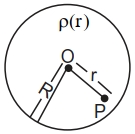
A spherically symmetric charge distribution is considered with charge density varying as

$\rho(r)=\left\{\begin{array}{ll}\rho_{0}\left(\frac{3}{4}-\frac{r}{R}\right) & \text { for } r \leq R \\ \text { Zero } & \text { for } r>R\end{array}\right.$

Where, $r ( r < R )$ is the distance from the centre $O$ (as shown in figure). The electric field at point $P$ will be.
A proton (mass $m$ and charge $+e$) and an $\alpha - $particle (mass $4m$ and charge $+2e$) are projected with the same kinetic energy at right angles to the uniform magnetic field. Which one of the following statements will be true
A proton with a kinetic energy of $2.0\,eV$ moves into a region of uniform magnetic field of magnitude $\frac{\pi}{2} \times 10^{-3}\,T$. The angle between the direction of magnetic field and velocity of proton is $60^{\circ}$. The pitch of the helical path taken by the proton is $..........cm$ (Take, mass of proton $=1.6 \times 10^{-27}\,kg$ and Charge on proton $=1.6 \times 10^{-19}\,kg)$
The mass defect per nucleon is called