MCQ
A stone ties to the end of a string $1\,m$ long is whirled in a horizontal circle with a constant speed. If the stone makes $22$ revolution in $44$ seconds, what is the magnitude and direction of acceleration of the stone
  • A
    $\frac{{{\pi ^2}}}{4}\;m{s^{ - 2}}$ and direction along the radius towards the centre
  • B
    ${\pi ^2}\;m{s^{ - 2}}$ and direction along the radius away from the centre
  • ${\pi ^2}\;m{s^{ - 2}}$ and direction along the radius towards the centre
  • D
    ${\pi ^2}\;m{s^{ - 2}}$ and direction along the tangent to the circle
Answer

Correct option: C.
${\pi ^2}\;m{s^{ - 2}}$ and direction along the radius towards the centre
c
(c) $a  = \frac{{{v^2}}}{r} = {\omega ^2}r$ $ = 4{\pi ^2}{n^2}r = 4{\pi ^2}{\left( {\frac{{22}}{{44}}} \right)^2} \times 1$ $ = {\pi ^2}\,m/{s^2}$

and its direction is always along the radius and towards the centre.

Need a full question paper?

Generate a complete, print-ready paper with questions like this in minutes — across 16+ boards, with answer keys.

Start Generating Free

Similar questions

The electric potential decreases uniformly from $120V$ to $80V$ as one moves on the $x-$axis from $x = -1\ cm$ to $x = + 1\ cm.$ The electric field at the origin.
The temperature of a solid object is observed to be constant during a period. In this period:
A table tennis ball has radius $(3 / 2) \times 10^{-2} m$ and mass $(22 / 7) \times 10^{-3} kg$. It is slowly pushed down into a swimming pool to a depth of $d=0.7 m$ below the water surface and then released from rest. It emerges from the water surface at speed $v$, without getting wet, and rises up to a height $H$. Which of the following option(s) is (are) correct?

[Given: $\pi=22 / 7, g=10 ms ^{-2}$, density of water $=1 \times 10^3 kg m ^{-3}$, viscosity of water $=1 \times 10^{-3} Pa$-s.]

$(A)$ The work done in pushing the ball to the depth $d$ is $0.077 J$.

$(B)$ If we neglect the viscous force in water, then the speed $v=7 m / s$.

$(C)$ If we neglect the viscous force in water, then the height $H=1.4 m$.

$(D)$ The ratio of the magnitudes of the net force excluding the viscous force to the maximum viscous force in water is $500 / 9$.

When a body of mass $1.0\, kg$ is suspended from a certain light spring hanging vertically, its length increases by $5\, cm$. By suspending $2.0\, kg$ block to the spring and if the block is pulled through $10\, cm$ and released the maximum velocity in it in $m/s$ is : (Acceleration due to gravity $ = 10\,m/{s^2})$
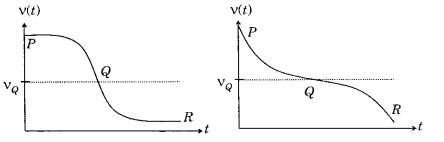
Two loudspeakers $M$ and $N$ are located $20 \mathrm{~m}$ apart and emit sound at frequencies $118 \mathrm{~Hz}$ and $121 \mathrm{~Hz}$, respectively. $A$ car is initially at a point $P, 1800 \mathrm{~m}$ away from the midpoint $Q$ of the line $M N$ and moves towards $Q$ constantly at $60 \mathrm{~km} / \mathrm{hr}$ along the perpendicular bisector of $M N$. It crosses $Q$ and eventually reaches a point $R, 1800(m$ away from $Q$. Let $v(t)$ represent the beat frequency measured by a person sitting in tlie car at time $t$. Let $v_P, v_Q$ and $v_R$ be the beat frequencies measured at locations $P . Q$ and $R$, respectively. The speed of sound in air is $330 \mathrm{~m} \mathrm{~s}^{-1}$. Which of the following statement($s$) is(are) true regarding the sound heard by the person?

($A$) $v_P+v_R=2 v_Q$

($B$) The rate of change in beat frequency is maximum when the car passes through $Q$

($C$) The plot below represents schematically the variation of beat frequency with time

(image)

($D$) The plot below represents schematically the variation of beat frequency with time

(image)

$200\,g$ water is heated from $40\,^oC$ to $60\,^oC.$ Ignoring the slight expansion of water, the change in its internal energy is close to ...... $kJ$ (Given specific heat of water $=4184\,J/kgK$ )
A pipe $30 cm$ long is open at both ends. Which harmonic mode of the pipe is resonantly excited by a $1.1 kHz$ source ? (Take speed of sound in air =$ 330 ms^{-1}$)
A particle moves in a circular path of radius $r$ with speed $v.$ It then increases its speed to $2\,v$ while travelling along the same circular path. The centripetal acceleration of the particle has changed by a factor of
$A$ yo-yo is resting on a rough horizontal table. Forces $F_1, F_2$ and $F_3$ are applied separately as shown. The correct statement is
A particle of mass $10\ kg$ is moving in a straight line. If its displacement, $x$ with time $t$ is given by $x = (t^3 - 2t - 10)m,$ then the force acting on it at the end of $4$ seconds is: