Question
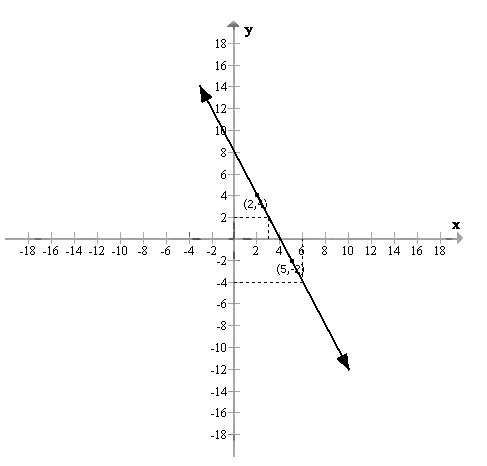
A straight line passes through the points $(2, 4)$ and $(5, - 2).$ Taking $1 \ cm = 1$ unit; mark these points on a graph paper and draw the straight line through these points. If points $(m, - 4)$ and $(3, n)$ lie on the line drawn; find the values of $m$ and $n.$
Answer

The table is:
$X$ $2$ $3$ $5$ $m$
$Y$ $4$ $n$ $- 2$ $- 4$
Plotting the points as shown in the above table,
we get the following required graph:

Plotting the points in the graph we get the above required graph.
Now draw a line$ x = 3$, parallel to$ y-$axis to meet the line
It meets the line at$ y = 2$ and therefore, $n = 2$
Now draw a line$ y = -4$, parallel to $x-$axis to meet the line
It meets the line at $x = 6$ and therefore, $m = 6$
Thus the values of $m$ and $n$ are $6$ and $2$ respectively.

Need a full question paper?

Generate a complete, print-ready paper with questions like this in minutes — across 16+ boards, with answer keys.

Start Generating Free

Similar questions

Construct a rectangle $\text{ABCD},$ when :Area $= 36 \ cm^2$ and height $= 4.5 \ cm$.
A boy played $100$ games, gaining $Rs. 50$ on each game that he won, and losing $Rs. 20$ for each game that he lost. If on the whole he gained $Rs. 800,$ find the number of games that he won.
"Area $A$ oof a circular ring formed by $2$ concentric circles is equal to the product of pie and the difference of the square of the bigger radius $R$ and the square of the bigger radius $R$ and the square of the smaller radius $r.$ Express the above statement as a formula. Make $r$ the subject of the formula and find $r$, when $A = 88 sq \ cm$ and $R = 8 \ cm$.
In the parallelogram $\text{ABCD},$ the angles $A$ and $C$ are obtuse. Points $X$ and $Y$ are taken on the diagonal $BD$ such that the angles $XAD$ and $YCB$ are right angles.Prove that: $XA = YC.$
In a quadrilateral $\text{ABCD}, \angle B=90^{\circ}$ and $\angle D=90^{\circ}$.Prove that: $2 A C^2-A B^2=B C^2+C D^2+D A^2$
Find $AB.$
Separate the rationals and irrationals from among the following numbers:
(i) [-8, (ii ) $\sqrt{25}$, (iii) $\frac{-3}{5}$, (iv)$\frac{-3}{5}$, (v) 0, (vi) $\pi$, (vii) $\sqrt[3]{5}$, (viii) $2 . \overline{4}$, (ix) $-\sqrt{3}$]
A kite is attached to a $100\ m$ long string. Find the greatest height reached by the kite when its string makes an angles of $60^\circ$ with the level ground.
In the following equations, verify if the given value is a solution of the equation: $\frac{3 x-1}{4}+\frac{3}{4}=2 ; x= 2$
Evaluate : $(64)^{\frac{2}{3}}-\sqrt[3]{125}-\frac{1}{2^{-5}}+(27)^{-\frac{2}{3}} \times\left(\frac{25}{9}\right)^{-\frac{1}{2}} \mathrm{}$