Question 14 Marks
Draw the graph $($straight line$)$ given by equation $x - 3y = 18$. If the straight line is drawn passes through the points $(m, - 5)$ and $(6, n);$ find the values of $m$ and $n.$
AnswerConsider the equation
$x - 3y = 18$
$\Rightarrow - 3y = 18 - x$
$\Rightarrow 3y = x - 18$
$\Rightarrow y =\frac{x-18}{3}$
The table for $x - 3y = 18$ is
| $X$ |
$9$ |
$0$ |
$6$ |
$3$ |
| $Y$ |
$- 3$ |
$- 6$ |
$- 4$ |
$- 5$ |
Plotting the above points, we get the following required graph:
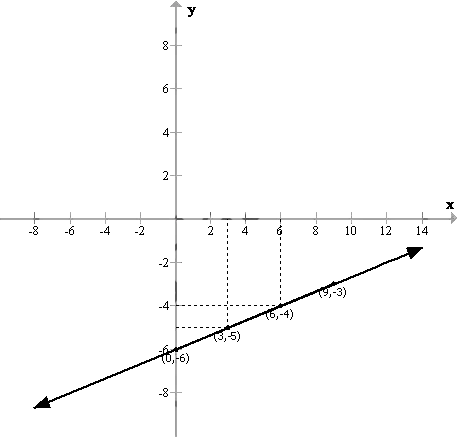
From the above figure, we have $m = 3$ and $n = - 4.$ View full question & answer→Question 24 Marks
Use the graphical method to find the value of $k$, if:$(5, k - 2)$ lies on the straight line $x - 2y + 1 = 0$
Answer$x - 2y + 1 = 0$
$\Rightarrow 2y = x + 1$
$\Rightarrow y=\frac{x+1}{2}$
The table for $ x - 2y + 1 = 0$ is
| $X$ |
$1$ |
$3$ |
$5$ |
| $Y$ |
$1$ |
$2$ |
$3$ |
Plotting the above points in a graph, we get the following graph:
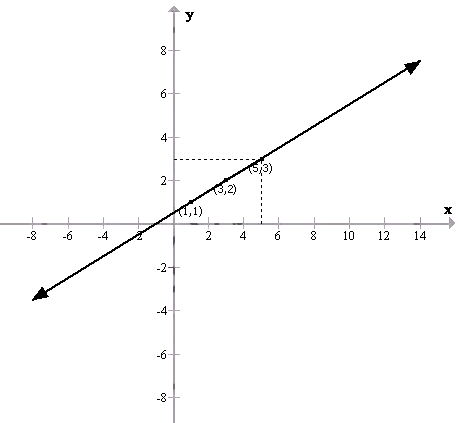
From the above graph, it is clear that
$k - 2 = 3$
$\Rightarrow k = 5.$ View full question & answer→Question 34 Marks
Use the graphical method to find the value of $k$, if:$(k, -3)$ lies on the straight line $2x + 3y = 1$
Answer$2x + 3y = 1$
$\Rightarrow 3y = 1 - 2x$
$\Rightarrow y =\frac{1-2 x}{3}$
The table for $2x + 3y = 1$ is
| $X$ |
$- 1$ |
$2$ |
$5$ |
| $Y$ |
$1$ |
$- 1$ |
$- 3$ |
Plotting the above points in a graph, we get the following graph:
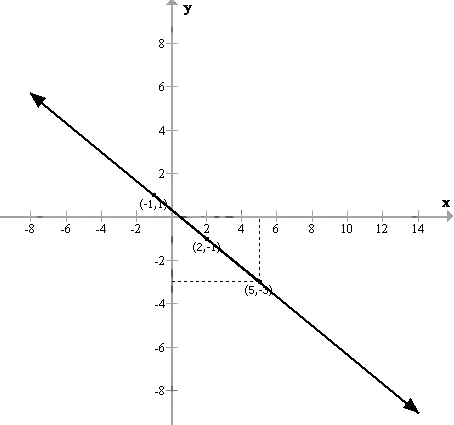
From the above graph, it is clear that $k = 5$ View full question & answer→Question 44 Marks
The cost of manufacturing $x$ articles is $Rs.(50 + 3x)$. The selling price of $x$ articles is $Rs. 4x.$On a graph sheet, with the same axes, and taking suitable scales draw two graphs, first for the cost of manufacturing against no. of articles and the second for the selling price against the number of articles.Use your graph to determine:The profit or loss made when $(a) 30\ (b) 60$ articles are manufactured and sold.
AnswerGiven that $C.P.$ is $50 + 3x$
Table of $C.P.$
| $X$ |
$0$ |
$10$ |
$20$ |
$30$ |
$40$ |
$50$ |
$60$ |
| $C.P.$ |
$50$ |
$80$ |
$110$ |
$140$ |
$170$ |
$200$ |
$230$ |
and $S.P. = 4x$
$\therefore $ Table of $S.P.$
| $X$ |
$0$ |
$10$ |
$20$ |
$30$ |
$40$ |
$50$ |
$60$ |
| $S.P.$ |
$0$ |
$40$ |
$80$ |
$120$ |
$160$ |
$200$ |
$240$ |
Now plot the points on a graph and we get the following required graph:
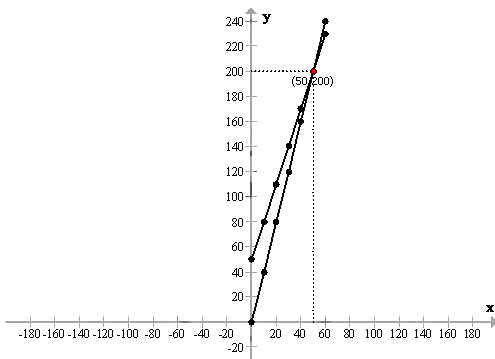
$(a)$
On article $30,$
$C.P. = Rs.140$ and $S.P. = 120$
Therefore Loss $= 140 - 120 = Rs. 20$
$(b)$On article $60,$
$C.P.= Rs. 230$ and $S.P.= Rs. 240$
Therefore Profit $= 240 - 230 = Rs.10$
View full question & answer→Question 54 Marks
The cost of manufacturing $x$ articles is $Rs. (50 + 3x)$. The selling price of $x$ articles is $Rs. 4x$.On a graph sheet, with the same axes, and taking suitable scales draw two graphs, first for the cost of manufacturing against no. of articles and the second for the selling price against the number of articles.Use your graph to determine:No. of articles to be manufactured and sold to break even $($no profit and no loss$)$.
AnswerGiven that $C.P.$ is 4
Table of $C.P.$
| $X$ |
$0$ |
$10$ |
$20$ |
$30$ |
$40$ |
$50$ |
$60$ |
| $C.P.$ |
$50$ |
$80$ |
$110$ |
$140$ |
$170$ |
$200$ |
$230$ |
and $S.P. = 4x$
$\therefore $ Table of $S.P.$
| $X$ |
$0$ |
$10$ |
$20$ |
$30$ |
$40$ |
$50$ |
$60$ |
| $S.P.$ |
$0$ |
$40$ |
$80$ |
$120$ |
$160$ |
$200$ |
$240$ |
Now plot the points on a graph and we get the following required graph:
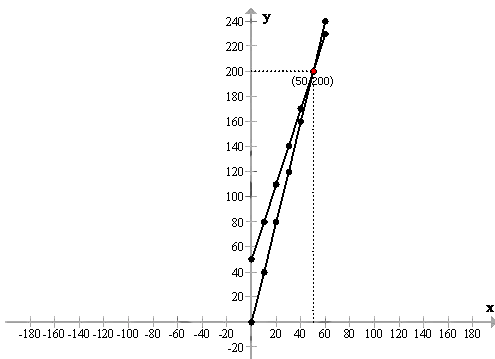
No. of articles to be manufactured and sold are $50$ when there is no loss and no profit.
$C.P. = S.P = Rs. 200.$ View full question & answer→Question 64 Marks
Using a scale of $1 \ cm$ to $1$ unit for both the axes, draw the graphs of the following equations$: 6y = 5x + 10, y = 5x - 15.$From the graph find :$(i)$ the coordinates of the point where the two lines intersect;$(ii)$ the area of the triangle between the lines and the $x-$ axis.
Answer$6y = 5x + 10$
$\Rightarrow y=\frac{5 x+10}{6}$
The table of $6y = 5x + 10$ is
| $X$ |
$4$ |
$- 2$ |
$- 8$ |
| $Y$ |
$5$ |
$0$ |
$- 5$ |
Also, we have
$y = 5x - 15$
The table of $y = 5x - 15$ is
| $X$ |
$3$ |
$4$ |
$5$ |
| $Y$ |
$0$ |
$5$ |
$10$ |
Plotting the points in a graph, we get the following graph.
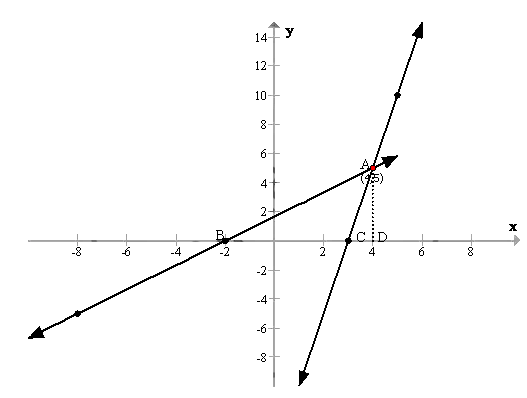
$(i)$ The two lines intersect at $(4, 5)$
$\therefore AD \perp BC$
$AD = 5$ units and $BC = 5$ units
$(ii)$ The area of the triangles $=\frac{1}{2} \times BC \times AD$
$=\frac{1}{2} \times 5 \times 5$
$=\frac{25}{2} \text { sq.}$units
$=12.5 \text { sq. }$units View full question & answer→Question 74 Marks
By drawing a graph for each of the equations $3x + y + 5 = 0; 3y - x = 5$ and $2x + 5y = 1$ on the same graph paper; show that the lines given by these equations are concurrent $($i.e. they pass through the same point$)$. Take $2 \ cm = 1$ unit on both the axes.
Answer$3x + y + 5 = 0$
$\Rightarrow y = - 3x - 5$
The table of $3x + y + 5 = 0$ is
| $X$ |
$1$ |
$- 3$ |
$- 2$ |
| $Y$ |
$- 8$ |
$4$ |
$1$ |
$3y - x = 5$
$\Rightarrow x = 3y - 5$
The table of $3y - x = 5$ is
| $X$ |
$- 2$ |
$1$ |
$7$ |
| $Y$ |
$1$ |
$2$ |
$4$ |
$2x + 5y = 1$
$\Rightarrow 2x = 1 - 5y$
$\Rightarrow x=\frac{1-5 y}{2}$
The table of $2x + 5y = 1$ is
| $X$ |
$3$ |
$- 7$ |
$- 2$ |
| $Y$ |
$- 1$ |
$3$ |
$1$ |
Plotting the above points, we get the following required graph:
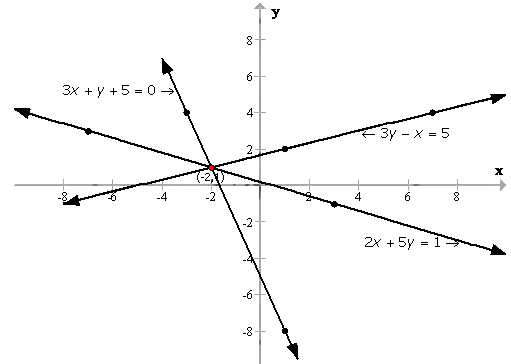
The graph shows that the lines of these equations are concurrent. View full question & answer→Question 84 Marks
The sides of a triangle are given by the equations $y - 2 = 0; y + 1 = 3 (x - 2) $ and $x + 2y = 0$. Find, graphically :$(i) $ the area of a triangle;$(ii)$ the coordinates of the vertices of the triangle.
Answer$y - 2 = 0$
$\Rightarrow y = 2$
$y + 1 = 3(x - 2)$
$\Rightarrow y + 1 = 3x - 6$
$\Rightarrow y = 3x - 6 - 1$
$\Rightarrow y = 3x - 7$
The table for $y + 1 = 3(x - 2)$ is
| $X$ |
$1$ |
$2$ |
$3$ |
| $Y$ |
$- 4$ |
$- 1$ |
$2$ |
Also we have
$x + 2y = 0$
$\Rightarrow x = - 2y$
The table for $x + y = 0$ is
| $X$ |
$- 4$ |
$4$ |
$- 6$ |
| $Y$ |
$2$ |
$- 2$ |
$3$ |
Plotting the above points we get the folllowing required graph:
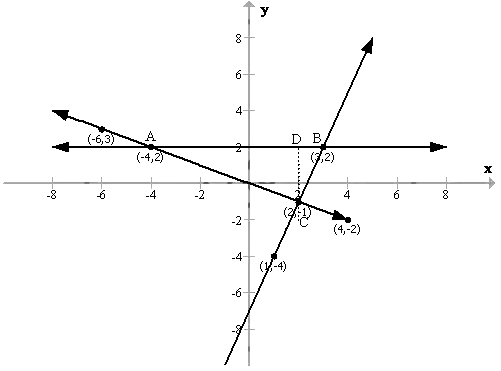
$(i)$ The area of the $\triangle ABC =\frac{1}{2} \times AB \times CD$
$=\frac{1}{2} \times 7 \times 3$
$=\frac{21}{2}$
$= 10.5^2 $.units
$(ii)$ The coordinates of the verticles of the triangle are $( - 4, 2), (3, 2)$ and $(2, -1).$ View full question & answer→Question 94 Marks
Use graph paper for this question. Take $2 \ cm = 1$ unit on both the axes.$(i)$ Draw the graphs of $x + y + 3 = 0$ and $3x - 2y + 4 = 0.$ Plot only three points per line.$(ii)$ Write down the coordinates of the point of intersection of the lines.$(iii)$ Measure and record the distance of the point of intersection of the lines from the origin in $\ cm.$
Answer$(i)$
$x + y + 3 = 0$
$\Rightarrow x = - 3 - y$
The table for $x + y = 3 = 0$ is
| $X$ |
$1$ |
$0$ |
$- 2$ |
| $Y$ |
$- 4$ |
$- 3$ |
$- 1$ |
Also we have
$3x - 2y + 4 = 0$
$\Rightarrow 3x = 2y - 4$
$\Rightarrow x =\frac{2 y-4}{3}$
The table for $3x - 2y + 4 = 0$ is
| $X$ |
$0$ |
$- 2$ |
$-\frac{2}{3}$ |
| $Y$ |
$2$ |
$- 1$ |
$1$ |
Plotting the above points we get the following required graph :
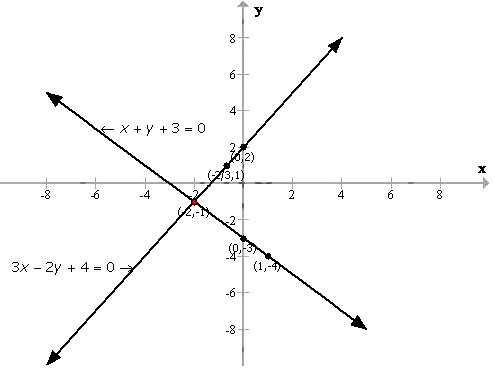
$(ii)$ From the above graph, it is clear that the two lines $x + y + 3 = 0$ and $3x - 2y + 4 = 0$ intersect at the point $(-2, -1)$
$(iii)$ Applying Pythagoras Theorem,
the distance from the origin
$=\sqrt{(-2-0)^2+(-1-0)^2}$
$=\sqrt{2^2+1^2}$
$=\sqrt{4+1}$
$=\sqrt{5}$
$= 2.2 \ cm ($ approx$).$ View full question & answer→Question 104 Marks
Use graph paper for this question. Take $2 \ cm = 2$ units on $ x-$axis and $2 \ cm = 1$ unit on $y-$axis.Solve graphically the following equation:$3x + 5y = 12; 3x - 5y + 18 = 0 ($Plot only three points per line$)$
Answer$3x + 5y = 12$
$\Rightarrow 3x = 12 - 5y$
$x=\frac{12-5 y}{3}$
The table for $3x + 5y = 12$ is
| $X$ |
$4$ |
$- 1$ |
$- 6$ |
| $Y$ |
$0$ |
$3$ |
$6$ |
Also we have
$3x - 5y + 18 = 0$
$\Rightarrow 3x = 5y - 18$
$\Rightarrow x =\frac{5 y-18}{3}$
The table for $3x - 5y + 18 = 0$ is
| $X$ |
$- 6$ |
$4$ |
$- 1$ |
| $Y$ |
$0$ |
$6$ |
$3$ |
Plotting the above points we get the following required graph:
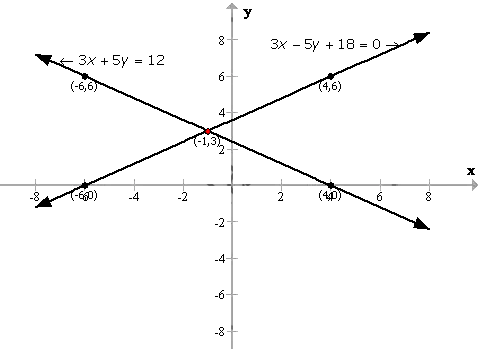
From the above graph, it is clear that the two lines $3x + 5y = 12$ and $3x - 5y + 18 = $0 intersect at the point $(-1, 3)$ View full question & answer→Question 114 Marks
Use graph paper for this question. Draw the graph of $2x - y - 1 = 0$ and $2x + y = 9$ on the same axes. Use $2 \ cm = 1$ unit on both axes and plot only $3$ points per line. Write down the coordinates of the point of intersection of the two lines.
Answer$2x - y - 1 = 0$
$\Rightarrow 2x = y + 1$
$\Rightarrow x =\frac{y+1}{2}$
This table for$ 2x - y - 1 = 0$ is
| $X$ |
$2$ |
$1$ |
$0$ |
| $Y$ |
$3$ |
$1$ |
$- 1$ |
Also we have
$2x + y = 9$
$\Rightarrow 2x = 9 - y$
$\Rightarrow x =\frac{9-y}{2}$
The table for $2x + y = 9$ is
| $X$ |
$4$ |
$3$ |
$5$ |
| $Y$ |
$1$ |
$3$ |
$- 1$ |
Plotting the above points we get the following required graph:
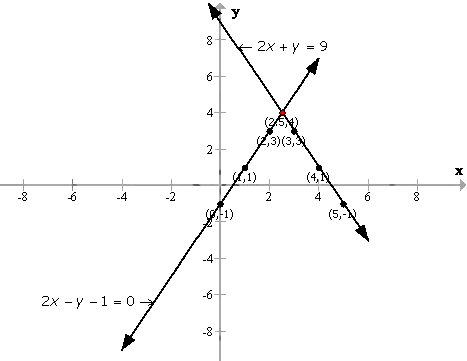
From the above graph, it is clear that the two lines $2x - y - 1 = 0$ and $2x + y = 9$ intersect at the point $(2, 5, 4)$ View full question & answer→Question 124 Marks
Solve graphically the simultaneous equations given below. Take the scale as $2 \ cm = 1$ unit onboth the axes.$x - 2y - 4 = 0;2x + y = 3$
Answer$x - 2y - 4 = 0$
$\Rightarrow x = 2y + 4$
The table for$ x - 2y - 4 = 0$ is
| $X$ |
$4$ |
$6$ |
$2$ |
| $Y$ |
$0$ |
$1$ |
$- 1$ |
Also we have
$2x + y = 3$
$\Rightarrow 2x = 3 - y$
$\Rightarrow x =\frac{3-y}{2}$
The table for $2x + y = 3$ is
| $X$ |
$1$ |
$0$ |
$2$ |
| $Y$ |
$1$ |
$3$ |
$- 1$ |
Plotting the above points we get the following required graph:
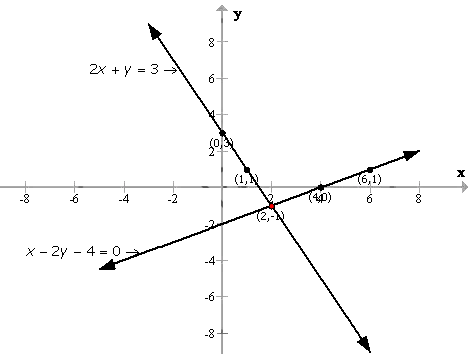
From the above graph, it is dear that the two lines $x - 2y - 4 = 0$ and $2x + y = 3 $ intersect at the point $(2, -1)$ View full question & answer→Question 134 Marks
The course of an enemy submarine, as plotted on rectangular co$-$ordinate axes, gives the equation $2x + 3y = 4$. On the same axes, a destroyer's course is indicated by the graph $x - y = 7$. Use the graphical method to find the point at which the paths of the submarine and the destroyer intersect?
Answer$2x + 3y = 4$
$\Rightarrow x =\frac{4-3 y}{2}$
The table for $2x + 3y = 4$ is
| $X$ |
$-1$ |
$-4$ |
$5$ |
| $Y$ |
$2$ |
$4$ |
$-2$ |
$x - y = 7$
$\Rightarrow x = y + 7$
The table for $x - y = 7$ is
| $X$ |
$5$ |
$11$ |
$9$ |
| $Y$ |
$-2$ |
$4$ |
$2$ |
Now plot the points on a graph and we get the following required graph:
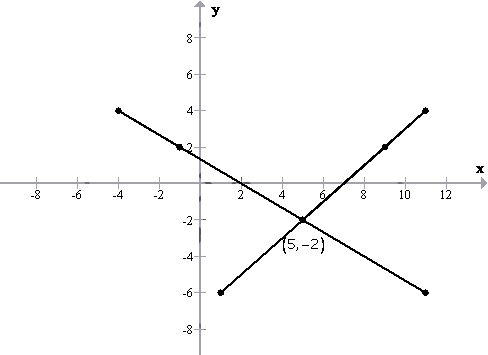
The point at which the paths of the submarine and the destroyer intersect are $(5, -2)$ View full question & answer→Question 144 Marks
Solve, graphically, the following pairs of equations :$\frac{x+1}{4}=\frac{2}{3}(1-2 y);\frac{2+5 y}{3}=\frac{x}{7}-2$
Answer$\frac{x+1}{4}=\frac{2}{3}(1-2 y)$
$\Rightarrow \frac{x+1}{4}=\frac{2}{3}-\frac{4 y}{3}$
$\Rightarrow 12 \times \frac{x+1}{4}$
$=12 \times \frac{2}{3}-12 \times \frac{4 y}{3}$
$\Rightarrow 3(x + 1) = 8 - 16y$
$\Rightarrow 3x + 3 = 8 - 16y$
$\Rightarrow 3x + 3 - 8 = -16y$
$\Rightarrow 3x - 5 = -16y$
$\Rightarrow x=\frac{5-16 y}{3}$
The table for $\frac{x+1}{4}=\frac{2}{3}(1-2 y)$ is
| $X$ |
$7$ |
$- 9$ |
$23$ |
| $Y$ |
$- 1$ |
$2$ |
$- 4$ |
Also, we have
$\frac{2+5 y}{3}=\frac{x}{7}-2$
$\Rightarrow 21 \times \frac{2+5 y}{3}=21 \times \frac{x}{7}-21 \times 2$
$\Rightarrow 7(2 + 5y) = 3x - 42$
$\Rightarrow 14 + 35y = 3x - 42$
$\Rightarrow 3x = 14 + 35y + 42$
$\Rightarrow 3x = 56 + 35y$
$\Rightarrow x =\frac{56+35 y}{3}$
The table for $\frac{2+5 y}{3}=\frac{x}{7}-2$ is
| $X$ |
$7$ |
$- 28$ |
$42$ |
| $Y$ |
$- 1$ |
$- 4$ |
$2$ |
Plotting the points we get the following required graph:
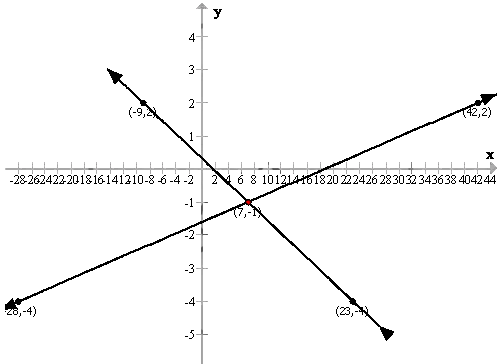
From the above graph, it is dear that the two lines $\frac{x+1}{4}=\frac{2}{3}(1-2 y)$ and $\frac{2+5 y}{3}=\frac{x}{7}-2$ intersect at the point $(7, -1)$ View full question & answer→Question 154 Marks
Use the graphical method to find the value of $'x\ '$ for which the expressions $\frac{3 x+2}{2}$ and $\frac{3}{4} x-2$
AnswerLet $y =\frac{3 x+2}{2}$
The table for $y =\frac{3 x+2}{2}$ is
Let $y=\frac{3}{4} x-2$
The table for $y =\frac{3}{4} x-2$ is
Now plot the points on a graph and we get the following required graph:
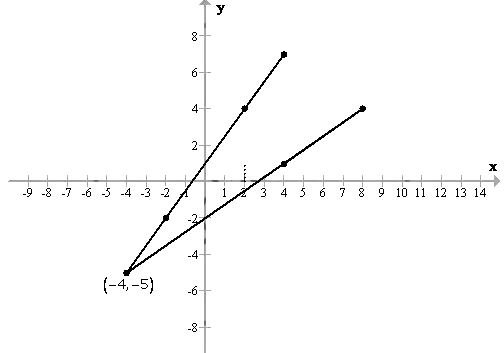
Thus, the value of $'x\ '$ is $- 4.$ View full question & answer→Question 164 Marks
Solve, graphically, the following pairs of equation :$3x + 7y = 27;8-y=\frac{5}{2} x$
Answer$3x + 7y = 27$
$\Rightarrow 3x = 27 - 7y$
$\Rightarrow x =\frac{27-7 y}{3}$
The table for $3x + 7y = 27$ is
| $X$ |
$9$ |
$2$ |
$-5$ |
| $Y$ |
$0$ |
$3$ |
$6$ |
Also, we have
$8-y=\frac{5}{2} x$
$\Rightarrow x=(8-y) \times \frac{2}{5}$
The table for $5x + 2y = 16$ is
| $X$ |
$2$ |
$4$ |
$0$ |
| $Y$ |
$3$ |
$- 2$ |
$8$ |
Plotting the points we get the following required graph:
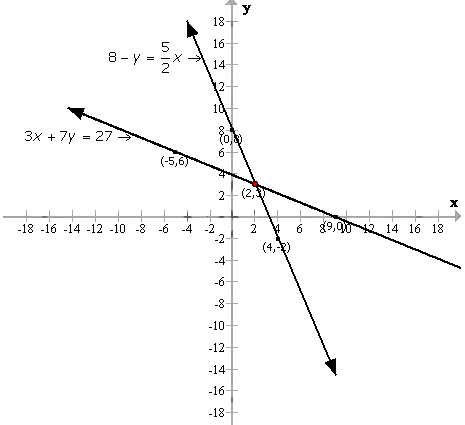
From the above graph, it is clear that the two lines $3x + 7y = 27$ and $8 - y = \frac{5}{2} x$ intersect at the point $(2,3)$ View full question & answer→Question 174 Marks
Solve graphically, the following equations. $x + 2y = 4; 3x - 2y = 4.$ Take $2 \ cm = 1$ unit on each axis.Also, find the area of the triangle formed by the lines and the $x-$ axis.
Answer$x + 2y = 4$
$\Rightarrow x = 4 - 2y$
The table of $x + 2y = 4$ is
| $X$ |
$2$ |
$- 4$ |
$12$ |
| $Y$ |
$1$ |
$4$ |
$- 4$ |
$3x - 2y = 4$
$\Rightarrow x =\frac{4+2 y}{3}$
The table of $3x - 2y = 4$ is
| $X$ |
$2$ |
$4$ |
$6$ |
| $Y$ |
$1$ |
$4$ |
$7$ |
Now plotting the points on a graph and we get the following required graph:
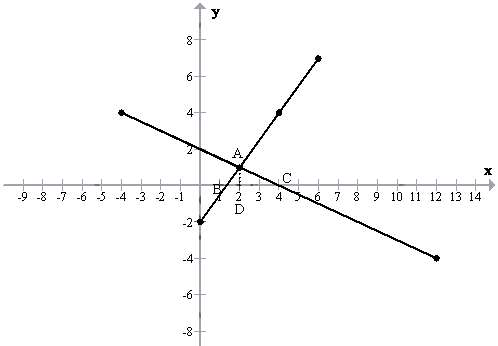
Therefore the solution of the given system of equations is $(2,1).$
Thus the vertices of the triangle are:
$A(2,1), B \left(\frac{4}{3}, 0\right)$ and $C(4,0)$
$AB \perp BC$ and $D ≡ (2,0)$
$AD = 1$ and $BC =2 \frac{2}{3}$ units $=\frac{8}{3}$ units
Area of the triangle $\text{ABC} =\frac{1}{2} \times AD \times BC$
$=\frac{1}{2} \times 1 \times \frac{8}{3}$
$=\frac{4}{3} sq.$units
$=1 \frac{1}{3} sq.$units View full question & answer→Question 184 Marks
Solve, graphically, the following pairs of equation :$2x + y = 23;4x - y = 19$
Answer$2x + y = 23$
$ \Rightarrow y = 23 - 2x$
The table for $y = 23 - 2x$ is
| $X$ |
$5$ |
$10$ |
$15$ |
| $Y$ |
$13$ |
$3$ |
$- 7$ |
Also, we have
$4x - y = 19$
$ \Rightarrow y = 4x - 19$
The table for $y = 4x - 19$ is
| $X$ |
$3$ |
$4$ |
$6$ |
| $Y$ |
$- 7$ |
$- 3$ |
$5$ |
Plotting the points we get the following required graph:
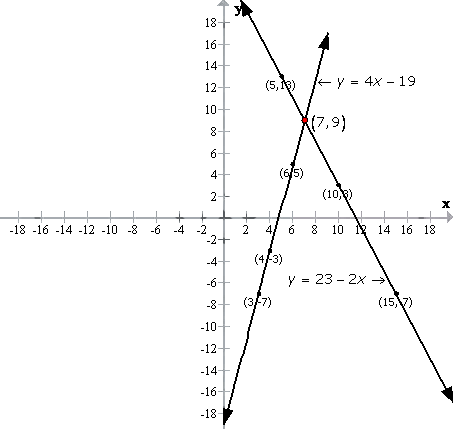
From the above graph, it is clear that the two lines $y = 23 - 2x$ and $y = 4x - 19$ intersect at the point $(7, 9)$ View full question & answer→Question 194 Marks
Using the same axes of co$-$ordinates and the same unit, solve graphically :$x + y = 0$ and $3x - 2y = 10.($Take at least $3$ points for each line drawn$).$
Answer$x + y = 0$
$y = - x;$
The table of $x + y = 0$ is
| $X$ |
$5$ |
$2$ |
$- 5$ |
| $Y$ |
$- 5$ |
$- 2$ |
$5$ |
$3x - 2y = 10$
$\Rightarrow x=\frac{10+2 y}{3}$
The table of $3x - 2y = 10$ is
| $X$ |
$4$ |
$6$ |
$2$ |
| $Y$ |
$1$ |
$4$ |
$- 2$ |
Now plotting the points on a graph and we get the following required graph:
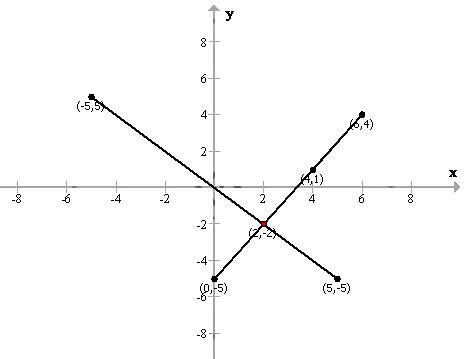
The two lines intersect at $(2, - 2)$
$\therefore x = 2$ and $y = - 2$ View full question & answer→Question 204 Marks
Find graphically, the vertices of the triangle whose sides have the equations $2y - x = 8; 5y - x = 14$ and $y - 2x = 1$ respectively. Take $1 \ cm = 1$ unit on both the axes.
Answer$2y - x = 8;$
$y =\frac{8+x}{2} ;$
The table of $2y - x = 8$ is
| $X$ |
$- 6$ |
$- 2$ |
$0$ |
| $Y$ |
$1$ |
$3$ |
$4$ |
$5y - x = 14$
$\Rightarrow x = 5y - 14$
The table of $x = 5y - 14$ is
| $X$ |
$- 9$ |
$- 4$ |
$1$ |
| $Y$ |
$1$ |
$2$ |
$3$ |
$y - 2x = 1$
$\Rightarrow y = 1 + 2x$
The table of $y - 2x = 1$ is
| $X$ |
$2$ |
$- 2$ |
$0$ |
| $Y$ |
$5$ |
$- 3$ |
$1$ |
Now plotting the points on a graph and we get the following required graph:
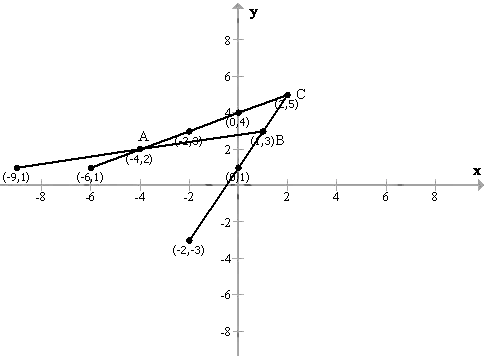
Thus, the verticles of the triangle $\triangle ABC$ are: $A(- 4, 2), B(1, 3)$ And $C(2, 5).$ View full question & answer→Question 214 Marks
A straight line passes through the points $(2, 4)$ and $(5, - 2).$ Taking $1 \ cm = 1$ unit; mark these points on a graph paper and draw the straight line through these points. If points $(m, - 4)$ and $(3, n)$ lie on the line drawn; find the values of $m$ and $n.$
AnswerThe table is:
| $X$ |
$2$ |
$3$ |
$5$ |
$m$ |
| $Y$ |
$4$ |
$n$ |
$- 2$ |
$- 4$ |
Plotting the points as shown in the above table,
we get the following required graph:
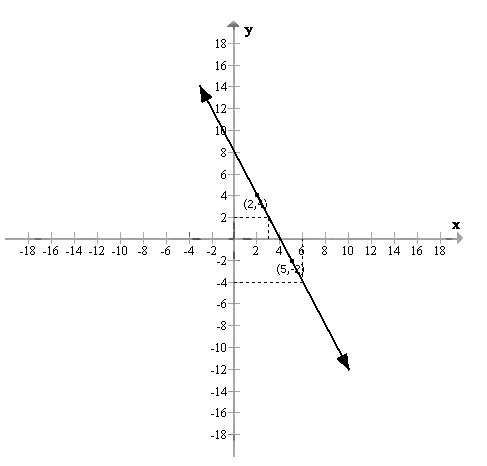
Plotting the points in the graph we get the above required graph.
Now draw a line$ x = 3$, parallel to$ y-$axis to meet the line
It meets the line at$ y = 2$ and therefore, $n = 2$
Now draw a line$ y = -4$, parallel to $x-$axis to meet the line
It meets the line at $x = 6$ and therefore, $m = 6$
Thus the values of $m$ and $n$ are $6$ and $2$ respectively. View full question & answer→Question 224 Marks
Use the table given below to draw the graph.
| $X$ |
$a$ |
$3$ |
$-5$ |
$5$ |
$c$ |
$-1$ |
| $Y$ |
$- 1$ |
$2$ |
$b$ |
$3$ |
$4$ |
$0$ |
Use the graph to find the values of $a, b$ and $c$. State a linear relation between the variables $x$ and $y$. AnswerThe table is:
| $X$ |
$a$ |
$3$ |
$- 5$ |
$5$ |
$c$ |
$- 1$ |
| $Y$ |
$- 1$ |
$2$ |
$b$ |
$3$ |
$4$ |
$0$ |
Plotting the points as shown in the above table,
we get the following required graph:
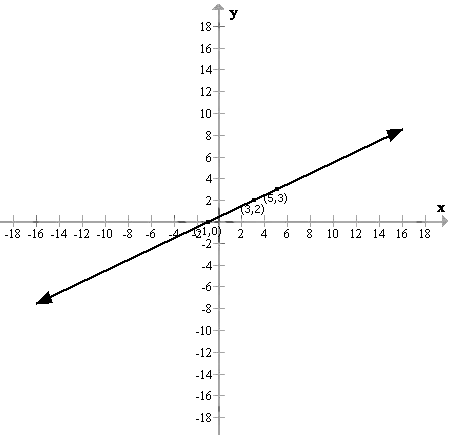
When $y = - 1,$ then $x = - 3$
$\Rightarrow a = - 3$
When $x = - 5,$ then $y = - 2$
$\Rightarrow b = - 2$
When $y = 4$, then $x = 7$
$\Rightarrow c = 7$
Let $y = px + q \dots....(1)$
be a linear relation between $x$ and $y$
Substitute $x = - 3$ and $y = - 1$ in the equation $(1),$ we have,
$-1 = - 3p + q \dots....(2)$
Substitute $x = - 5$ and $y = - 2$ in the equation $(1),$ we have,
$-2 = - 5p + q \dots....(3)$
Subtracting $(3)$ from $(2),$ we have,
$1 = 2p$
$\Rightarrow p=\frac{1}{2}$
From $(3),$ we have,
$-2 = -5p + q$
$-2=-5\left(\frac{1}{2}\right)+q$
$\Rightarrow -4 = -5 + 2q$
$\Rightarrow 2q = 5 - 4$
$\Rightarrow 2q = 1$
$\therefore q=\frac{1}{2}$
Thus, the linear relation is
$y = px + q$
$\Rightarrow y =\frac{1}{2} x+\frac{1}{2}$
$\Rightarrow y =\frac{x+1}{2}$ View full question & answer→Question 234 Marks
Use the table given below to draw the graph.
| $x$ |
$-5$ |
$-1$ |
$3$ |
$b$ |
$13$ |
| $y$ |
$-2$ |
$a$ |
$2$ |
$5$ |
$7$ |
From your graph, find the values of $'a\ '$ and $'b\ '.$
State a linear relationship between the variables $x$ and $y$. AnswerThe table is:
| $X$ |
$- 5$ |
$- 1$ |
$3$ |
$b$ |
$13$ |
| $Y$ |
$- 2$ |
$a$ |
$2$ |
$5$ |
$7$ |
Plotting the points as shown in the above table, we get the following required graph:
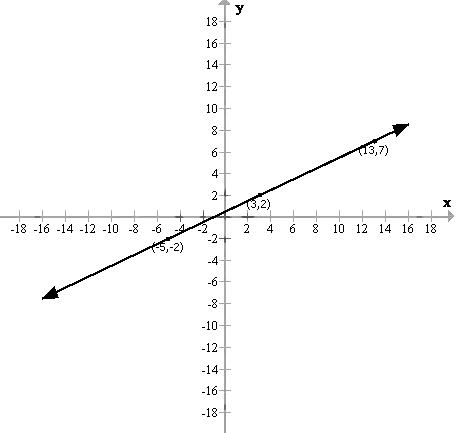
When $x = - 1,$ then $y = 0$
$\Rightarrow a = 0$
When $y = 5,$ then $x = 9$
$\Rightarrow b = 9$
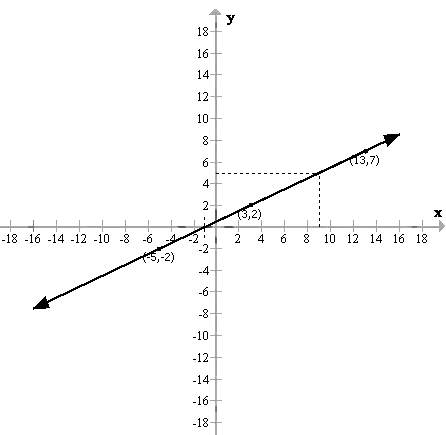
Let $y = px + q \dots....(1)$
be a linear relation between $x$ and $y$
Substitute $x = 9$ and $y = 5$ in the equation $(1),$ we have,
$5 = 9p + q\dots....(2)$
Substitute $x = - 1$ and $y = 0$ in the equation $(1),$ we have,
$0 = - p + q \dots....(3)$
Subtracting $(3)$ from $(2),$ we have,
$5 = 10p$
$\Rightarrow p=\frac{5}{10}$
$\Rightarrow p=\frac{1}{2}$
From $(3),$ we have,
$p = q$
$\therefore q=\frac{1}{2}$
Thus, the linear relation is
$y = px + q$
$\Rightarrow y =\frac{1}{2} x+\frac{1}{2}$
$\Rightarrow y =\frac{x+1}{2}$ View full question & answer→Question 244 Marks
Draw the graph of the equation $4x + 3y + 6 = 0$ From the graph, find :$(i)\ y_1,$ the value of $y,$ when $x = 12.(ii) \ y_2,$ the value of $y,$ when $x = - 6.$
Answer$4x + 3y + 6 = 0$
$\Rightarrow 3y = -4x - 6$
$\Rightarrow y=\frac{-4 x-6}{3}$
When $x = 0,$
$y=\frac{-4(0)-6}{3}$
$=\frac{-6}{3}$
$= -2$
When $x = 3,$
$y=\frac{-4(3)-6}{3}$
$=\frac{-12-6}{3}$
$= -6$
When $x = -3,$
$y=\frac{-4(3)-6}{3}$
$=\frac{12-6}{3}$
$= 2$
| $X$ |
$0$ |
$3$ |
$-3$ |
| $Y$ |
$-2$ |
$-6$ |
$2$ |
Plotting these points we get the required graph as shown below :
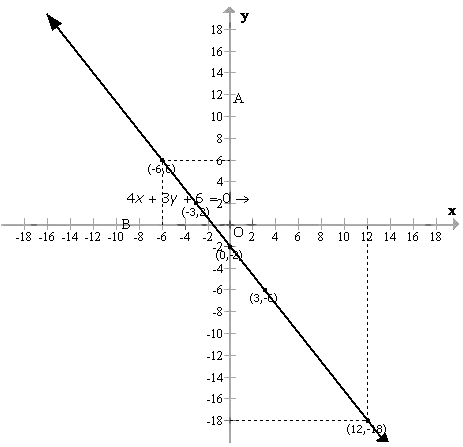
The value of $y,$ when $x = 12:$
We have the equation of the line as
y = $\frac{-4 x-6}{3}$
Now substitute $x = 12$ and $y = y_1:$
$y_1=\frac{-4(12)-6}{3}$
$=\frac{-48-6}{3}$
$=\frac{-54}{3}$
$= - 18$
The value of $y,$ when $x = - 6:$
Now substitute $x = - 6$ and $y = y_2:$
$y_2=\frac{-4(-6)-6}{3}$
$=\frac{24-6}{3}$
$=\frac{18}{3}$
$=6$ View full question & answer→Question 254 Marks
Draw the graph of the equation $2x - 3y - 5 = 0$From the graph, find :$(i) \ x_1,$ the value of $x,$ when $y = 7;(ii) \ x_2,$ the value of $x,$ when $y = - 5.$
Answer$2x - 3y - 5 = 0$
$\Rightarrow 2x = 3y + 5$
$\Rightarrow x =\frac{3 y+5}{2}$
When $y = 1,$
$x=\frac{3(1)+5}{2}$
$=\frac{8}{2}$
$= 4$
When $y = 3,$
$x=\frac{3(-1)+5}{2}$
$=\frac{5-3}{2}$
$= 7$
When $y = - 1,$
$x=\frac{3(-1)+5}{2}$
$=\frac{5-3}{2}$
$= 1$
| $X$ |
$4$ |
$7$ |
$1$ |
| $Y$ |
$1$ |
$3$ |
$- 1$ |
Plotting these points we get the required graph as shown below :
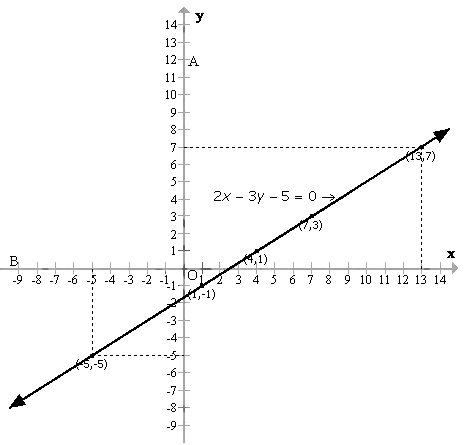
$(i)$ The value of $x,$ when $y = 7:$
We have the equation of the line as
$x=\frac{3 y+5}{2}$
Now substitute $y = 7$ and $x = x_1:$
$x_1=\frac{3(7)+5}{2}$
$=\frac{21+5}{2}$
$=\frac{26}{2}$
$=13$
$(ii)$ The value of $x,$ when $y = - 5:$
Now substitute $y = - 5$ and $x = x_2$
$x_2=\frac{3(-5)+5}{2}$
$=\frac{-15+5}{2}$
$=\frac{-10}{2}$
$=-5 .$ View full question & answer→Question 264 Marks
Draw the graph of the straight line given by the equation $4x - 3y + 36 = 0$.Calculate the area of the triangle formed by the line drawn and the co $-$ ordinate axes.
Answer$4x - 3y + 36 = 0$
$\Rightarrow 4x - 3y = -36$
$\Rightarrow -3y = -36 - 4x$
$\Rightarrow 3y = 36 + 4x$
$\Rightarrow y =\frac{36+4 x}{3}$
When $x = - 6,$
$y=\frac{36+4 \times(-6)}{3}$
$=\frac{36-24}{3}$
$= 4$
When $x = - 3,$
$y=\frac{36+4 \times(-3)}{3}$
$=\frac{36-12}{3}$
$= 8$
When $x = - 9,$
$y=\frac{36+4 \times(-9)}{3}$
$=\frac{36-36}{3}$
$= 0$
| $X$ |
$- 9$ |
$- 3$ |
$- 6$ |
| $Y$ |
$0$ |
$8$ |
$4$ |
Plotting these points we get the required graph as shown below:
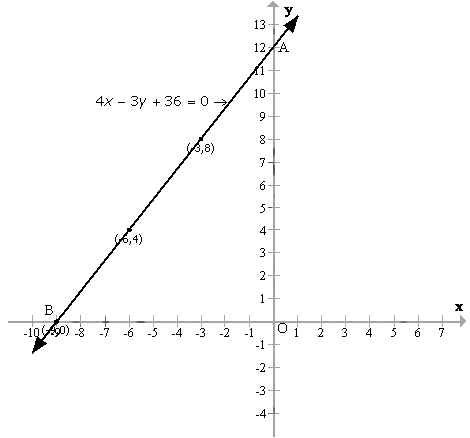
The straight line cuts the co $-$ ordinates axis at $A(0,12)$ and $B(-9,0)$.
$\therefore$ The triangle $\triangle AOB$ is formed.
Area of the $\triangle AOB$
$=\frac{1}{2} \times AO \times OB$
$=\frac{1}{2} \times 12 \times 9$
$= 54 \text{ sq .}$ units
$\therefore $ Area of the triangle is $54 \text{ sq .}$ units View full question & answer→Question 274 Marks
Draw the graph for the equation given below; hence find the co $-$ ordinates of the points where the graph is drawn meets the co $-$ ordinates axes : $\frac{2 x+15}{3}=y-1$
Answer$\frac{2 x+15}{3}=y-1$
$\Rightarrow 2x + 15 = 3(y - 1)$
$\Rightarrow 2x + 15 = 3y - 3$
$\Rightarrow 2x - 3y = -15 - 3$
$\Rightarrow 2x - 3y = -18$
$\Rightarrow -3y = -18 - 2x$
$\Rightarrow y =\frac{-18-2 x}{-3}$
When $x = 0,$
$y=\frac{-18-[2 \times 0]}{-3}$
$=\frac{-18-0}{-3}$
$= 6$
When $x = -3,$
$y=\frac{-18-[2 \times(-3)]}{-3}$
$=\frac{-18+6}{-3}$
$= 4$
When $x = -6,$
$y=\frac{-18-[2 \times(-6)]}{-3}$
$=\frac{-18+12}{-3}$
$= 2$
| $X$ |
$0$ |
$- 3$ |
$- 6$ |
| $Y$ |
$6$ |
$4$ |
$2$ |
Plotting these points we get the required graph as shown below:
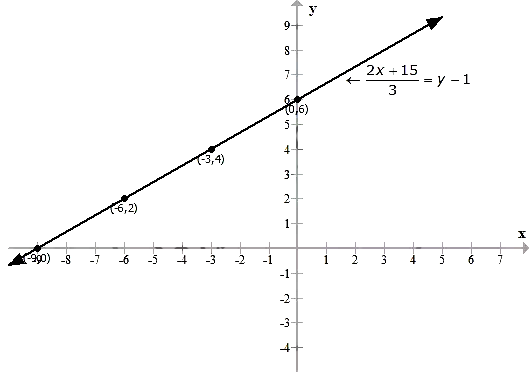
From the figure it is clear that, the graph meets the coordinate axes at $(-9, 0)$ and $(0, 6).$ View full question & answer→Question 284 Marks
Draw the graph for the equation given below; hence find the co $-$ ordinates of the points where the graph is drawn meets the co $-$ ordinates axes : $\frac{1}{3} x+\frac{1}{5} y=1$.
Answer$\frac{1}{3} x+\frac{1}{5} y=1$
$\Rightarrow \frac{5 x+3 y}{15}=1$
$\Rightarrow 5x + 3y = 15$
$\Rightarrow 3y = 15 - 5x$
$\Rightarrow y =\frac{15-5 x}{3}$
When $x=0 ; y=\frac{15-5 \times 0}{3}=\frac{15-0}{3}=5$
When $x=3 ; y=\frac{15-5 \times 3}{3}=\frac{15-15}{3}=0$
When $x=-3 ; y=\frac{15-5 \times(-3)}{3}=\frac{15+15}{3}=10$
| $X$ |
$0$ |
$3$ |
$- 3$ |
| $Y$ |
$5$ |
$0$ |
$10$ |
Plotting these points we get the required graph as shown below:
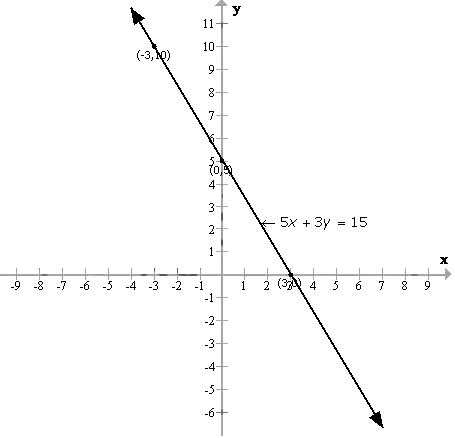
From the figure it is clear that, the graph meets the coordinate axes at $(3,0)$ and $(0,5).$ View full question & answer→Question 294 Marks
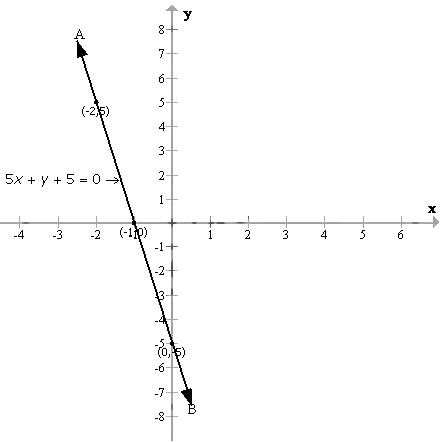
Draw the graph for the equation, given below :$5x + y + 5 = 0$
Answer$5x + y + 5 = 0$
$\Rightarrow y = - 5x - 5$
When $x = 0;$
$y = - 5 \times x - 5$
$= - 0 - 5$
$= - 5$
When $x = - 1;$
$y = - 5 \times (- 1) - 5$
$= 5 - 5$
$= 0$
When $x = - 2;$
$y = - 5 \times (- 2) - 5$
$= 10 - 5$
$= 5$
| $X$ |
$0$ |
$- 1$ |
$- 2$ |
| $Y$ |
$- 5$ |
$0$ |
$5$ |
Plotting these points we get the required graph as shown below:
View full question & answer→Question 304 Marks
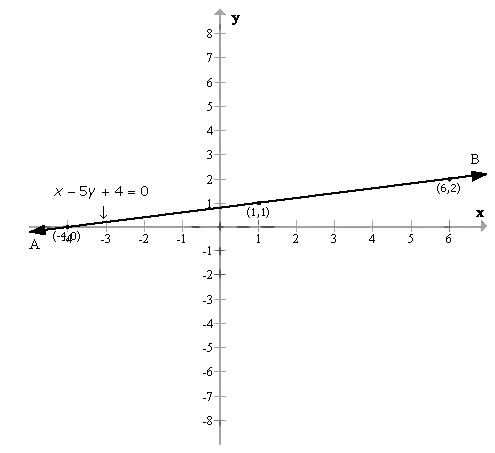
Draw the graph for the equation, given below : $x - 5y + 4 = 0$
Answer$x-5 y+4=0$
$\Rightarrow 5 y=4+x$
$\therefore y =\frac{x+4}{5}$
When $x = 1;$
$y=\frac{1+4}{5}$
$=\frac{5}{5}$
$=1$
When $x = 6$ ;
$y=\frac{6+4}{5}$
$=\frac{10}{5}$
$= 2$
When $x = - 4$ ;
$y=\frac{-4+4}{5}$
$=\frac{0}{5}$
$= 0$
| $X$ |
$1$ |
$6$ |
$- 4$ |
| $Y$ |
$1$ |
$2$ |
$0$ |
Plotting these points we get the required graph as shown below :
View full question & answer→Question 314 Marks
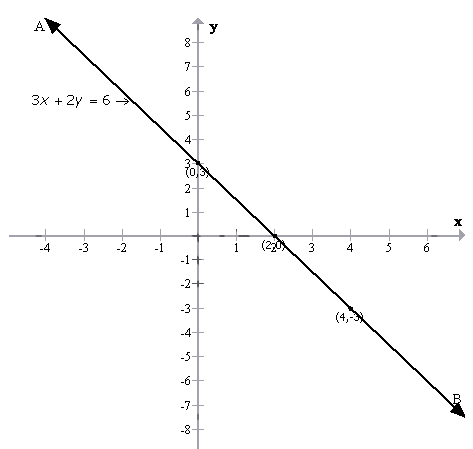
Draw the graph for the equation, given below : $3x + 2y = 6$
Answer$3 x+2 y=6$
$\Rightarrow 2 y=6-3 x$
$\therefore y=\frac{6-3 x}{2}$
When $ x=0 ;$
$y=\frac{6-3 \times 0}{2}$
$=\frac{6-0}{2}$
$=3$
When $x =2$;
$y=\frac{6-3 \times 2}{2}$
$=\frac{6-6^2}{2}$
$=0$
When $ x=4 ;$
$y=\frac{6-3 \times 4}{2}$
$=\frac{6-12}{2}$
$=-3$
| $X$ |
$0$ |
$2$ |
$4$ |
| $Y$ |
$3$ |
$0$ |
$- 3$ |
Plotting these points we get the required graph as shown below :
View full question & answer→Question 324 Marks
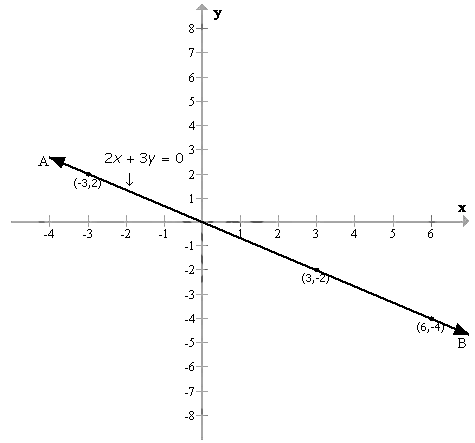
Draw the graph for the equation, given below :$2x + 3y = 0$
Answer$2x + 3y = 0$
$\Rightarrow 3y = - 2x$
$\therefore y =\frac{-2 x}{3}$
When $x=-3 ; y=\frac{-2(-3)}{3}=\frac{6}{3}=2$
When $x=3 ; y=\frac{-2(3)}{3}=\frac{-6}{3}=-2$
When $x=6 ; y=\frac{-2(6)}{3}=\frac{-12}{3}=-4$
| $X$ |
$- 3$ |
$3$ |
$6$ |
| $Y$ |
$2$ |
$- 2$ |
$- 4$ |
Plotting these points we get the required graph as shown below:
View full question & answer→