MCQ
A stretched wire of length $110 cm$ is divided into three segments whose frequencies are in ratio $1 : 2 : 3$. Their lengths must be
  • A
    $20 cm ; 30 cm ; 60 cm$
  • $60 cm ; 30 cm ; 20 cm$
  • C
    $60 cm ; 20 cm ; 30 cm$
  • D
    $30 cm ; 60 cm ; 20 cm$

Answer

Correct option: B.
$60 cm ; 30 cm ; 20 cm$
b
(b) ${l_1} + {l_2} + {l_3} = 110\,cm$ and ${n_1}{l_1} = {n_2}{l_2} = {n_3}{l_3}$

${n_1}:{n_2}:{n_3}::1:2:3$

$\because \frac{{{n_1}}}{{{n_2}}} = \frac{1}{2} = \frac{{{l_2}}}{{{l_1}}} \Rightarrow {l_2} = \frac{{{l_1}}}{2}$and $\frac{{{n_1}}}{{{n_3}}} = \frac{1}{3} = \frac{{{l_3}}}{{{l_1}}} \Rightarrow {l_3} = \frac{{{l_1}}}{3}$

$\therefore {l_1} + \frac{{{l_1}}}{2} + \frac{{{l_1}}}{3} = 110$ so ${l_1} = 60cm,{l_2} = 30cm,{l_3} = 20cm$

Need a full question paper?

Generate a complete, print-ready paper with questions like this in minutes — across 16+ boards, with answer keys.
Start Generating Free

Similar questions

A diatomic gas $(\gamma=1.4)$ does $200 \mathrm{~J}$ of work when it is expanded isobarically. The heat given to the gas in the process is:
In the 5th overtone of an open organ pipe, these are $(N-$ stands for nodes and $A-$ for antinodes)
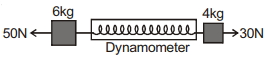
A dynamometer $D$ is attached to two blocks of masses $6 \,kg$ and $4 \,kg$ as shown in the figure. The reading of the dynamometer is ............ $N$
A rectangular body is held at rest by pressing it against a vertical wall. Which of the following is generally true?
$A$ slender uniform rod of length $\lambda$ is balanced vertically at a point $P$ on a horizontal surface having some friction. If the top of the rod is displaced slightly to the right, the position of its centre of mass at the time when the rod becomes horizontal :
A sphere $P$ of mass $m$ and moving with velocity $v$ undergoes an oblique and perfectly elastic collision with an identical sphere $Q$ initially at rest. The angle $\theta $ between the velocities of the spheres after the collision shall be ............... $^o$
$A$ flexible chain of weight $W$ hangs between two fixed points $A$ & $B$ which are at he same horizontal level. The inclination of the chain with the horizontal at both the points of support is $\theta$ . What is the tension of the chain at the mid point? 
Which of the following is $CORRECT$
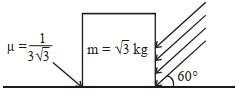
As shown in the figure, a block of mass $\sqrt{3}\, kg$ is kept on a horizontal rough surface of coefficient of friction $\frac{1}{3 \sqrt{3}}$. The critical force to be applied on the vertical surface as shown at an angle $60^{\circ}$ with horizontal such that it does not move, will be $3 x$. The value of $3x$ will be

$\left[ g =10 m / s ^{2} ; \sin 60^{\circ}=\frac{\sqrt{3}}{2} ; \cos 60^{\circ}=\frac{1}{2}\right]$
$A$ thin rod of length $L$ is placed vertically on a frictionless horizontal floor and released with a negligible push to allow it to fall. At any moment, the rod makes an angle $\theta$ with the vertical. If the center of mass has acceleration $= A$, and the rod an angular acceleration $= \alpha$ at initial moment, then