MCQ
In the 5th overtone of an open organ pipe, these are $(N-$ stands for nodes and $A-$ for antinodes)
  • A
    $2N, 3A$
  • B
    $3N, 4A$
  • $4N, 5A$
  • D
    $5N, 4A$

Answer

Correct option: C.
$4N, 5A$
c
(c) In open organ pipe $5$th overtone corresponds to $4$th harmonic mode.

Also in open pipe, Number of nodes = Order of mode of vibration and number of antinodes = (Number of nodes $+ 1$). Here number of nodes $= 4$, Number of antinodes $= 4 + 1 =5$.

Need a full question paper?

Generate a complete, print-ready paper with questions like this in minutes — across 16+ boards, with answer keys.
Start Generating Free

Similar questions

A system performs work $\Delta W$ when an amount of heat is$\Delta Q$ added to the system, the corresponding change in the internal energy is $\Delta U$. A unique function of the initial and final states (irrespective of the mode of change) is
A particle of mass $m$  moving with velocity $v $ strikes a stationary particle of mass $2m$ and sticks to it. The speed of the system will be
In stationary waves, distance between a node and its nearest antinode is $20 cm$. The phase difference between two particles having a separation of $60 cm$ will be
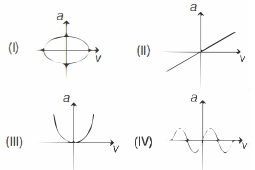
If the speed $v$ of the bob in a simple pendulum is plotted against the tangential acceleration $a$, the correct graph will be represented by
In an experiment, mass of an object is measured by applying a known force on it, and then measuring its acceleration. If in the experiment, the measured values of applied force and the measured acceleration are $F=10.0 \pm 0.2 \,N$ and $a=1.00 \pm 0.01 \,m / s ^2$, respectively. Then, the mass of the object is ............... $kg$
Which of the following is not the unit of time
A bicyclist comes to a skidding stop in $10m.$ During this process, the force on the bicycle due to the road is $200N$ and is directly opposed to the motion. The work done by the cycle on the road is:
For the four sets of three measured physical quantities as given below. Which of the following options is correct ?

$(i)$ $\mathrm{A}_{1}=24.36, \mathrm{B}_{1}=0.0724, \mathrm{C}_{1}=256.2$

$(ii)$ $\mathrm{A}_{2}=24.44, \mathrm{B}_{2}=16.082, \mathrm{C}_{2}=240.2$

$(iii)$ $\mathrm{A}_{3}=25.2, \mathrm{B}_{3}=19.2812, \mathrm{C}_{3}=236.183$

$(iv)$ $\mathrm{A}_{4}=25, \mathrm{B}_{4}=236.191, \mathrm{C}_{4}=19.5$

Parallel rays of light of intensity $I =912 \ Wm ^{-2}$ are incident on a spherical balck body kept in surroundings of temperature $300 \ K$. Take Stefan-Boltzmann constant $\sigma=5.7 \times 10^{-8} Wm ^{-2} K ^{-4}$ and assume that the energy exchange with the surroundings is only through radiation. Th final steady state temperature of the black body is close to:
If flux of the electric field through a closed surface is zero:
  1. The electric field must be zero everywhere on the surface.
  2. The electric field may be zero everywhere in the surface.
  3. The charge inside the surface must be zero.
  4. The charge in the vicinity of the surface must be zero.