MCQ
A string in musical instrument is $50 \mathrm{~cm}$ long and its fundamental frequency is $800 \mathrm{~Hz}$. If a frequency of $1000 \mathrm{~Hz}$ is to be produced, then required length of string is
  • A
    $62.5 \mathrm{~cm}$
  • B
    $50 \mathrm{~cm}$
  • $40 \mathrm{~cm}$
  • D
    $37.5 \mathrm{~cm}$

Answer

Correct option: C.
$40 \mathrm{~cm}$
(c) $n_1 l_1=n_2 l_2 \Rightarrow 800 \times 50=1000 \times l_2 \Rightarrow l_2=40 \mathrm{~cm}$

Need a full question paper?

Generate a complete, print-ready paper with questions like this in minutes — across 16+ boards, with answer keys.

Start Generating Free

Similar questions

The acceleration of a particle performing S.H.M. is $cm sec at$ a distance of $3 cm$ from the mean position. Its time period is
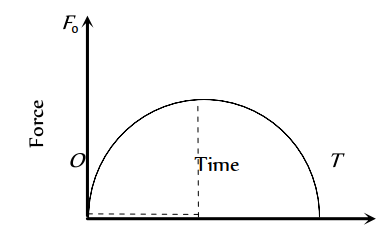
$F$ for a brief interval of time $T$. It begins to move with a velocity $u$ after the force stops acting. $F$ is shown in the graph as a function of time. The curve is a semicircle.
A particle of mass , initially at rest, is acted upon by a variable forceImage
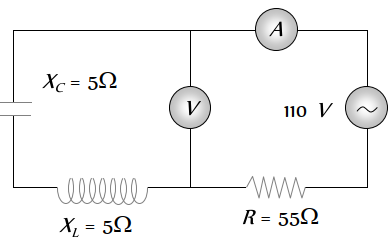
The reading of ammeter in the circuit shown will be
Image
A body is moving with a velocity $v$, breaks up into two equal parts. One of the part retraces back with velocity $v$. Then the velocity of the other part is
A small circular loop of conducting wire has radius $a$ and carries current $I$. It is placed in a uniform magnetic field $\mathrm{B}$ perpendicular to its plane such that when rotated slightly about its diameter and released, it starts performing simple harmonic motion of time period $T$. If the mass of the loop is $m$ then 
lce formed over lakes has
The isothermal Bulk modulus of an ideal gas at pressure $P$ is
A Carnot engine working between $300 \mathrm{~K}$ and $600 \mathrm{~K}$ has work output of $800 \mathrm{~J}$ per cycle. What is amount of heat energy supplied to the engine from source per cycle
Consider the acceleration, velocity and displacement of a tennis ball as it falls to the ground and bounces back. Directions of which of these changes in the process
Equal potentials are applied on an iron and copper wire of same length. In order to have the same current flow in the two wires, the ratio $r$ (iron) $/ r$ (copper) of their radii must be (Given that specific resistance of iron $=1.0 \times 10^{-7} \mathrm{ohm}-\mathrm{m}$ and specific resistance of copper $=1.7 \times 10^{-8}$ ohm-m)