Question
A string is producing transverse vibration whose equation is $y = 0.021\;\sin (x + 30t)$, Where $x$ and $y$ are in meters and $t$ is in seconds. If the linear density of the string is $1.3 \times {10^{ - 4}}\,kg/m,$ then the tension in the string in $N$ will be
Answer

(d) $y = 0.021\sin (x + 30t)$==> $v = \frac{\omega }{k} = \frac{{30}}{1} = 30\,m/s$. 

Using, $v = \sqrt {\frac{T}{m}} \Rightarrow 30 = \sqrt {\frac{T}{{1.3 \times {{10}^{ - 4}}}}} \Rightarrow T = 0.117\,N$

Need a full question paper?

Generate a complete, print-ready paper with questions like this in minutes — across 16+ boards, with answer keys.

Start Generating Free

Similar questions

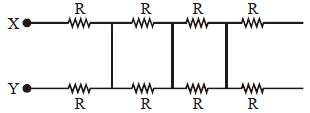
Net resistance between $X$ and $Y$ is
A scalar quantity is one that
A monochromatic light of wavelength $6000$A is incident on the single slit of width $0.01 \mathrm{~mm}$. If the diffraction pattern is formed at the focus of the convex lens of focal length $20 \mathrm{~cm}$, the linear width of the central maximum is :
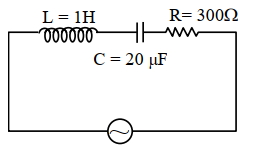
An ac source is connected in given series $LCR$ circuit. The rms potential difference across the capacitor of $20 \mu \mathrm{F}$ is_________.$v$.

$\mathrm{V}=50 \sqrt{2} \sin 100 \mathrm{t}$ volt

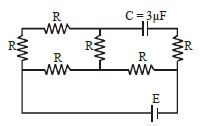
In steady state the potential difference across the capacitor is $10\,\, V.$ Each resistance is of $3\,\Omega $. The cell is ideal. The $emf$ of the cell is .............. $\mathrm{V}$
A body executes simple harmonic motion. The potential energy $(P.E.)$, the kinetic energy $(K.E.)$ and total energy $(T.E.)$ are measured as a function of displacement $x$. Which of the following statements is true
In an $E.M.$ wave the average energy density is associated with
The planet Mars has two moons, if one of them has a period $7\, hours,\, 30\, minutes$ and an orbital radius of $9.0 \times 10^{3}\, {km} .$ Find the mass of Mars.

$\left\{\operatorname{Given} \frac{4 \pi^{2}}{G}=6 \times 10^{11} {N}^{-1} {m}^{-2} {kg}^{2}\right\}$

Sum of the two binary numbers ${(1000010)_2}$ and ${(11011)_2}$ is
An inductance of $1\, mH$ a condenser of $10$ $\mu$ $F$ and a resistance of $50\,  \Omega $ are connected in series. The reactances of inductor and condensers are same. The reactance of either of them will be........$\Omega$