MCQ
A string is stretched between two fixed points separated by $75\,cm$ . It is observed to have resonant frequencies of $420\,Hz$ and $315\,Hz$ . There are no other resonant frequencies between these two. Then, the lowest resonant frequency for this string is  ..... $Hz$
  • A
    $10.5$
  • $105$
  • C
    $1.05$
  • D
    $1050$

Answer

Correct option: B.
$105$
b
$\frac{\mathrm{n}}{2 l} \mathrm{v}=315 \quad$ and $\quad \frac{(\mathrm{n}+1) \mathrm{v}}{2 l}=420$

Solving $, \frac{\mathrm{v}}{2 l}=105 \mathrm{\,Hz}$

Need a full question paper?

Generate a complete, print-ready paper with questions like this in minutes — across 16+ boards, with answer keys.

Start Generating Free

Similar questions

Velocity of sound waves in air is $330\; m/sec$. For a particular sound in air, a path difference of $40 \;cm$ is equivalent to a phase difference of $1.6 \pi$. The frequency of this wave is... $Hz$
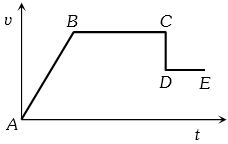
The adjoining diagram shows the velocity versus time plot for a particle. The work done by the force on the particle is positive from
$R$ is the radius of the earth and $\omega $ is its angular velocity and ${g_p}$ is the value of $g$ at the poles. The effective value of $g$ at the latitude $\lambda = 60^\circ $ will be equal to
Which of the following physical quantities do not have same dimensions?
If the equation for the displacement of a particle moving on a circular path is given by $(\theta) = 2t^3 + 0.5$, where $\theta$ is in radians and $t$ in seconds, then the angular velocity of the particle after $2\, sec$ from its start is    ......... $rad/sec$
A gas mixture consists of molecules of type $1, 2$ and $3$, with molar masses ${m_1} > {m_2} > {m_3}.$ ${V_{rms}}$ and $\overline K $ are the $r.m.s.$ speed and average kinetic energy of the gases. Which of the following is true
A certain block weight $15\, N$ in air. It weight $12\, N$ when immersed in water when immersed in another liquid it weighs $13\, N$, the relative density of the block is
A particle executing simple harmonic motion of amplitude $5\, cm$ has maximum speed of $31.4\, cm/s$. The frequency of its oscillation is ..... $Hz$
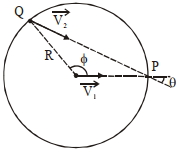
Two particles, one at the centre of a circle of radius $R$, and another at a point $Q$ on the circle, start moving towards a point $P$ on the circle at the same time (see figure below). Both are at rest initially and move with uniform velocities $\vec{V}_1$ and $\overrightarrow{V_2}$ respectively. They also reach the point $P$ at the same time, If the angle between the velocities is $\theta$ and the angle subtended by $P$ and $Q$ at the centre is $\phi$ (as shown in the figure), then
If the change in the value of $‘g’$ at a height $h$ above the surface of the earth is the same as at a depth $x$ below it, then (both $x$ and $h$ being much smaller than the radius of the earth)