MCQ
Velocity of sound waves in air is $330\; m/sec$. For a particular sound in air, a path difference of $40 \;cm$ is equivalent to a phase difference of $1.6 \pi$. The frequency of this wave is... $Hz$
  • A
    $165$
  • B
    $150$
  • $660$
  • D
    $330$

Answer

Correct option: C.
$660$
c
(c) Phase difference $=\frac{{2\pi }}{\lambda } \times $ path difference

==>$1.6\pi = \frac{{2\pi }}{\lambda } \times 40$

$ \Rightarrow  \lambda = 50 \,cm= 0.5\,m$

==> $v = n\lambda $

==> $330 = 0.5 \times n \Rightarrow n = 660\,Hz$

Need a full question paper?

Generate a complete, print-ready paper with questions like this in minutes — across 16+ boards, with answer keys.
Start Generating Free

Similar questions

The equation of motion of a projectile is $y=12 x-\frac{3}{4} x^2$ $..........\,m$ is the range of the projectile.
When the pressure on water is increased the boiling temperature of water as compared to $100°C$ will be
A point moves such that its displacement as a function of time is given by $x^3$ = $t^3 + 1$. Its acceleration as a function of time $t$ will be
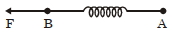
Two masses $A$ and $B ,$ each of mass $M$ are fixed together by a massless spring. $A$ force acts on the mass $B$ as shown in figure. If the mass $A$ starts moving away from mass $B$ with acceleration $'a',$ then the acceleration of mass $B$ wil be :-
An aircraft is moving with a velocity of $300\,m{s^{ - 1}}.$ If all the forces acting on it are balanced, then
A lift is moving down with acceleration $a$. A man in the lift drops a ball inside the lift. The acceleration of the ball as observed by the man in the lift and a man standing stationary on the ground are respectively
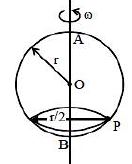
A smooth wire of length $2\pi r$ is bent into a circle and kept in a vertical plane. A bead can slide smoothly on the wire. When the circle is rotating with angular speed $\omega$ about the vertical diameter $AB$, as shown in figure, the bead is at rest with respect to the circular ring at position $P$ as shown. Then the value of $\omega^2$ is equal to
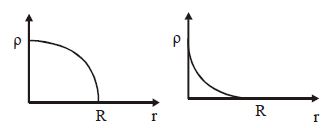
Two planets $A$ and $B$ have same mass and radii $(R)$ . The variation of density of the planets with distance from centre is shown in the following diagrams. The ratio of acceleration due to gravity at the surface of the planets $A$ and $B$ will be
Two balls $A$ and $B$ are thrown with same velocity $u$ from the top of a tower. Ball $A$ is thrown vertically upwards and the ball $B$ is thrown vertically downwards. If $t_A = 6\  s$ and $t_B = 2\ s$, then the height of the tower is ......... $m$
An astronaut takes a ball of mass $m$ from earth to space. He throws the ball into a circular orbit about earth at an altitude of $318.5 \mathrm{~km}$. From earth's surface to the orbit, the change in total mechanical energy of the ball is $x \frac{\mathrm{GM}_e \mathrm{~m}}{21 R_e}$. The value of $x$ is (take $R_{\mathrm{e}}=6370 \mathrm{~km}$ ):