A string of area of cross-section $4\,mm ^{2}$ and length $0.5$ is connected with a rigid body of mass $2\,kg$. The body is rotated in a vertical circular path of radius $0.5\,m$. The body acquires a speed of $5\,m / s$ at the bottom of the circular path. Strain produced in the string when the body is at the bottom of the circle is $\ldots . . \times 10^{-5}$. (Use Young's modulus $10^{11}\,N / m ^{2}$ and $g =10\,m / s ^{2}$ )
JEE MAIN 2022, Diffcult
Download our app for free and get started
Strain $=$ F/AY
$=\frac{ mg +\frac{ mv ^{2}}{ R }}{ AY }$
$=\frac{20+\frac{2(5)^{2}}{0.5}}{3 \times 10^{-6} \times 10^{11}}=30 \times 10^{-5}$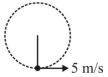

Download our appand get started for free
Experience the future of education. Simply download our apps or reach out to us for more information. Let's shape the future of learning together!No signup needed.*
Similar Questions
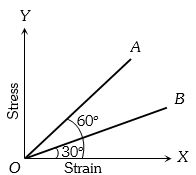
- 1The stress versus strain graphs for wires of two materials $A$ and $B$ are as shown in the figure. If ${Y_A}$ and ${Y_B}$ are the Young ‘s modulii of the materials, thenView Solution
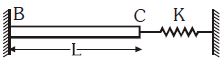
- 2A rod $BC$ of negligible mass fixed at end $B$ and connected to a spring at its natural length having spring constant $K = 10^4\ N/m$ at end $C$, as shown in figure. For the rod $BC$ length $L = 4\ m$, area of cross-section $A = 4 × 10^{-4}\ m^2$, Young's modulus $Y = 10^{11} \ N/m^2$ and coefficient of linear expansion $\alpha = 2.2 × 10^{-4} K^{-1}.$ If the rod $BC$ is cooled from temperature $100^oC$ to $0^oC,$ then find the decrease in length of rod in centimeter.(closest to the integer)View Solution
- 3The elastic limit of brass is $379\,MPa.$ .......... $mm$ should be the minimum diameter of a brass rod if it is to support a $400\,N$ load without exceeding its elastic limit .View Solution
- 4A steel wire can sustain $100\,kg$ weight without breaking. If the wire is cut into two equal parts, each part can sustain a weight of ......... $kg$View Solution
- 5A wire of cross section $4 \;mm^2$ is stretched by $0.1\, mm$ by a certain weight. How far (length) will be wire of same material and length but of area $8 \;mm^2$ stretch under the action of same force......... $mm$View Solution
- 6A wire is suspended by one end. At the other end a weight equivalent to $20\, N$ force is applied. If the increase in length is $1.0\, mm,$ the ratio of the increase in energy of the wire to the decrease in gravitational potential energy when load moves downwards by $1\, mm,$ will beView Solution
- 7A wire fixed at the upper end stretches by length $l$ by applying a force $F$. The work done in stretching isView Solution
- 8View SolutionThe material which practically does not show elastic after effect is
- 9View SolutionA light rod acted upon by three forces, is in equilibrium. Which of the following diagram shows the possible position and direction of the forces?
- 10If the Young's modulus of the material is $3$ times its modulus of rigidity, then its volume elasticity will beView Solution