MCQ
A student determined Young's Modulus of elasticity using the formula $Y=\frac{M g L^{3}}{4 b d^{3} \delta} .$ The value of $g$ is taken to be $9.8 \,{m} / {s}^{2}$, without any significant error, his observation are as following.

Physical Quantity Least count of the Equipment used for measurement Observed value
Mass $({M})$ $1\; {g}$ $2\; {kg}$
Length of bar $(L)$ $1\; {mm}$ $1 \;{m}$
Breadth of bar $(b)$ $0.1\; {mm}$ $4\; {cm}$
Thickness of bar $(d)$ $0.01\; {mm}$ $0.4 \;{cm}$
Depression $(\delta)$ $0.01\; {mm}$ $5 \;{mm}$

Then the fractional error in the measurement of ${Y}$ is

  • A
    $0.0083$
  • $0.0155$
  • C
    $0.155$
  • D
    $0.083$

Answer

Correct option: B.
$0.0155$
b
${y}=\frac{{MgL}^{3}}{4 {bd}^{3} \delta}$

$\frac{\Delta {y}}{{y}}=\frac{\Delta {M}}{{M}}+\frac{3 \Delta {L}}{{L}}+\frac{\Delta {b}}{{b}}+\frac{3 \Delta {d}}{{d}}+\frac{\Delta \delta}{\delta}$

$\frac{\Delta {y}}{{y}}=\frac{10^{-3}}{2}+\frac{3 \times 10^{-3}}{1}+\frac{10^{-2}}{4}+\frac{3 \times 10^{-2}}{4}+\frac{10^{-2}}{5}$

$=10^{-3}[0.5+3+2.5+7.5+2]=0.0155$

Need a full question paper?

Generate a complete, print-ready paper with questions like this in minutes — across 16+ boards, with answer keys.

Start Generating Free

Similar questions

An $8\,m$ long copper wire and $4\,m$ long steel wire, each of cross section $0.5\,cm^2$ are fastened end to end and stretched by $500\,N$ force. The elastic potential energy of the system is (Youngs mod $: Y_{cu}= 1\times 10^{11}\,N/m^2,$ $Y_{steel} = 2\times 10^{11}\,N/m^2$ ) :
$N _{2}$ gas is heated from $300\, K$ temperature to $600\, K$ through an isobaric process. Then find the change in entropy of the gas. $( n =1 mole )$ (in $J/K$)
Two bar magnets with magnetic moments $ 2 M $ and $M$ are fastened together at right angles to each other at their centres to form a crossed system, which can rotate freely about a vertical axis through the centre. The crossed system sets in earth’s magnetic field with magnet having magnetic moment $2M $ making and angle  $ \theta $ with the magnetic meridian such that
The addition of three masses $1.6 \,g , 7.32 \,g$ and $4.238 \,g$, addressed upto proper decimal places is ....... $g$
During motion of a man from equator to pole of earth, its weight will ....... $\%$ (neglect the effect of change in the radius of earth)
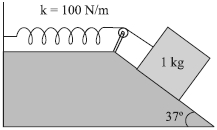
A $1\; kg$ block situated on a rough incline is connected to a spring of spring constant $100\;N m ^{-1}$ as shown in Figure. The block is released from rest with the spring in the unstretched position. The block moves $10 \;cm$ down the incline before coming to rest. Find the coefficient of friction between the block and the incline. Assume that the spring has a negligible mass and the pulley is frictionless.
$N\,moles$ of a diatomic gas in a cylinder are at a temperature $T$. Heat is supplied to the cylinder such that the temperature remains constant but $n\,moles$ of the diatomic gas get converted into monoatomic gas. What is the change in the total kinetic energy of the gas ?
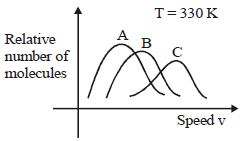
Maxwell distribution function is shown in figure for different gases, which of the following is correct matching?
The moment of inertia of a uniform circular disc of radius $R$ and mass $M$ about an axis passing from the edge of the disc and normal to the disc is
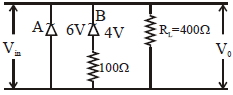
Two Zener diodes ($A$ and $B$) having breakdown voltages of $6\, V$ and $4\, V$ respectively, are connected as shown in athe circuit below. The output voltage $V _{0}$ variation with input voltage linearly increasing with time, is given by : $\left( V _{\text {input }}= OV \right.$ at $\left. t =0\right)$ (figures are qualitative)