A student is performing the experiment of Resonance Column. The diameter of the column tube is $4 \ cm$. The distance frequency of the tuning for $k$ is $512 \ Hz$. The air temperature is $38^{\circ} C$ in which the speed of sound is $336 \ m / s$. The zero of the meter scale coincides with the top and of the Resonance column. When first resonance occurs, the reading of the water level in the column is
IIT 2012, Advanced


Download our appand get started for free
Experience the future of education. Simply download our apps or reach out to us for more information. Let's shape the future of learning together!No signup needed.*
Similar Questions
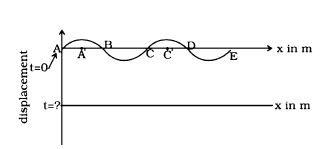
- 1The pattern of standing waves formed on a stretched string at two instants of time (extreme,mean) are shown in figure. The velocity of two waves superimposing to form stationary waves is $360\ ms^{-1}$ and their frequencies are $256\ Hz$. Which is not possible value of $t$ (in $sec$)View Solution
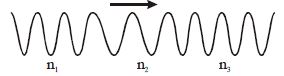
- 2A light wave travels through three transparent materials of equal thickness. Rank in order, from the highest to lowest, the indices of refraction $n_1, n_2$ and $n_3$.View Solution
- 3A source of sound is travelling with a velocity $40\, km/hour$ towards observer and emits sound of frequency $2000 Hz$. If velocity of sound is $1220 \,km/hour$, then what is the apparent frequency heard by an observer .... $Hz$View Solution
- 4The path Difference between the two waves ${y_1} = {a_1}\,\sin \,\left( {\omega t - \frac{{2\pi x}}{\lambda }} \right)$ and ${y_2} = {a_2}\,\cos \,\left( {\omega t - \frac{{2\pi x}}{\lambda } + \phi } \right)$ isView Solution
- 5View SolutionTwo waves of same frequency and intensity superimpose with each other in opposite phases, then after superposition the
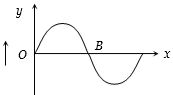
- 6Fig. below shows the wave $y = A\sin (\omega t - kx)$ at any instant travelling in the $+ve$ $x-$direction. What is the slope of the curve at $B$View Solution
- 7View SolutionIn the musical octave ‘Sa’, ‘Re’, ‘Ga’
- 8Tube $A$ has both ends open while tube $B$ has one end closed, otherwise they are identical. The ratio of fundamental frequency of tube $A$ and $B$ isView Solution
- 9An observer is riding on a bicycle and moving towards a hill at $18\,km\,h ^{-1}$. He hears a sound from a source at some distance behind him directly as well as after its reflection from the hill. If the original frequency of the sound as emitted by source is $640\,\,Hz$ and velocity of the sound in air is $320\,m / s$, the beat frequency between the two sounds heard by observer will be $...Hz$.View Solution
- 10View SolutionThe Doppler effect is applicable for