MCQ
A student traces the path of a ray of light through a rectangular glass slab for four different angles of incidence. He very cautiously measures the angle $f,$ angle $r$ and the angle $e$. On analysing his measurements, he is likely to draw the following conclusion :
  • $\angle\text{i} = \angle\text{e} > \angle\text{r}$
  • B
    $\angle\text{i} > \angle\text{r} > \angle\text{e}$
  • C
    $\angle\text{i} = \text{Zr} < \text{Ze}$
  • D
    $\angle\text{i} = \angle\text{e}< \angle\text{r}$
Answer

Correct option: A.
$\angle\text{i} = \angle\text{e} > \angle\text{r}$
Since the emergent ray is always parallel to the incident ray, therefore the angle of incidence is always equal to the angle of emergence i.e.
$\angle\text{i}=\angle\text{e}\ .....(\text{i})$
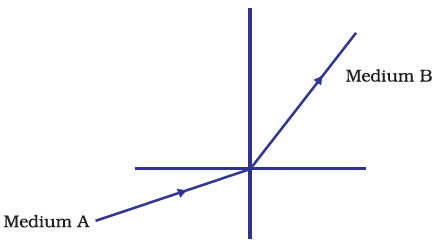
Also, when a light ray travels from rarer to denser medium, it bends towards the normal. Hence
$\angle\text{i}>\angle\text{r}\ .....(\text{ii})$
From $(i)$ and $(ii),$ we get
$\angle\text{i}=\angle\text{e} > \angle\text{r}$
Hence, the correct answer is $\angle\text{i}=\angle\text{e} > \angle\text{r}$

Need a full question paper?

Generate a complete, print-ready paper with questions like this in minutes — across 16+ boards, with answer keys.

Start Generating Free