Sample QuestionsLight – Reflection and Refraction questions
One sample from each question group in this chapter. Select any group above to see the full set with answer keys.
When light enters the atmosphere it strikes on extremely fine particles, which deflect the rays of light in all possible directions, This is due to -
Answer: C.
View full solution →An object is placed in front of a convex mirror. Its image is formed :
- A
at a distance equal to the object distance in front of the mirror.
- B
at twice the distance of the object in front of the mirror.
- C
half the distance of the object in front of the mirror.
- ✓
behind the mirror and it's position varies according to the object distance.
Answer: D.
View full solution →Study the given ray diagrams and select the correct statement from the following :
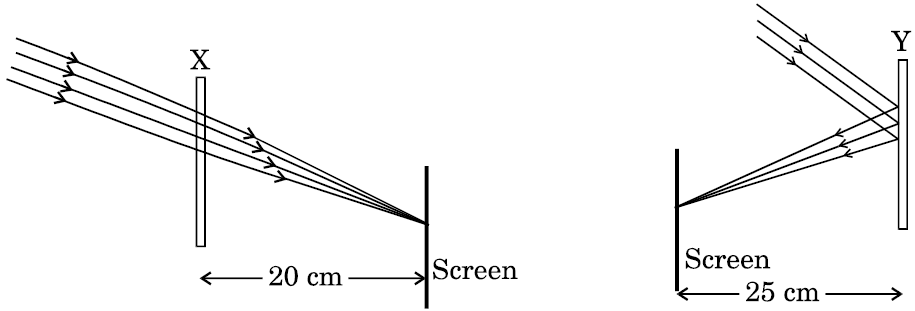
- A
Device $X$ is a concave mirror and device $Y$ is a convex lens, whose focal lengths are $20 \ cm$ and $25 \ cm $ respectively.
- B
Device $X$ is a convex lens and device $Y$ is a concave mirror, whose focal lengths are $10 \ cm$ and $25 \ cm $ respectively.
- C
Device $X$ is a concave lens and device $Y$ is a convex mirror, whose focal lengths are $20 \ cm$ and $25 \ cm$ respectively.
- ✓
Device $X$ is a convex lens and device $Y$ is a concave mirror, whose focal lengths are $20 \ cm$ and $25 \ cm$ respectively.
Answer: D.
View full solution →Study the following ray diagram : In this diagram, the angle of incidence, the angle of emergence and the angle of deviation respectively have been represented by.
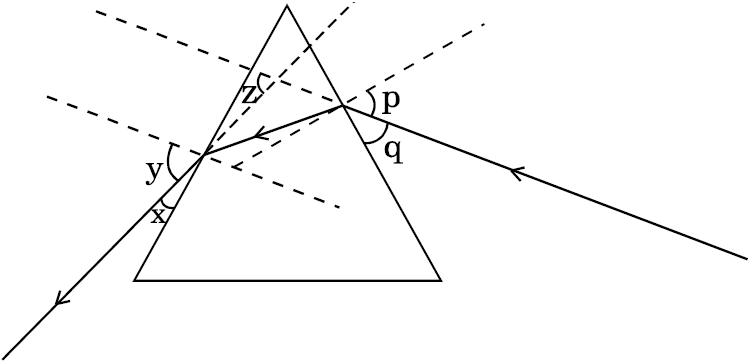
- A
$\ce{y, p, z}$
- B
$\ce{x, q, z}$
- ✓
$\ce{p, y, z}$
- D
$\ce{p, z, y}$
Answer: C.
View full solution →A student very cautiously traces the path of a ray through a glass slab for different values of the angle of incidence refraction $(\angle\text{i}).$ He then measures the corresponding values of the angle of refraction $(\angle\text{r}) $ and the angle of emergence $(\angle\text{e})$ for every value of the angle of incidence. On analysing these measurements of angles, his conclusion would be.
- A
$\angle\text{i} > \angle\text{r} > \angle\text{e}$
- ✓
$\angle\text{i}=\angle\text{e} > \angle\text{r}$
- C
$\angle\text{i} < \angle\text{r} < \angle\text{e}$
- D
$\angle\text{i}=\angle\text{e} < \angle\text{r}$
Answer: B.
View full solution →For two statements are given $-$ one labelled Assertion $(A)$ and the other labelled Reason $(R)$. Select the correct answer to these questions from the codes $\ce{(a), (b), (c)}$ and $(d)$ as given below :
Assertion : In the case of concave mirror, the minimum distance between real object and its real image is zero.
Reason : If concave mirror forms virtual image of real object, the image is magnified.
- A
Both $A$ and $R$ are true, and $R$ is correct explanation of the assertion.
- ✓
Both $A$ and $R$ are true, but $R$ is not the correct explanation of the assertion.
- C
$A$ is true, but $R$ is false.
- D
$A$ is false, but $R$ is true.
Answer: B.
View full solution →For two statements are given $-$ one labelled Assertion $(A)$ and the other labelled Reason $(R).$ Select the correct answer to these questions from the codes $\ce{(a), (b), (c)}$ and $(d)$ as given below :
Assertion : Light is able to reach earth from the sun.
Reason : Light rays can travel in vaccum.
- ✓
Both $A$ and $R$ are true, and $R$ is correct explanation of the assertion.
- B
Both $A$ and $R$ are true, but $R$ is not the correct explanation of the assertion.
- C
$A$ is true, but $R$ is false.
- D
$A$ is false, but $R$ is true.
Answer: A.
View full solution →For two statements are given $-$ one labelled Assertion $(A)$ and the other labelled Reason $(R).$ Select the correct answer to these questions from the codes $\ce{(a), (b), (c)}$ and $(d)$ as given below :
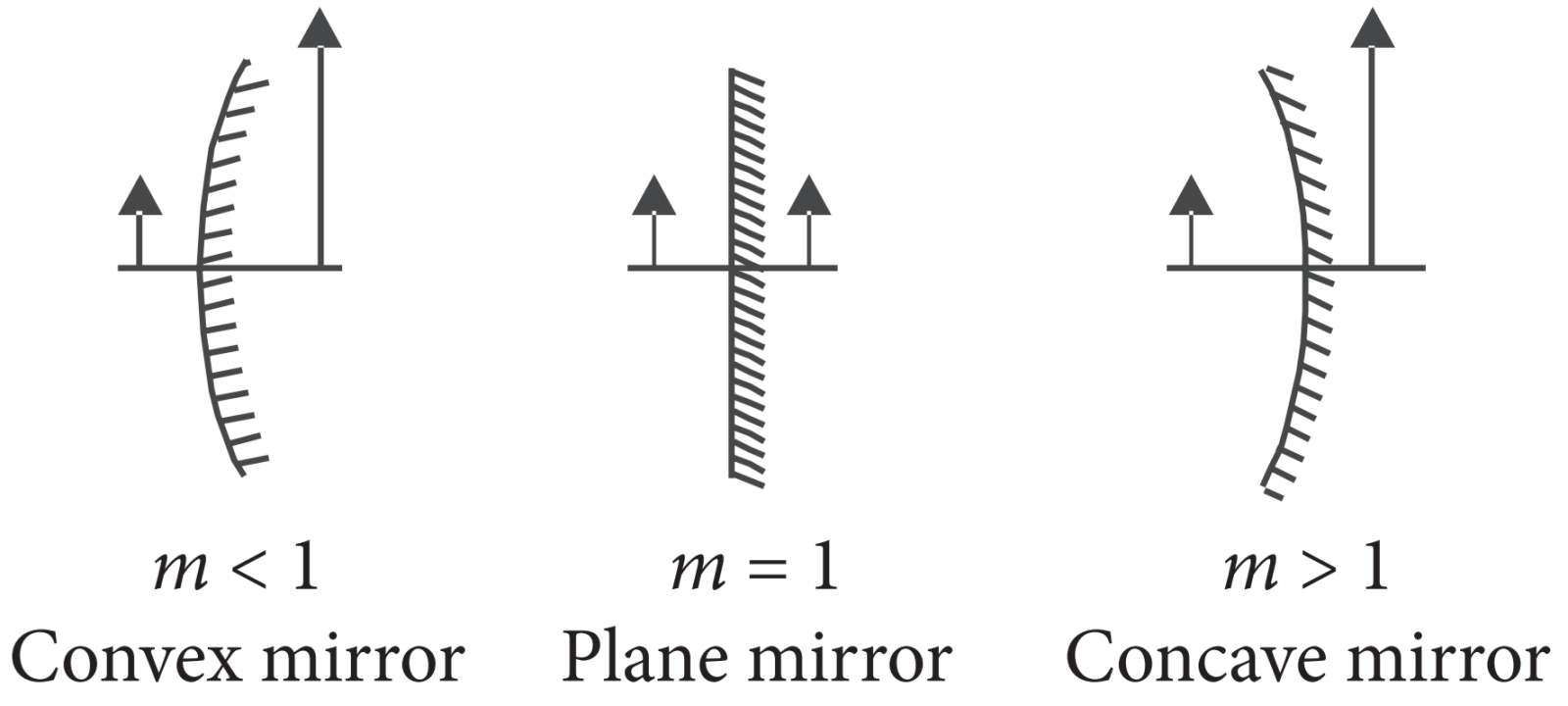
Assertion : We can decide the nature of a mirror by observing the size of erect image in the mirror.
Reason : The minimum distance between a real object and its real image in a concave mirror is non zero.
- A
Both $A$ and $R$ are true and $R$ is correct explanation of the assertion.
- B
Both $A$ and $R$ are true but $R$ is not the correct explanation of the assertion.
- C
$A$ is true but $R$ is false.
- ✓
$A$ is false but $R$ is true.
Answer: D.
View full solution →For two statements are given $-$ one labelled Assertion $(A)$ and the other labelled Reason $(R).$ Select the correct answer to these questions from the codes $\ce{(a), (b), (c)}$ and $(d)$ as given below :
Assertion : A plane mirror neither converges parallel rays of light nor diverges them.
Reason : The focal length of a plane mirror can be considered to be infinite.
- ✓
Both $A$ and $R$ are true and $R$ is correct explanation of the assertion.
- B
Both $A$ and $R$ are true but $R$ is not the correct explanation of the assertion.
- C
$A$ is true but $R$ is false.
- D
$A$ is false but $R$ is true.
Answer: A.
View full solution →For two statements are given $-$ one labelled Assertion $(A)$ and the other labelled Reason $(R)$. Select the correct answer to these questions from the codes $\ce{(a), (b), (c)}$ and $(d)$ as given below :
Assertion : A convex lens is made of two different materials. A point object is placed on the principal axis. The number of images formed by the lens will be two.
Reason : The image formed by convex lens is always virtual.
- A
Both $A$ and $R$ are true and $R$ is correct explanation of the assertion.
- B
Both $A$ and $R$ are true but $R$ is not the correct explanation of the assertion.
- ✓
$A$ is true but $R$ is false.
- D
$A$ is false but $R$ is true.
Answer: C.
View full solution →Medium 2 is said to ____________ medium 1 if light refracted in going from 1 to 2 bends ____________ normal.
For a convex mirror, parallel rays of light appear to diverge from a point called the ______ .
A convex lens _________ rays of light, whereas a concave lens __________ rays of light.
Lenses refract light to form images, a _________ lens can form both real and virtual images, but a diverging lens forms only ________ images.
A ray of light which is parallel to the principal axis of a convex mirror, appears to be coming from ______ after reflection from the mirror.
State whether the following statement is true or false:
A diverging mirror is used as a rear-view mirror.
Both concave and convex mirror send the reflected light at the same angle as the angle of incidence on the other side of the principal axis. [True/ False]
A convex mirror of focal length 'f' produces an image $\frac{1}{\text{m}}$ of the size of object, then object distance is (m - 1)f numerically. [True/ False]
View full solution →Magnification produced for an object at 2F by a convex lens is m = +1. [True/ False]
One can identify the nature of a mirror from the nature of the image it forms. [True/ False]
Draw the following diagram in your answer-book and show the formation of image of the object AB with the help of suitable rays.
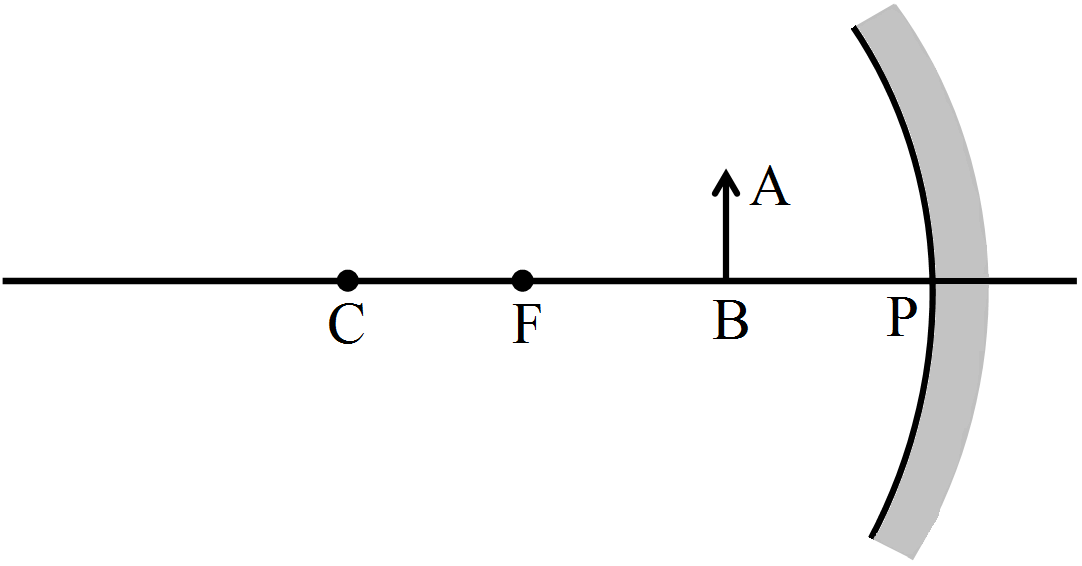
What is the magnification of the images formed by plane mirrors and why?
What is meant by power of a lens?
Explain why a ray of light passing through the centre of curvature of a concave mirror gets reflected along the same path.
What is the nature of the image formed by a concave mirror if the magnification produced by the mirror is + 3?
The refractive indices of three media are given below :| Medium | Refractive Index |
| A | 1.6 |
| B | 1.8 |
| C | 1.5 |
A ray of light is travelling from $A$ to $B$ and another ray is travelling from $B$ to $C$.
(a) In which of the two cases the refracted ray bends towards the normal?
(b) In which case does the speed of light increase in the second medium?
Give reasons for your answer. View full solution →An object is placed at a distance of 15 cm from a concave lens of focal length 30 cm. List four characteristics (nature, position, etc.) of the image formed by the lens.
A student focuses the image of a candle flame, placed at about 2 m from a convex lens of focal length 10 cm, on a screen. After that he moves gradually the flame towards the lens and each time focuses its image on the screen.
- In which direction does he move the lens to focus the flame on the screen?
- What happens to the size of the image of the flame formed on the screen?
- What difference is seen in the intensity (brightness) of the image of the flame on the screen?
- What is seen on the screen when the flame is very close (at about 5 cm) to the lens?
The refractive indices of glass and water with respect to air are 3/2 and 4/3 respectively. If speed of light in glass is 2×10⁸ m/s, find the speed of light in water.
Draw a ray diagram to show the path of the reflected ray corresponding to an incident ray of light parallel to the principal axis of a convex mirror and show the angle of incidence and angle of reflection on it.
(i) Explain why the refractive index of any material with respect to air is always greater 1 .
(ii) In the figure below a light ray travels from air into the semi-circular plastic block. Give a reason why the ray does not deviate at the semi-circular boundary of the plastic block.
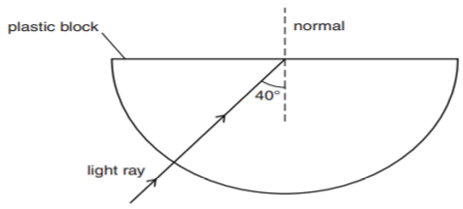
(iii) Complete the ray diagram of the above scenario when the light ray comes out of the plastic block from the top flat end.
‘‘A lens can form a magnified erect image as well as magnified inverted image of an object placed in front of it.’’ State the nature of this lens and draw ray diagrams to justify the above statement. Mark the positions of O, F and 2F in the diagram.
The image formed by a spherical mirror is real, inverted and is of magnification - 2. If the image is at a distance of 30 cm from the mirror, where is the object placed ? Find the focal length of the mirror. List two characteristics of the image formed if the object is moved 10 cm towards the mirror.
An object of height 5 cm is placed perpendicular to the principal axis of a concave lens of focal length 10 cm. If the distance of the object from the optical centre of the lens is 20 cm, determine the position, nature and size of the image formed using the lens formula.
A student wants to project the image of a candle flame on a screen 90 cm in front of a mirror by keeping the flame at a distance of 15 cm from its pole.
- Suggest the type of mirror he should use.
- Determine the linear magnification in this case.
- Find the distance between the object and its image.
- Draw ray diagram to show the image formation in this case.
A $10 cm$ long pencil is placed $5 cm$ in front of a concave mirror having a radius of curvature of $40 cm$.
(i) Determine the position of the image formed by this mirror.
(ii) What is the size of the image?
(iii) Draw a ray diagram to show the formation of the image as mentioned in the part (i).
View full solution →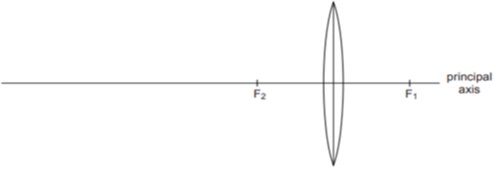
The above image shows a thin lens of focal length $5 m$.
(i) What is the kind of lens shown in the above figure?
(ii) If a real inverted image is to be formed by this lens at a distance of $7 m$ from the pole, then show with calculation where should the object be placed?
(iii) Draw a neatly labelled diagram of the image formation mentioned in (ii)
- Define focal length of a divergent lens.
- A divergent lens of focal length 30 cm forms the image of an object of size 6 cm on the same side as the object at a distance of 15 cm from its optical centre. Use lens formula to determine the distance of the object from the lens and the size of the image formed.
- Draw a ray diagram to show the formation of image in the above situation.
What is meant by power of a lens? Define its S.I. unit. You have two lenses A and B of focal lengths +10 cm and –10 cm respectively. State the nature and power of each lens. Which of the two lenses will form a virtual and magnified image of an object placed 8 cm from the lens? Draw a ray diagram to justify your answer.
One half of a convex lens of focal length 10 cm is covered with a black paper. Can such a lens produce an image of a complete object placed at a distance of 30 cm from the lens? Draw a ray diagram to justify your answer.
A 4 cm tall object is placed perpendicular to the principal axis of a convex lens of focal length 20 cm. The distance of the object from the lens is 15 cm. Find the nature, position and size of the image.
Mr. Rakesh was helping her daughter Aruna at home understanding about the basics of reflection of light. He found the simplest way to convey the role of curved mirrors using stainless steel teaspoon. Aruna got surprised to know that virtual image is that which can be seen but cannot be obtained on the screen. Mr. Rakesh then explained the formation of image using Ray diagrams.
(i) What do you mean by reflection of light?
(ii) The angle between incident ray and reflected ray is $60^{\circ}$. What is the value of angle of incidence?
(iii) A ray of light is incident on a plane mirror at an angle of $30^{\circ}$. what is the angle of reflection?
or
(iv) What happens to a light ray that is incident normally on a surface?
View full solution →Study the following table for a convex lens for different positions of object and answer the following questions:| Position of object | Position of image | Relative size of image |
| At infinity | At focus F_(2) | Highly diminished point sized |
| Beyond 2F_(1) | Between F_(2) and 2F_(2) | Diminished |
| At 2F_(1) | At 2F_(2) | Same size |
| Between F_(1) and 2F_(1) | Beyond 2F_(2) | Enlarged |
| At focus F_(1) | At infinity | Infinitely large or highly enlarged |
| Between focus F_(1) and optical centre O | On the same side of the lens as the object | Enlarged |
(i) What is the nature of the image, if an object is placed at infinity ?
(ii) Identify the nature of the image for which the object is between focus and optical centre.
(iii) What is position of image, when object is place at focus $\left(f_1\right)$ ?
or
(iv) What is the focal length of a lens for an object placed $50 cm$ from the lens producing virtual image at a distance of $10 cm$ in front of the lens?
View full solution →Is there a relationship between the radius of curvature $R$, and focal length $f$, of a spherical mirror ? For spherical mirrors of small apertures, the radius of curvature is found to be equal to twice the focal length. We put this as $R=2 f$. This implies that the principal focus of a spherical mirror lies midway between the pole and centre of curvature.
(i) Write relation between radius of curvature and focal length.
(ii) For which type of mirrors above relation is verified?
(iii) What should be size of the aperture?
or
(iv) Where is the principle focus of a spherical mirror lies?
View full solution →"Change in path of a light ray as it passes from one medium to another medium is called refraction of light."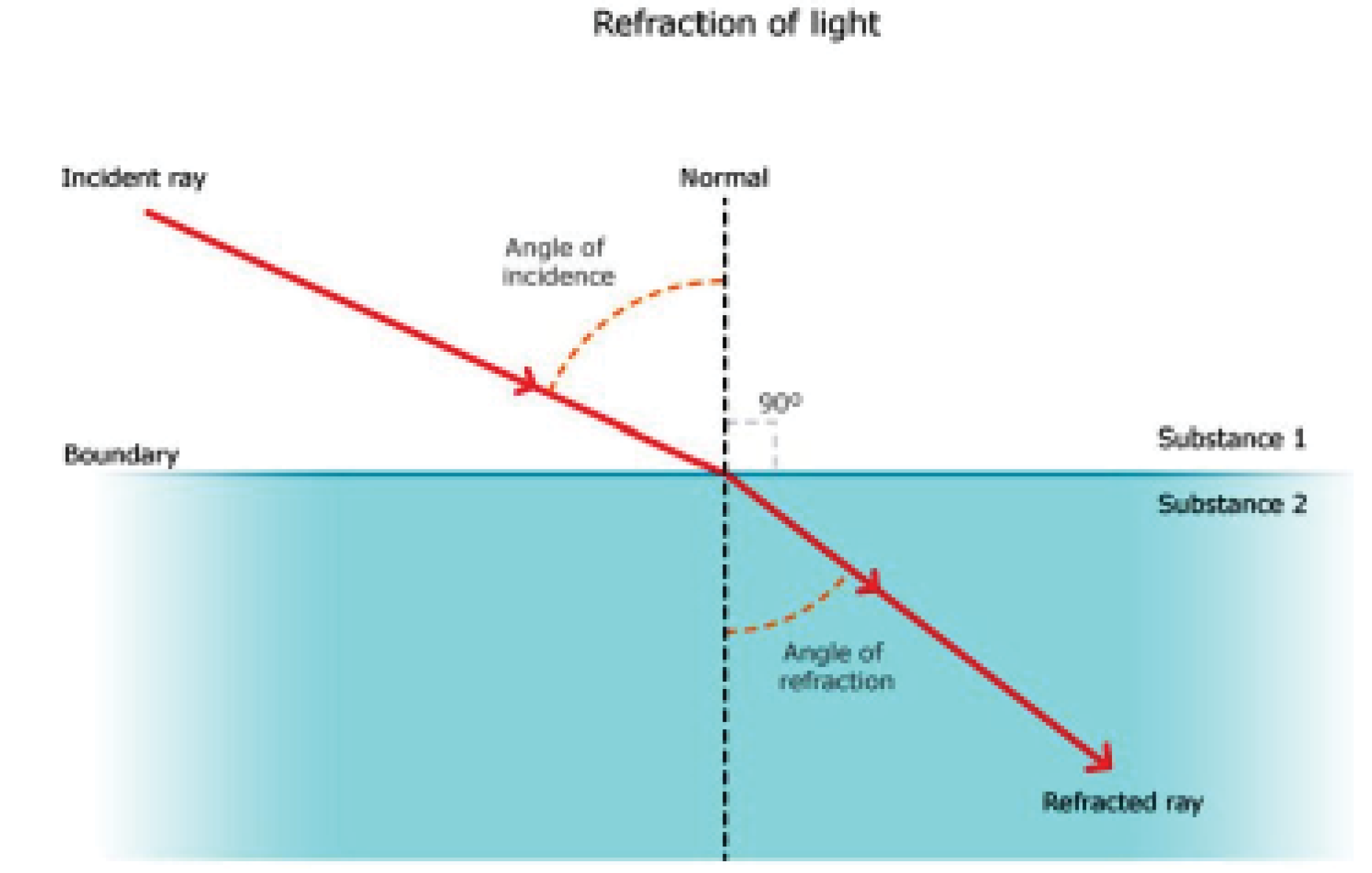
When light travels from a rarer medium to a denser one, it bends towards the normal $(i>r)$ and when travels from a denser medium to a rarer one. it bends away from the normal $(i<r)$.
Where, $\quad i=$ Angle of incidence
and $\quad r=$ Angle of refraction
We can see refraction in our daily life, some of the examples are given below :
The bottom of a tank or pond containing water appears to be raised due to refraction of light which takes place when light rays pass from the pool of water into the air. The letters appear to be raised when viewed through a glass slab placed over the document because of refraction of light.
When a light ray enters in a glass slab, then the emergent ray is parallel to the incident ray but it is shifted sideward slightly.
In this case, refraction takes place twice, first when ray enters glass slab from air and second when exits from glass slab to air.
(i) What do you mean by optically rarer and denser medium ?
(ii) What is the cause of refraction?
(iii) Draw a ray diagram shotving refraction through a glass slab.
or
(iv) Give one example of refraction from our daily life experience other than the two examples given above.
View full solution →When light ray goes from one transparent medium to another transparent medium, it suffers a change in direction, into second medium. The extent of the change in direction suffered by the phenomenon of change in the path of light rays when going from one medium to another medium is known as refraction. Ray is a given pair of media can be expressed in terms of refractive index. The refractive index is related to an important physical quantity in the relative speed of light in different media.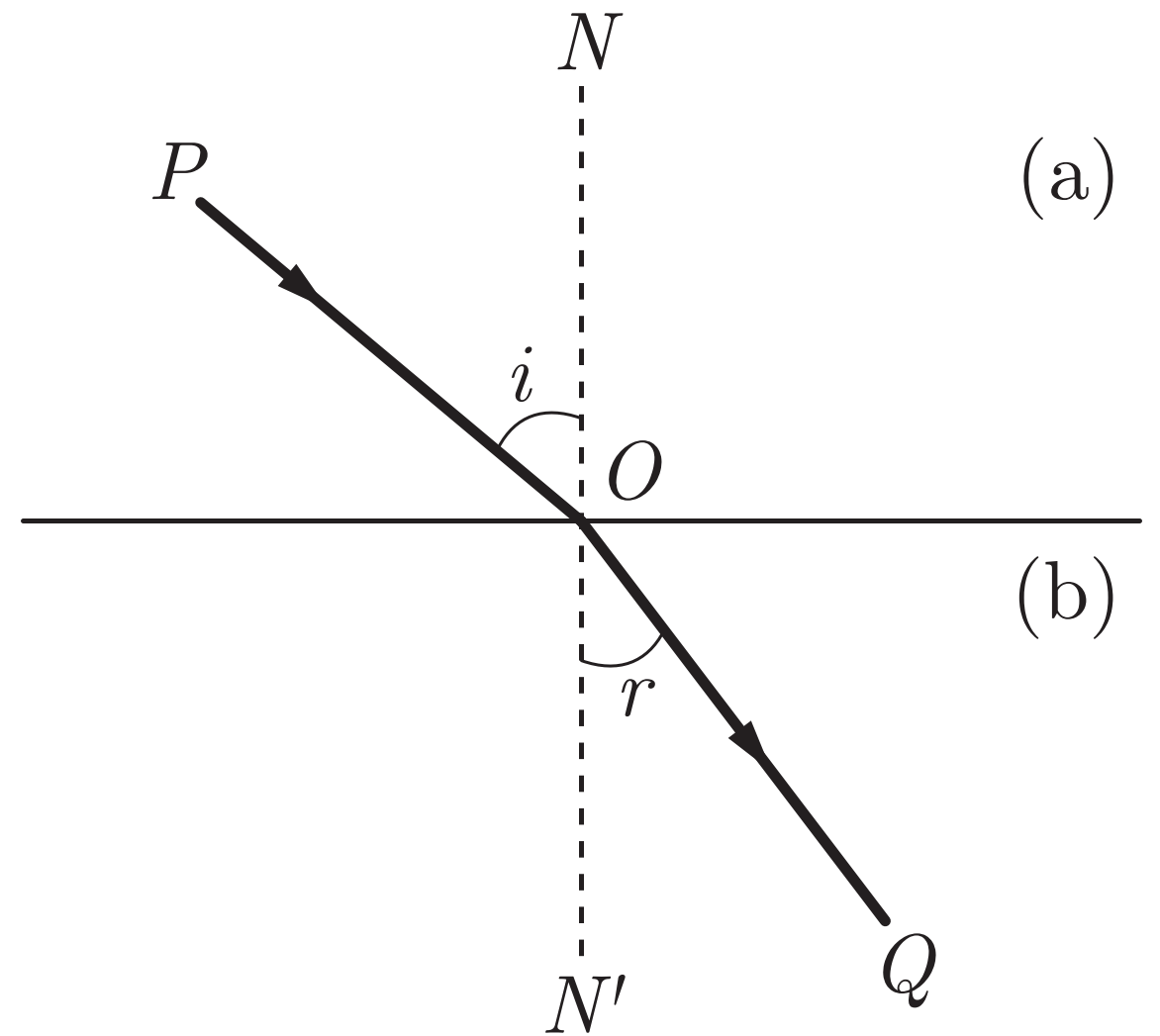 <
<
(i) A ray of light enters into the glass from air. Does it bend towards normal ?
(ii) What is the unit of refractive index?
(iii) Light enters from air to glass having refractive index 1.50. What is the speed of light in the glass? The speed of light in vacuum is $3 \times 10^3 ms ^{-1}$.
or
(iii) When light goes from one medium to another, which of the three parameters, frequency, wavelength, velocity change?
View full solution →Which of the following lenses would you prefer to use while reading small letters found in a dictionary?
- A
A convex lens of focal length 50 cm.
- B
A concave lens of focal length 50 cm.
- C
A convex lens of focal length 5 cm.
- D
A concave lens of focal length 5 cm.
View full solution →No matter how far you stand from a mirror, your image appears erect. The mirror is likely to be
A spherical mirror and a spherical lens each have a focal length of, -15cm. The mirror and the lens are likely to be:
- A
- B
- C
The mirror is concave but the lens is convex.
- D
The mirror is convex but the lens is concave.
View full solution →Where should an object be placed in front of a convex lens to get a real image of the size of the object?
- A
At the principal focus of the lens.
- B
At twice the focal length.
- C
- D
Between the optical centre of the lens and its principal focus.
View full solution →The image formed by a concave mirror is observed to be virtual, erect and larger than the object. Where should be the position of the object?
- A
Between the principal focus and the centre of curvature.
- B
At the centre of curvature.
- C
Beyond the centre of curvature.
- D
Between the pole of the mirror and its principal focus.
View full solution →In the following questions, a statement of Assertion is given by the corresponding statement of Reason. Of the statements, mark the correct answer as:
- If both Assertion and Reason are true and Reason is the correct explanation of Assertion.
- If both Assertion and Reason are true, but Reason is not the correct explanation of Assertion.
- If Assertion is true, but Reason is false.
- If Assertion is false, but Reason is true.
- If both Assertion and Reason are false.
Assertion: The speed of light in a rarer medium is greater than that in a denser medium.
Reason: One light year equal to 9.5 × 10¹³ km.
In the following questions, a statement of Assertion is given by the corresponding statement of Reason. Of the statements, mark the correct answer as:
- If both Assertion and Reason are true and Reason is the correct explanation of Assertion.
- If both Assertion and Reason are true, but Reason is not the correct explanation of Assertion.
- If Assertion is true, but Reason is false.
- If Assertion is false, but Reason is true.
- If both Assertion and Reason are false.
Assertion: Keeping a point object fixed, if a plane mirror is moved, the image will also move.
Reason: In case of a plane mirror, distance of object and its image is equal from any point on the mirror.
In the following questions, a statement of Assertion is given by the corresponding statement of Reason. Of the statements, mark the correct answer as:
- If both Assertion and Reason are true and Reason is the correct explanation of Assertion.
- If both Assertion and Reason are true, but Reason is not the correct explanation of Assertion.
- If Assertion is true, but Reason is false.
- If Assertion is false, but Reason is true.
- If both Assertion and Reason are false.
Assertion: ENT specialist use a concave mirror as a head mirror to concentrate light on the body parts like eye, ear, nose etc.
Reason: A concave mirror is more effective and easily available.
For two statements are given-one labelled Assertion (A) and the other labelled Reason (R). Select the correct answer to these questions from the codes (a), (b), (c) and (d) as given below:
- Both A and R are true, and R is correct explanation of the assertion.
- Both A and R are true, but R is not the correct explanation of the assertion.
- A is true, but R is false.
- A is false, but R is true.
Assertion: We can decide the nature of a mirror by observing the size of erect image in the mirror.
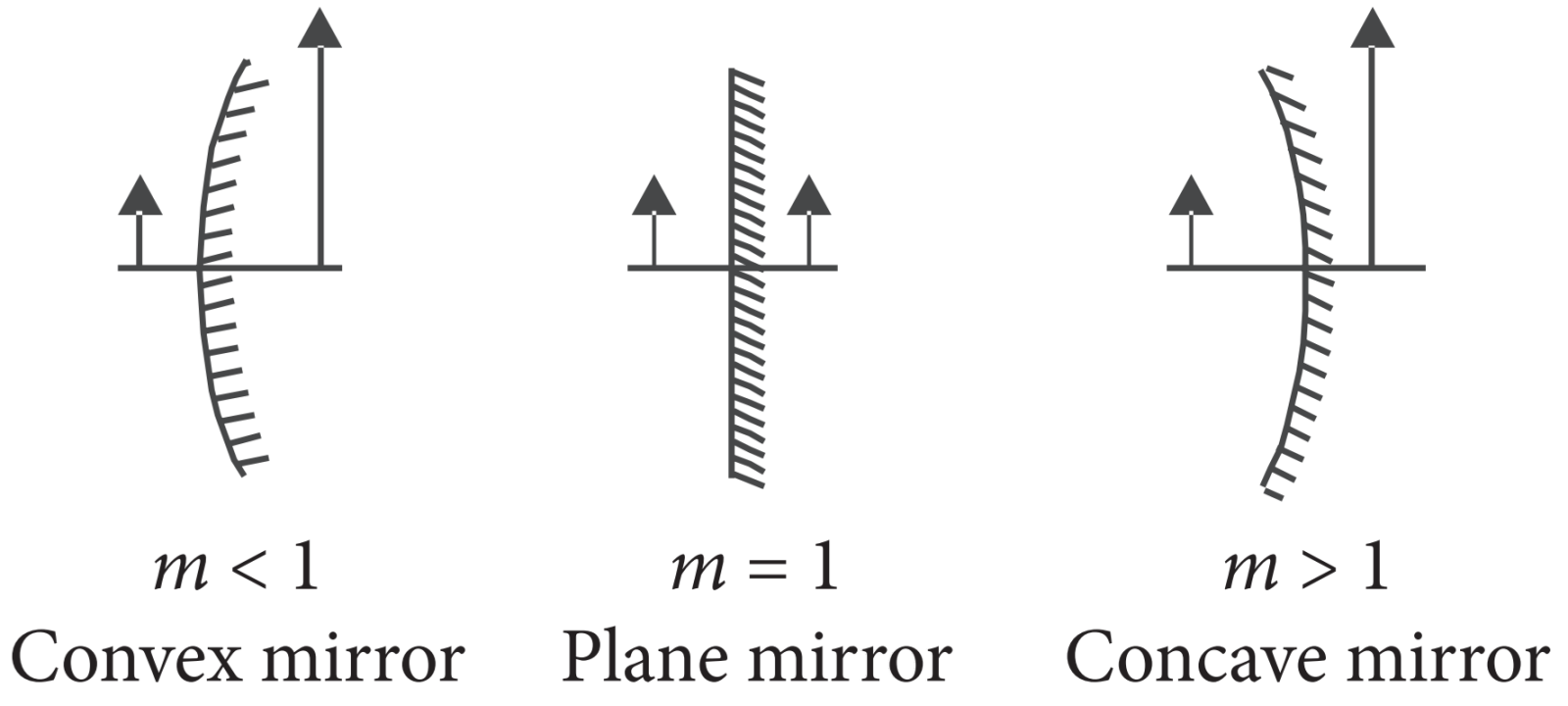
Reason: The minimum distance between a real object and its real image in a concave mirror is non zero.
For two statements are given-one labelled Assertion (A) and the other labelled Reason (R). Select the correct answer to these questions from the codes (a), (b), (c) and (d) as given below:
- Both A and R are true, and R is correct explanation of the assertion.
- Both A and R are true, but R is not the correct explanation of the assertion.
- A is true, but R is false.
- A is false, but R is true.
Assertion: The size of the mirror affect the nature of the image.
Reason: Small mirrors always form virtual images.
When light is reflected, the angles of incidence and reflection are _____.
When a ray of light goes from air into a clear material, you see the ray bend. How much the ray bends is determined by the ___________ of the material.
The SI unit of power of a lens is _____________.
The reciprocal of the focal length in metres gives you the _____________ of the lens, which is measured in _____________.
The image in a convex lens depends upon the distance of the __________ from the lens.
State whether the following statement is true or false:
Refraction occurs because light slows down in denser materials.
State whether the following statement is true or false:
A student says that we can see an object because light from our eyes is reflected back by the object
State whether the following statement is true or false:
A diverging mirror is used as a rear-view mirror.
One can identify the nature of a mirror from the nature of the image it forms. [True/ False]
Magnification produced for an object at 2F by a convex lens is m = +1. [True/ False]
The magnification produced by a plane mirror is +1. What does this mean?
Draw the following diagram in your answer-book and show the formation of image of the object AB with the help of suitable rays.
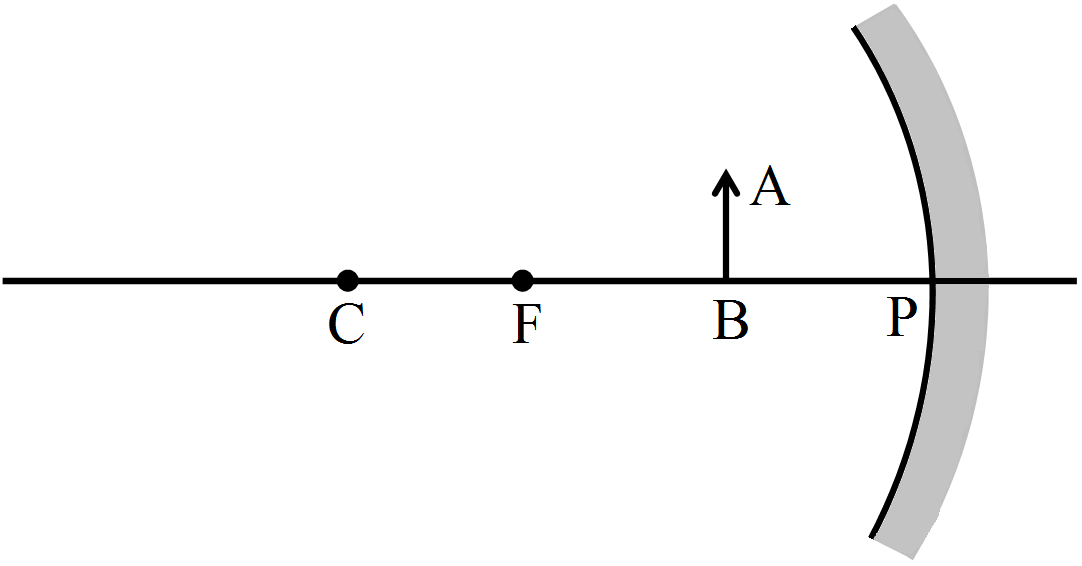
What is the magnification of the images formed by plane mirrors and why?
What is meant by power of a lens?
What is the nature of the image formed by a concave mirror if the magnification produced by the mirror is + 3?
A doctor has prescribed a corrective lens of power +1.5 D. Find the focal length of the lens. Is the prescribed lens diverging or converging?
Find the focal length of a lens of power – 2.0 D. What type of lens is this?
The refractive indices of three media are given below :| Medium | Refractive Index |
| A | 1.6 |
| B | 1.8 |
| C | 1.5 |
A ray of light is travelling from $A$ to $B$ and another ray is travelling from $B$ to $C$.
(a) In which of the two cases the refracted ray bends towards the normal?
(b) In which case does the speed of light increase in the second medium?
Give reasons for your answer. View full solution →A student focuses the image of a candle flame, placed at about 2 m from a convex lens of focal length 10 cm, on a screen. After that he moves gradually the flame towards the lens and each time focuses its image on the screen.
- In which direction does he move the lens to focus the flame on the screen?
- What happens to the size of the image of the flame formed on the screen?
- What difference is seen in the intensity (brightness) of the image of the flame on the screen?
- What is seen on the screen when the flame is very close (at about 5 cm) to the lens?
An object is placed at a distance of 15 cm from a concave lens of focal length 30 cm. List four characteristics (nature, position, etc.) of the image formed by the lens.
Name the type of mirror used in the following situations.
- Headlights of a car.
- Side/rear-view mirror of a vehicle.
- Solar furnace.
Support your answer with reason.
We wish to obtain an erect image of an object, using a concave mirror of focal length 15 cm. What should be the range of distance of the object from the mirror? What is the nature of the image? Is the image larger or smaller than the object? Draw a ray diagram to show the image formation in this case.
An object of size 7.0 cm is placed at 27 cm in front of a concave mirror of focal length 18 cm. At what distance from the mirror should a screen be placed, so that a sharp focussed image can be obtained? Find the size and the nature of the image.
An object 5.0 cm in length is placed at a distance of 20 cm in front of a convex mirror of radius of curvature 30 cm. Find the position of the image, its nature and size.
An object is placed at a distance of 10 cm from a convex mirror of focal length 15 cm. Find the position and nature of the image.
Study the following table for a convex lens for different positions of object and answer the following questions:| Position of object | Position of image | Relative size of image |
| At infinity | At focus F_(2) | Highly diminished point sized |
| Beyond 2F_(1) | Between F_(2) and 2F_(2) | Diminished |
| At 2F_(1) | At 2F_(2) | Same size |
| Between F_(1) and 2F_(1) | Beyond 2F_(2) | Enlarged |
| At focus F_(1) | At infinity | Infinitely large or highly enlarged |
| Between focus F_(1) and optical centre O | On the same side of the lens as the object | Enlarged |
(i) What is the nature of the image, if an object is placed at infinity ?
(ii) Identify the nature of the image for which the object is between focus and optical centre.
(iii) What is position of image, when object is place at focus $\left(f_1\right)$ ?
or
(iv) What is the focal length of a lens for an object placed $50 cm$ from the lens producing virtual image at a distance of $10 cm$ in front of the lens?
View full solution →Mr. Rakesh was helping her daughter Aruna at home understanding about the basics of reflection of light. He found the simplest way to convey the role of curved mirrors using stainless steel teaspoon. Aruna got surprised to know that virtual image is that which can be seen but cannot be obtained on the screen. Mr. Rakesh then explained the formation of image using Ray diagrams.
(i) What do you mean by reflection of light?
(ii) The angle between incident ray and reflected ray is $60^{\circ}$. What is the value of angle of incidence?
(iii) A ray of light is incident on a plane mirror at an angle of $30^{\circ}$. what is the angle of reflection?
or
(iv) What happens to a light ray that is incident normally on a surface?
View full solution →Is there a relationship between the radius of curvature $R$, and focal length $f$, of a spherical mirror ? For spherical mirrors of small apertures, the radius of curvature is found to be equal to twice the focal length. We put this as $R=2 f$. This implies that the principal focus of a spherical mirror lies midway between the pole and centre of curvature.
(i) Write relation between radius of curvature and focal length.
(ii) For which type of mirrors above relation is verified?
(iii) What should be size of the aperture?
or
(iv) Where is the principle focus of a spherical mirror lies?
View full solution →When light ray goes from one transparent medium to another transparent medium, it suffers a change in direction, into second medium. The extent of the change in direction suffered by the phenomenon of change in the path of light rays when going from one medium to another medium is known as refraction. Ray is a given pair of media can be expressed in terms of refractive index. The refractive index is related to an important physical quantity in the relative speed of light in different media.
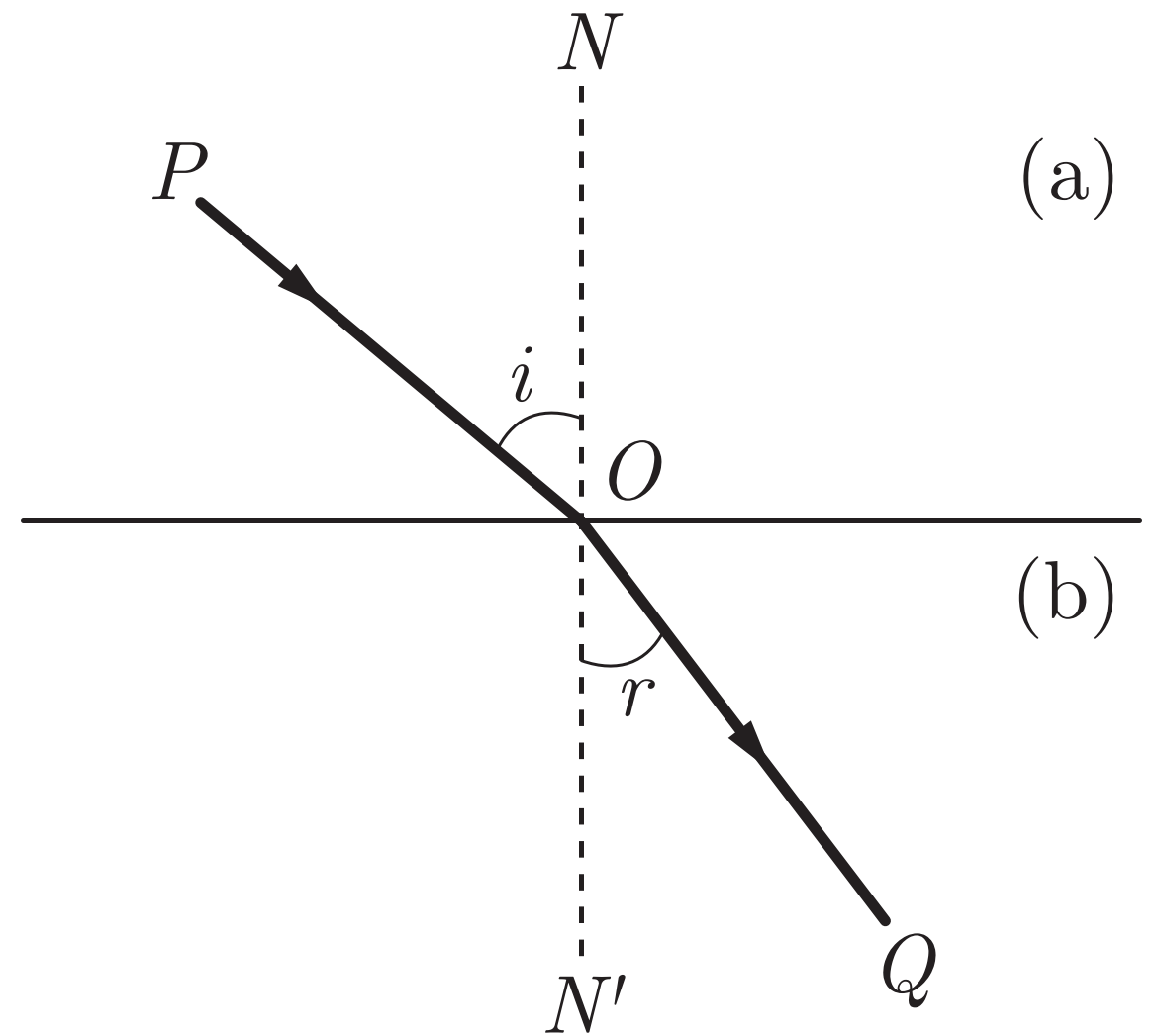
(i) A ray of light enters into the glass from air. Does it bend towards normal ?
(ii) What is the unit of refractive index?
(iii) Light enters from air to glass having refractive index 1.50. What is the speed of light in the glass? The speed of light in vacuum is $3 \times 10^3 ms ^{-1}$.
or
(iii) When light goes from one medium to another, which of the three parameters, frequency, wavelength, velocity change? View full solution →Lenses are objects made of transparent materials such as glass or clear plastic that has curved surfaces. Diverging lenses are thicker at their edges than at their centres and makes light rays passing through them spread out. Converging lenses are thicker in their middle than at this edges and make light rays passing through them focus at a point. These are used in spectacles to help people with poor vision see better. The converging lenses magnify by bending the rays of light that pass through them to meet at a point called focus. Thicker the converging lens is at its centre, the more its magnifies and closer the focus is to the lens.
(i) Ravi uses two lenses $A$ and $B$ of same size and same material as shown. $P _1$ and $P _2$ are the powers of $A$ and B. An object is kept at the same distance from the lens between $F$ and $2 F$ of each lens on the principal axis in turn. Let $I_1$ and $I_2$ be the image formed by two lenses respectively. What is the relation of image distances of both lens?
(ii) Write down the relation between the power of lens of both lenses ?
(iii) Meenakshi uses above two lenses $A$ and $B$ along with another two lenses $C$ and $D$, as shown :
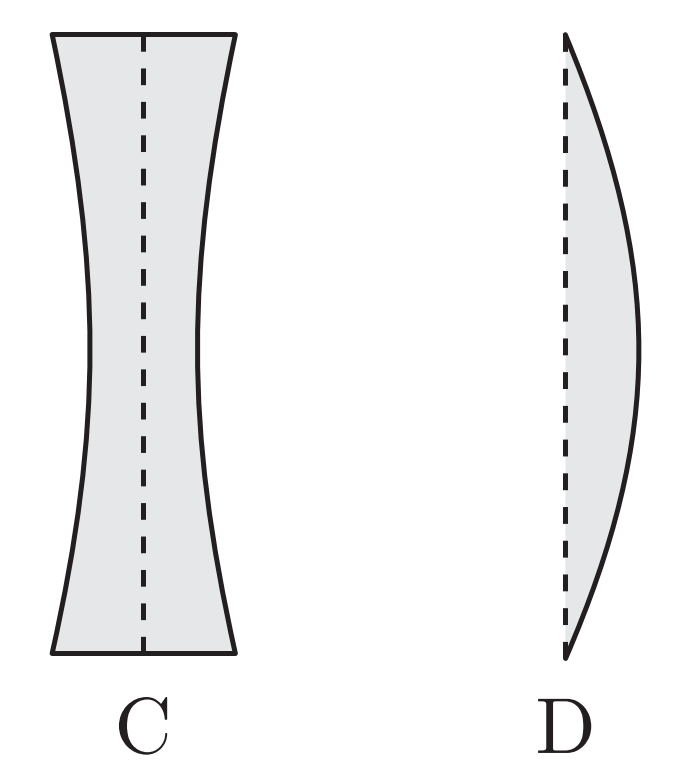
She is able to see the subject matter on the black board while sitting in the front row in the classroom but is unable to see the same matter while sitting in the last row.
Which of the above four lenses will she require to correct the defect in her vision? Why ?
or
(iv) Natasha places an object on the principal axis of above given lens A. One end of this object coincides with the focus $F$ and the other end with $2 F$. What will be the nature of the image formed by the lens on the other side? View full solution →One-half of a convex lens is covered with a black paper. Will this lens produce a complete image of the object? Verify your answer experimentally. Explain your observations.
An object 5 cm in length is held 25 cm away from a converging lens of focal length 10 cm. Draw the ray diagram and find the position, size and the nature of the image formed.
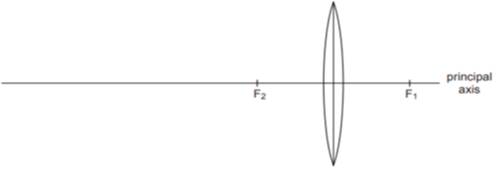
The above image shows a thin lens of focal length $5 m$.
(i) What is the kind of lens shown in the above figure?
(ii) If a real inverted image is to be formed by this lens at a distance of $7 m$ from the pole, then show with calculation where should the object be placed?
(iii) Draw a neatly labelled diagram of the image formation mentioned in (ii)
A $10 cm$ long pencil is placed $5 cm$ in front of a concave mirror having a radius of curvature of $40 cm$.
(i) Determine the position of the image formed by this mirror.
(ii) What is the size of the image?
(iii) Draw a ray diagram to show the formation of the image as mentioned in the part (i).
View full solution → - Define focal length of a divergent lens.
- A divergent lens of focal length 30 cm forms the image of an object of size 6 cm on the same side as the object at a distance of 15 cm from its optical centre. Use lens formula to determine the distance of the object from the lens and the size of the image formed.
- Draw a ray diagram to show the formation of image in the above situation.