A student wants to project the image of a candle flame on a screen 60 cm in front of a mirror by keeping the flame at a distance of 15 cm from its pole.
- Write the type of mirror he should use.
- Find the linear magnification of the image produced.
- What is the distance between the object and its image?
- Draw a ray diagram to show the image formation in this case.
CBSE OUTSIDE DELHI - SET 1 2014
Download our app for free and get started
- Concave mirror.
$\text{M} = - \frac{\text{V}}{\text{U}}$
- Object distance, u = -15 (u is always negative)
$\text{m} = \frac{(- 60)}{(- 50)}$
$\therefore \text{m} = -4$
- Distance between object and its image = 45cm
- Ray diagram:
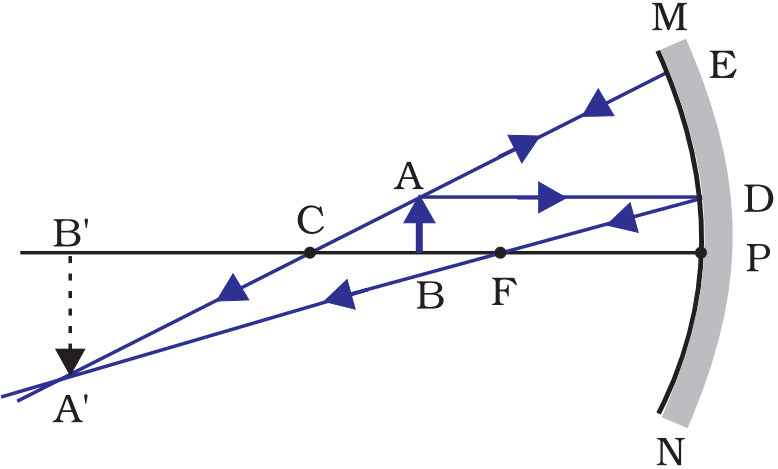
This image formed is real, inverted, magnified and beyond 2f.

Download our appand get started for free
Experience the future of education. Simply download our apps or reach out to us for more information. Let's shape the future of learning together!No signup needed.*
Similar Questions
- 1View SolutionWhich of the following are concave mirrors and which convex mirrors?
Shaving mirrors, Car headlight mirror, Searchlight mirror, Driving mirror, Dentist’s inspection mirror, Torch mirror, Staircase mirror in a double-decker bus, Make-up mirror, Solar furnace mirror, Satellite TV dish, Shop security mirror. - 2View SolutionWhat can you see in a completely dark room? If you switch on an electric bulb in this dark room as a light source, explain how you could now see:
- The electric bulb.
- A piece of white paper.
- 3View SolutionGiving reasons, state the ‘signs’ (positive or negative) which can be given to the following:
- Object distance (u) for a concave mirror or convex mirror.
- Image distances (v) for a concave mirror.
- Image distances (v) for a convex mirror.
- 4View SolutionA dentist’s mirror has a radius of curvature of 3cm. How far must it be placed from a small dental cavity to give a virtual image of the cavity that is magnified five times?
- 5View SolutionState the laws of refraction of light. Explain the term ‘absolute refractive index of a medium’ and write an expression to relate it with the speed of light in vacuum.
- 6View SolutionA man standing in front of a special mirror finds his image having a very small head, a fat body and legs of normal size. What is the shape of:
- Top part of the mirror?
- Middle part of the mirror?
- Bottom part of the mirror?
- 7View SolutionAn object of size 7.0cm is placed at 27cm in front of a concave mirror of focal length 18cm. At what distance from the mirror should a screen be placed so that a sharp focussed image can be obtained? Find the size and nature of image.
[Hint. Find the value of image distance (v) first. The screen should be placed from the mirror at a distance equal to image distance.] - 8View SolutionAn object 5.0 cm in length is placed at a distance of 20 cm in front of a convex mirror of radius of curvature 30 cm. Find the position of the image, its nature and size.
- 9View SolutionDraw a labelled ray diagram to show how a ray of light passes through a parallel sided glass block:
- If it hits the glass block at 90° (that is, perpendicular to the glass block).
- If it hits the glass block at an angle other than 90° (that is, obliquely to the glass block).
- 10View SolutionTwo lenses A and B have focal lengths of +20cm and, -10cm, respectively.
- What is the nature of lens A and lens B?
- What is the power of lens A and lens B?
- What is the power of combination if lenses A and B are held close together?